

Customer Success vs Customer Support: A SaaS Leader's Guide
TL;DR:
- Customer success proactively guides customers toward measurable outcomes to improve retention and growth. Customer support reacts to issues reports, focusing on quick resolution of technical problems. Separating these functions ensures efficient management of customer health and prevents silent churn.
Customer success is defined as a proactive, outcome-driven function that guides customers toward measurable business results, while customer support is a reactive function triggered by customer-reported problems. The customer success vs customer support difference is not a matter of semantics. It is a structural distinction that directly shapes how SaaS companies retain revenue, prevent churn, and grow accounts. Confusing the two is one of the most common and costly organizational mistakes SaaS founders make. Zendesk defines customer success as proactive relationship-building to maximize ROI and customer lifetime value, well beyond issue resolution. Forrester draws an equally sharp line, noting that customer success is narrower than customer experience, focused on measurable outcomes with operationalized success plans.
What does customer support actually do in SaaS?
Customer support in SaaS is reactive by design. It is initiated by customer tickets or chats when an issue arises, not before. The support team’s job is to restore a customer’s ability to use the product as quickly as possible.

Typical support tickets in SaaS fall into predictable categories: login failures, product bugs, billing discrepancies, and integration errors. Each ticket represents a moment of friction. The support team’s value is measured by how fast and how completely it removes that friction. Key performance indicators include first response time, average resolution time, and customer satisfaction scores (CSAT). These metrics are short-horizon by nature. They measure a single interaction, not a customer’s long-term trajectory.
Support teams typically report to a VP of Operations or a Head of Customer Experience. They are staffed with agents who excel at clear communication, technical troubleshooting, and process adherence. The best support professionals are calm under pressure and skilled at translating complex product issues into plain language. As SaaS companies scale, support teams grow in proportion to the volume of active users and the complexity of the product.
Pro Tip: Track first-contact resolution rate alongside CSAT. A high CSAT with a low first-contact resolution rate signals that customers are satisfied with the interaction but still returning with the same problem. That pattern is a warning sign, not a success metric.
How does customer success differ in approach and business impact?
Customer success is proactive, triggered by internal account health signals and milestones rather than customer complaints. A customer success manager (CSM) does not wait for a ticket. They monitor adoption data, track usage patterns, and intervene before a customer reaches the point of frustration or disengagement. This is the core of the difference between customer success and support: one function prevents problems, the other resolves them.
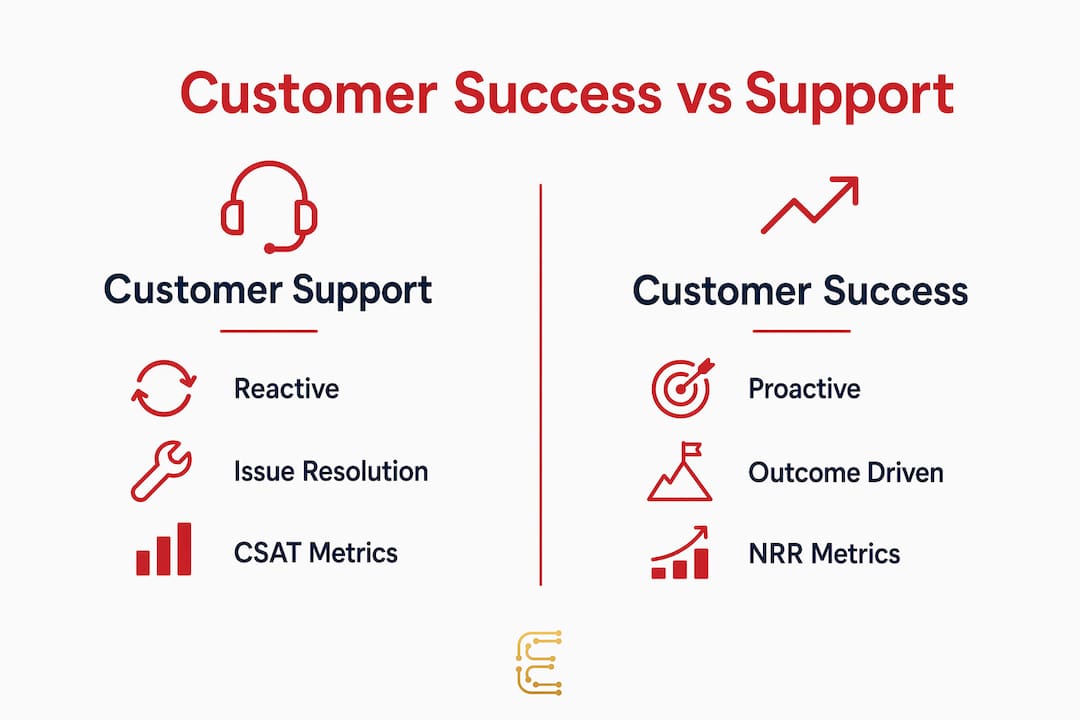
The activities of a CS team look very different from support workflows. CSMs conduct quarterly business reviews (QBRs), build milestone-based success plans, manage renewal timelines, and identify expansion opportunities. Customer success plans include milestones shared between the company and the customer to track adoption and value realization. The metrics that matter here are adoption rates, renewal rates, expansion revenue, and net revenue retention (NRR). These are long-horizon metrics that reflect whether customers are growing with the product, not just using it.
The skills required for customer success are consultative and strategic. A strong CSM understands the customer’s business model, speaks the language of ROI, and can connect product features to business outcomes. This is closer to account management than technical support. CS teams typically report to a Chief Revenue Officer or VP of Customer Success, reflecting their direct connection to revenue retention and growth.
Pro Tip: Assign each CSM a portfolio of accounts segmented by annual contract value (ACV) and health score. High-ACV accounts with declining health scores should receive weekly touchpoints. Low-ACV accounts with strong health scores can be managed through automated check-ins and self-service resources.
How do customer success and customer support compare side by side?
The clearest way to understand the difference between customer success and support is to compare them across four dimensions: mode, goal, primary metric, and time horizon.
| Dimension | Customer Support | Customer Success |
|---|---|---|
| Mode | Reactive | Proactive |
| Primary goal | Resolve immediate issues | Drive long-term customer outcomes |
| Key metric | CSAT, resolution time | NRR, renewal rate, expansion revenue |
| Time horizon | Single interaction | Full customer lifecycle |
| Trigger | Customer-reported problem | Internal health signals and milestones |
Customer support ensures customers can use the product by resolving immediate issues. Customer success works to ensure ongoing value and business growth. These are complementary goals, but they require different skills, different workflows, and different organizational structures.
A common misconception is that a great support team eliminates the need for customer success. This is false. Support can resolve issues quickly but cannot guarantee customer value or prevent churn without customer success intervention. A customer can submit zero tickets and still churn silently because they never achieved the outcome they purchased the product to reach. This is what practitioners call “silent churn,” and it is invisible to support metrics.
Customer service covers broader non-technical interactions, customer support focuses on technical problem solving, and customer success focuses on long-term customer goals in SaaS. Understanding where each function begins and ends prevents role overlap that drains both teams.
Pro Tip: Build a shared Slack channel or CRM tag system between your CS and support teams. When a support ticket reveals a pattern of confusion around a core feature, that signal should automatically surface to the assigned CSM. This closes the feedback loop without requiring CS to work the ticket queue.
What should SaaS leaders do to align these two functions?
SaaS leadership must make deliberate structural decisions to protect the integrity of both functions. The most common failure mode is allowing customer success managers to absorb support demand. When CSMs spend their days resolving tickets, they lose the capacity to manage renewals, conduct QBRs, and intervene on at-risk accounts. The result is a firefighting loop: the CS team is busy, but churn accelerates anyway.
The first decision is knowing when to hire which role. For SaaS companies with ACV under $5,000, dedicated customer success managers are less common. Strong support combined with self-service resources may suffice at that price point. Customer success investment becomes clearly justified when ACV rises, when the product requires active outcome management, and when expansion revenue is a meaningful part of the growth model.
The second decision is operational separation. When support demand is high, support handles tickets to protect customer success time so CSMs can stay proactive. This is not a luxury. It is a structural requirement for churn prevention. Leadership should set explicit rules: CSMs do not work the ticket queue. Support agents do not own renewal conversations.
The third decision is metric alignment. CS teams must track whether customers achieve intended outcomes, not just activity or CSAT. Milestone-based plans tied to renewal and NRR outcomes prevent CS from drifting into support work. When a CSM’s performance review is tied to NRR and expansion revenue, their daily priorities align accordingly.
A practical workflow looks like this. A customer submits a ticket about a reporting feature. Support resolves the technical issue within four hours and closes the ticket with a strong CSAT score. Simultaneously, the CSM notices that this customer has not used the reporting feature in 30 days, a signal in the account health dashboard. The CSM schedules a proactive call to walk through the feature’s business value and connect it to the customer’s stated goals. Support fixed the problem. Customer success prevented the next one.
Key takeaways
Customer success and customer support are distinct functions that require separate structures, metrics, and leadership mandates to drive retention and revenue growth in SaaS.
| Point | Details |
|---|---|
| Define the functions clearly | Customer success is proactive and outcome-driven; customer support is reactive and issue-driven. |
| Use the right metrics | Measure support with CSAT and resolution time; measure customer success with NRR and renewal rates. |
| Protect CS time | Never allow CSMs to absorb support tickets; operational separation prevents the firefighting loop. |
| Match investment to ACV | Dedicated CS roles are most justified at higher contract values where outcome management drives retention. |
| Close the feedback loop | Build a system for support signals to surface automatically to the assigned CSM without merging the roles. |
Why the distinction matters more than most SaaS founders realize
The organizations that confuse customer success with support tend to discover the problem too late. They look at their CSAT scores and see green. They look at their renewal rates and see red. The gap between those two data points is where silent churn lives.
What I have observed across SaaS companies at various growth stages is that the confusion is rarely intentional. It is structural. A startup hires one or two people to “handle customers,” and those people end up doing everything: tickets, onboarding, renewals, and QBRs. That works until it doesn’t. The moment the customer base grows past a certain density, the reactive demand crowds out the proactive work entirely. The team is always busy. The churn rate climbs anyway.
The importance of customer success becomes undeniable when you map it to revenue. NRR above 100% means your existing customer base is growing. That only happens when customers achieve outcomes, expand their usage, and renew at higher tiers. Support cannot produce that result on its own. Support keeps the product working. Customer success makes the product worth keeping.
The most effective SaaS leaders treat these two functions as distinct disciplines with shared intelligence. They build the customer success strategy around milestone tracking and health scoring, and they build the support function around speed and resolution quality. They share data between the teams but protect each team’s primary mandate. That separation is not bureaucracy. It is the architecture of retention.
— Raymond
How E-regency helps SaaS founders build both functions right
SaaS founders who want to move from reactive support to proactive revenue generation need more than a framework. They need a partner who understands the operational mechanics of both functions and can build the right structure for their specific growth stage.
E-regency Advisory works directly with SaaS leadership teams to assess account health, define CS and support boundaries, and build milestone-based success plans tied to NRR and renewal outcomes. Clients have seen over a 20% reduction in gross churn and more than 115% increase in net revenue retention after implementing E-regency’s AI-driven advisory approach. If your CS team is stuck in a firefighting loop or your support metrics look strong while churn climbs, the E-regency advisory team can help you diagnose the gap and build the structure to close it. You can also schedule a consultation to discuss your specific customer success and support challenges directly.
FAQ
What is the core difference between customer success and customer support?
Customer support is reactive, resolving issues customers report. Customer success is proactive, guiding customers to achieve business outcomes before problems arise.
Can a small SaaS team combine both roles?
Early-stage teams often do, but the roles should be separated as ACV and customer volume grow. For companies with ACV under $5,000, strong support and self-service may suffice without a dedicated CSM.
What metrics separate customer success from customer support?
Support is measured by CSAT, response time, and resolution time. Customer success is measured by NRR, renewal rates, expansion revenue, and adoption milestones.
Why does conflating these roles increase churn?
Misconflating customer success and support leads to CSMs absorbed in ticket resolution, leaving no capacity for proactive renewal and outcome management. Silent churn accelerates even when support metrics look healthy.
How does customer success connect to net revenue retention?
Customer success drives NRR by ensuring customers achieve their intended outcomes, renew contracts, and expand usage. Support alone cannot produce NRR above 100% because it addresses problems rather than driving value realization.