

Why Customer Success Is a Revenue Function in SaaS
Customer success is defined as the organizational function responsible for ensuring customers achieve their desired outcomes with a product, directly generating and protecting recurring revenue through renewals, expansion, and churn reduction. For SaaS leaders, this is not a philosophical reframe. It is a financial reality backed by industry data. TSIA’s 2026 report confirms that value managers are now expected to improve Net Revenue Retention (NRR) and reduce cost-to-serve as budgets tighten. Understanding why customer success is a revenue function means understanding where SaaS growth actually comes from: not just new logos, but the compounding value of customers who stay, expand, and advocate.
Why customer success is a revenue function, not a support role
The clearest way to see the link between customer success and revenue is to follow the money. In a subscription business, revenue does not close at the point of sale. It renews, expands, or disappears every month and every quarter. Salesforce notes that CS initiatives reduce churn and improve customer satisfaction and advocacy, directly stabilizing revenue streams. That means every interaction a customer success manager (CSM) has with a customer is either protecting or growing a revenue line.
The traditional view placed customer success alongside support: reactive, relationship-driven, and measured by satisfaction scores. That model no longer fits the economics of SaaS. When customer acquisition costs rise and growth targets remain fixed, the math forces every function to justify its financial contribution. Customer success does not just support revenue. It owns a portion of it.
Fullcast estimates that high-performing CS organizations influence roughly 30–40% of total company revenue through renewals, upsells, and expansion motions. That figure reframes the importance of customer success from a cost center to a growth driver. A team influencing that share of revenue deserves the same operational rigor applied to any quota-carrying sales function.
How does customer success drive revenue through renewals and expansion?
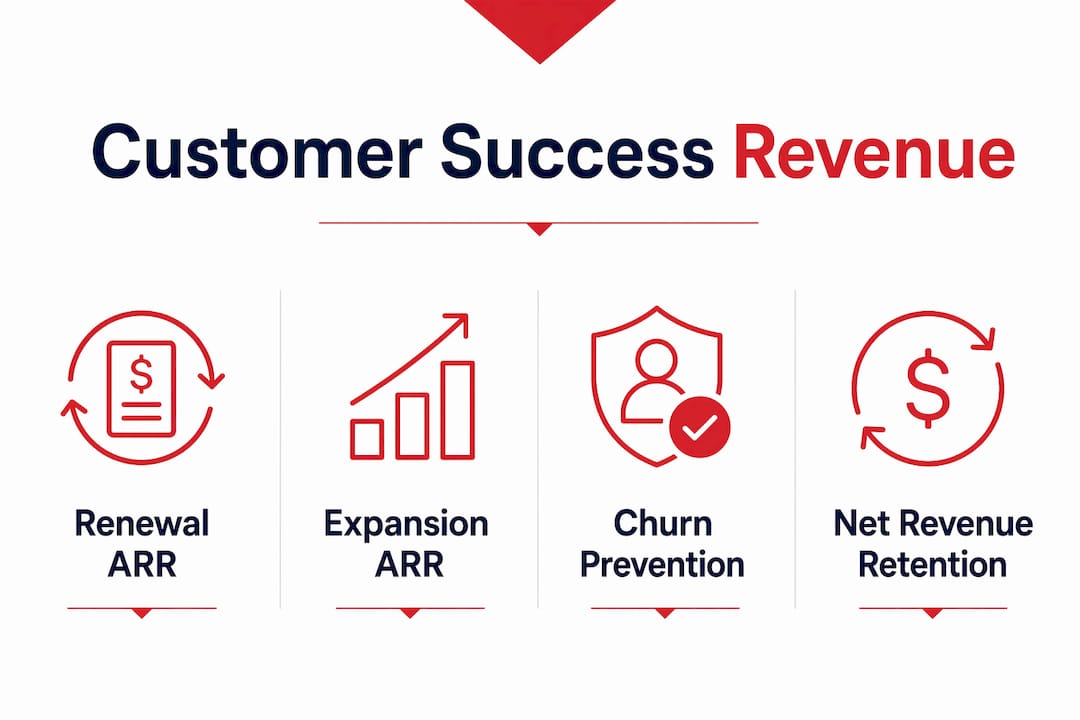
Customer success generates revenue through three distinct streams: renewal protection, expansion growth, and churn prevention. Each operates differently, and each requires a different motion from the CS team.

Renewal revenue protects existing Annual Recurring Revenue (ARR). When a CSM ensures a customer is actively using the product, hitting adoption milestones, and seeing measurable value, that customer renews. The renewal is not automatic. It is earned through consistent engagement and demonstrated outcomes. Losing a renewal does not just reduce next quarter’s revenue. It erases the compounding value that customer would have generated over years.
Expansion revenue comes from upsells, cross-sells, and seat additions. CS teams with clear expansion mandates identify the right moment to introduce a higher tier or an adjacent product. The sales cycle for expansion is shorter and cheaper than acquiring a new customer, because trust is already established. This is where the customer success revenue strategy pays its highest return.
| Revenue stream | Primary driver | CS team role | Relative cost |
|---|---|---|---|
| New customer ARR | Marketing and sales | Onboarding handoff | High acquisition cost |
| Renewal ARR | Retention and value delivery | Renewal ownership | Low, protects existing base |
| Expansion ARR | Upsell and cross-sell | Identify and execute growth | Lowest, built on existing trust |
Churn prevention is revenue preservation in its purest form. Silent churn, where customers stop using the product without formally canceling, is the leaky bucket that drains ARR before finance even notices. CS teams that monitor customer telemetry and act on churn-risk signals before a customer disengages are performing a direct revenue function.
Pro Tip: Map every CS activity to one of these three revenue streams. If a task does not protect renewal ARR, grow expansion ARR, or reduce churn risk, question whether it belongs in the CS workflow at all.
Why is NRR the financial heartbeat of customer success?
Net Revenue Retention (NRR) is the single metric that most clearly connects customer success activity to financial outcomes. Pendo defines NRR as the percentage of recurring revenue retained from existing customers over a given period, including expansion revenue and subtracting contraction and churn. An NRR above 100% means the existing customer base is growing on its own, without a single new logo.
That number is the financial proof that customer success works. A SaaS company with an NRR of 115% is growing its revenue base from existing customers alone. That growth compounds. Over three years, it creates a revenue foundation that no amount of new customer acquisition can replicate at the same cost.
| NRR range | What it signals | CS implication |
|---|---|---|
| Below 90% | Significant churn exceeds expansion | CS is in firefighting mode |
| 90%–100% | Retention is stable but expansion is weak | CS needs expansion motion |
| 100%–110% | Healthy growth from existing base | CS is performing as a revenue function |
| Above 110% | Exceptional expansion outpacing churn | CS is a primary growth engine |
Mature SaaS CS organizations align CSM compensation and operating cadence directly to NRR outcomes. This is not a minor structural detail. When a CSM’s performance review and payout are tied to NRR, every decision they make is filtered through a revenue lens. That alignment is what separates a CS team that feels like a revenue function from one that actually is one.
Pro Tip: Track NRR at the segment level, not just company-wide. A strong overall NRR can mask a collapsing cohort in your mid-market or enterprise tier. Segment visibility is where CS leaders find their most urgent problems.
What economic forces make customer success a revenue priority?
Rising customer acquisition costs are the primary economic force pushing SaaS companies to treat customer success as a revenue function. When the cost to acquire a new customer climbs, the return on retaining an existing one becomes proportionally more valuable. TSIA’s 2026 research confirms that ROI visibility now matters more than customer sentiment as budgets tighten. Boards and CFOs are asking CS leaders to show financial proof, not satisfaction scores.
This shift changes the profile of the CSM role entirely. The relationship manager who built rapport and handled escalations is giving way to the value manager who owns a revenue number, reads a P&L, and speaks in terms of ARR impact. TSIA describes modern CSMs as value managers tasked with financial outcome ownership. That is a fundamentally different job description, and it requires a fundamentally different skill set.
AI and predictive health modeling are accelerating this transition. When CS teams have access to real-time customer telemetry, adoption data, and churn-risk scores, they can act before a customer disengages. That proactive posture is only possible with data. Without it, CS teams are reactive, operating in a firefighting loop that consumes resources without generating measurable revenue outcomes.
The benefits of customer success teams are most visible when CS leaders can translate activity into leading indicators that forecast NRR. Time-to-value, adoption milestone completion rates, and churn-risk signal frequency are not soft metrics. They are early warnings that feed directly into revenue forecasts. TSIA emphasizes that translating CS initiatives into measurable leading indicators is critical for securing executive funding in the AI era.
How do you operationalize customer success as a revenue function?
Operationalizing customer success as a revenue function requires the same structural discipline applied to a sales organization. That means territory design, quota setting, and performance management tied to revenue outcomes, not activity metrics.
The most common mistake SaaS leaders make is incentivizing CS teams on activities rather than outcomes. Tracking the number of QBRs completed or check-in calls logged tells you nothing about whether the customer is on track to renew or expand. Activity-based incentives create the appearance of a revenue function without the substance. Outcome-based incentives, tied to NRR, renewal rates, and expansion ARR, create the reality.
A second operational risk is building a CS team focused entirely on churn prevention without a parallel expansion motion. Churn prevention protects the floor. Expansion raises the ceiling. A CS team that only defends existing ARR is leaving the most profitable revenue stream untouched. The customer success revenue strategy must include both motions, with clear ownership and clear metrics for each.
The following practices define how mature SaaS companies operationalize CS as a revenue function:
- Assign each CSM a revenue number that includes renewal ARR and expansion ARR targets.
- Build compensation plans that reward NRR improvement, not just renewal completion.
- Create a customer health scoring model using adoption data, support ticket frequency, and engagement signals.
- Establish a formal expansion playbook with defined trigger points for upsell conversations.
- Align CS and sales on a shared revenue forecast that includes renewal and expansion pipeline.
CS does not replace sales but converges with it, owning renewals, expansion motions, and revenue forecasting with full accountability. That convergence is the operational model that turns customer success from a cost center into a growth engine.
Key Takeaways
Customer success is a revenue function because it directly owns renewal ARR, expansion ARR, and NRR, making it as financially accountable as any quota-carrying sales team.
| Point | Details |
|---|---|
| CS owns revenue streams | CS teams influence 30–40% of total revenue through renewals, upsells, and expansion. |
| NRR is the core metric | NRR above 100% proves existing customers are growing revenue without new acquisition. |
| Outcome-based incentives matter | Compensation tied to NRR drives real revenue behavior, not just activity completion. |
| Rising acquisition costs force the shift | When CAC climbs, retaining and expanding existing customers becomes the primary growth path. |
| Leading indicators forecast NRR | Adoption milestones and churn-risk signals translate CS activity into financial proof for executives. |
The uncomfortable truth about CS and revenue accountability
Working closely with SaaS founders, I have seen the same pattern repeat itself. A company builds a CS team, hires talented people, and measures them on customer satisfaction scores and renewal rates. Then, two years in, the board asks why NRR is flat despite a growing headcount in customer success. The answer is almost always the same: the team was never given a revenue number to own.
The uncomfortable truth is that customer success as a growth driver requires financial literacy at every level of the CS organization. CSMs need to understand ARR, expansion economics, and churn math. CS leaders need to present a revenue forecast, not a health score dashboard. That shift is harder than it sounds, because it requires changing how CS professionals see their own role.
I have also seen the opposite failure: CS teams given aggressive expansion quotas without the tools or data to identify the right moment for an upsell conversation. Pushing expansion too early, before a customer has realized value, accelerates churn rather than preventing it. The balance between protecting the relationship and driving commercial outcomes is where the real skill of a mature CS organization lives.
AI changes this calculus significantly. Predictive health modeling removes the guesswork from timing. When a customer’s telemetry shows high adoption, positive engagement, and milestone completion, that is the signal to open an expansion conversation. When it shows declining usage and support escalations, that is the signal to intervene before the renewal is at risk. The data does not replace the CSM’s judgment. It sharpens it.
— Raymond
How E-regency helps SaaS leaders build CS as a revenue function
SaaS founders who are serious about turning customer success into a measurable revenue function need more than a framework. They need a partner who can translate strategy into execution.

E-regency Advisory works directly with growth-stage SaaS companies to build CS organizations that own NRR, reduce gross churn, and generate expansion revenue with precision. E-regency clients have seen over a 20% reduction in gross churn and more than a 115% increase in net revenue retention. The approach combines predictive AI health modeling with hands-on retention strategy execution to produce outcomes that show up in the revenue forecast, not just the satisfaction survey. If your CS team is not yet carrying a revenue number, schedule a consultation with E-regency to build the model that changes that.
FAQ
What makes customer success a revenue function?
Customer success is a revenue function because it directly owns renewal ARR, drives expansion through upsells and cross-sells, and reduces churn that would otherwise erode recurring revenue. High-performing CS organizations influence 30–40% of total company revenue.
What is NRR and why does it matter for CS teams?
NRR measures the percentage of recurring revenue retained from existing customers, including expansion and minus churn. An NRR above 100% means the existing customer base is growing revenue without new customer acquisition.
How does customer success differ from customer support?
Customer support resolves issues reactively. Customer success proactively ensures customers achieve outcomes that drive renewals and expansion, making it a forward-looking revenue function rather than a cost center.
How should CS compensation be structured for revenue impact?
CS compensation should be tied to NRR improvement, renewal ARR, and expansion ARR targets rather than activity metrics like calls completed or QBRs held. Outcome-based incentives align CS behavior with actual revenue results.
What role does AI play in customer success revenue strategy?
AI enables predictive health modeling that identifies churn risk and expansion readiness before a CSM would otherwise notice them. TSIA’s 2026 research confirms that translating CS activity into measurable financial indicators is the defining capability of AI-era customer success organizations.