

Customer Success Team Structure: A 2026 SaaS Guide
TL;DR:
- Customer success team structure organizes roles and workflows to retain customers and grow revenue. Proper design improves customer relationships and increases net revenue retention at scale.
Customer success team structure is the deliberate design and organization of roles, workflows, and account ownership models that enable a SaaS company to retain customers and drive revenue growth at scale. The right structure directly determines whether your team operates in a reactive firefighting loop or delivers the proactive engagement that protects net revenue retention (NRR). Growth-stage SaaS companies face a specific inflection point: the generalist approach that worked at 50 customers breaks down at 500. Aligning your customer success team design with account complexity, customer segment value, and company growth stage is the difference between a leaky bucket and a compounding retention engine.
What are the common customer success team structure models?
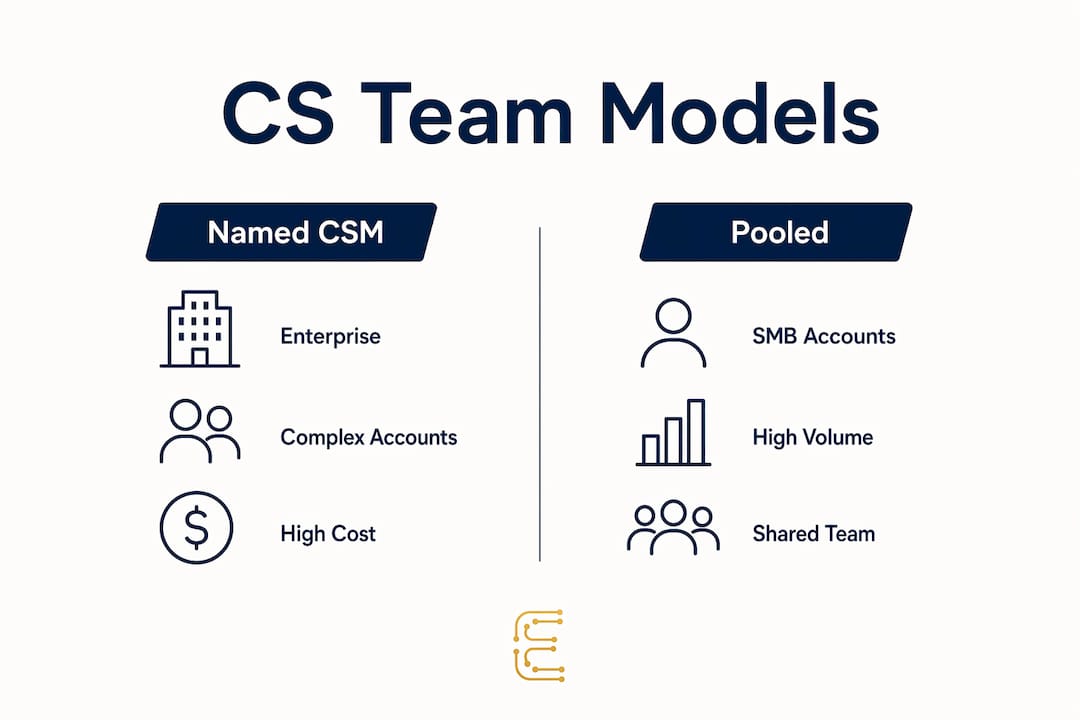
The Named CSM model assigns one dedicated Customer Success Manager to a defined book of accounts. Enterprise clients benefit most from this model because relationship depth, executive alignment, and complex renewal cycles demand continuity. A single CSM who knows the account history, the internal champions, and the product adoption gaps is far more effective than a rotating cast of generalists.

The Pooled model works in the opposite direction. A shared team of CSMs handles high volumes of SMB accounts through a ticket-based or queue-based system. This model trades relationship depth for coverage efficiency, which is the right trade when account complexity is low and the cost of a dedicated CSM exceeds the account’s revenue potential. The risk is silent churn: customers who disengage quietly because no one owns the relationship.
The Pod model addresses complexity at scale by grouping specialists around a set of accounts. A typical pod combines a CSM, a technical specialist, and a renewal manager. This structure works well for mid-market accounts that need more than a generalist but do not justify a full enterprise team. The pod creates internal accountability without the overhead of a fully dedicated enterprise motion.
Segmented and Vertical models add another layer of precision. Segmented structures divide the team by account size or revenue tier. Vertical structures divide by industry, so a CSM covering healthcare accounts builds deep domain knowledge that a generalist cannot replicate. Both approaches improve the quality of customer conversations and shorten time-to-value for new accounts.
Hybrid models combine elements across lifecycle stages. A company might use a high-touch Named CSM model for onboarding, then transition accounts to a Pooled model at steady state, and re-engage a dedicated CSM at renewal. This lifecycle-aware approach matches resource intensity to the moments that matter most.
| Model | Best for | Key trade-off |
|---|---|---|
| Named CSM | Enterprise, complex accounts | High cost per account |
| Pooled | High-volume SMB | Low relationship depth |
| Pod | Mid-market, cross-functional needs | Coordination overhead |
| Segmented | Mixed account sizes | Requires clear tier definitions |
| Vertical | Industry-specific products | Narrow CSM specialization |
| Hybrid | Multi-stage lifecycle management | Structural complexity |
Pro Tip: Map your current book of accounts by revenue tier and product complexity before choosing a model. Most growth-stage SaaS companies need a hybrid approach within 18 months of their first CS hire.
What foundational roles does a high-performing CS team need?
The core of any successful customer success team is the Customer Success Manager. CSMs own the relationship, monitor product adoption, and drive renewals. At early scale, CSMs handle everything from onboarding calls to executive business reviews. That breadth is necessary at first, but it becomes a ceiling as the team grows.
CS Operations is the role most growth-stage companies add too late. CS Ops owns the systems, data, and processes that make every CSM more effective. Without a dedicated CS Ops function, teams rely on spreadsheets, inconsistent health scores, and manual reporting. Scaling from generalists to specialists requires CS Ops as the connective tissue between tools, data, and customer-facing workflows.
Renewal Managers own the commercial side of retention. They track contract timelines, coordinate with finance and legal, and lead renewal conversations. The most effective renewal strategies focus on customer maturity milestones rather than commercial pressure. A customer who has hit clear adoption benchmarks renews naturally. A customer who has not reached those milestones will resist any upsell conversation, regardless of how well it is framed.
Account Managers handle expansion revenue within the existing customer base. In some structures, CSMs carry expansion quotas. In others, a dedicated Account Manager owns upsell and cross-sell motions. The right choice depends on your product complexity and the size of your expansion opportunity. Mixing retention and expansion responsibilities in a single role creates conflicting incentives if not managed carefully.
Pro Tip: Fix your CS Ops foundation before adding AI-driven roles. Data quality, journey mapping, and integrated workflows are formal prerequisites, not nice-to-haves. Automation built on bad data accelerates churn instead of preventing it.
How do you design and scale your CS team structure effectively?
Start by segmenting your customer base. Group accounts by annual contract value, product complexity, and strategic importance. This segmentation tells you which accounts need a Named CSM, which can be served by a Pooled model, and which are candidates for a Pod structure. Without this map, you are making staffing decisions without a foundation.
Define account ownership clearly before you hire. Every customer should have a named owner who is accountable for health, adoption, and renewal. Dedicated account ownership preserves trust and continuity even when support tickets are handled by a pooled team. The customer knows who to call when something matters. That single point of contact is a retention asset.
Integrate your onboarding, support, and renewal functions into a connected workflow. Onboarding sets the adoption trajectory. Support data reveals friction points and churn risk. Renewal conversations close the loop on value delivered. When these three functions operate in silos, the team misses early warning signals. Support ticket data is a leading churn indicator, and practitioners use it to build revenue-based product prioritization cases that protect accounts before they reach the point of cancellation.
Integrating ticket data into account health modeling produces measurable results. Gross retention improves by 5 points and NRR by 7 points within 18 months when support data feeds directly into health scoring and product development. That is not a marginal gain. It is the kind of outcome that changes how a board views the CS function.
Build revenue accountability into every customer-facing role. CSMs should understand the revenue impact of churn in their book of accounts. Renewal Managers should track NRR, not just renewal rates. Account Managers should report on expansion revenue as a percentage of total ARR. When every role carries a revenue lens, the team stops operating as a cost center and starts functioning as a growth driver.
| Team size | Priority action | Key metric |
|---|---|---|
| 1–5 CSMs | Define account ownership and segmentation | Gross retention rate |
| 6–15 CSMs | Add CS Ops and Renewal Manager roles | NRR and time-to-value |
| 16+ CSMs | Introduce Pod or Vertical model | Expansion ARR and churn by segment |
What AI-driven roles are reshaping CS teams in 2026?
Four new specialist roles have emerged in 2026 that are reshaping how customer success operations function. Each role addresses a specific gap that generalist CSMs cannot fill at scale.
The AI Operations Analyst owns the health scoring models and predictive data pipelines that flag at-risk accounts before CSMs see the symptoms. This role sits at the intersection of data science and CS strategy. The CX Automation Engineer builds and maintains the automated touchpoints across the customer lifecycle, from onboarding sequences to renewal alerts. Without this role, automation projects stall in the backlog of engineering teams who do not prioritize CS workflows.
The Digital Journey Orchestrator designs the end-to-end customer experience across digital channels, ensuring that automated and human touchpoints feel connected rather than fragmented. The Predictive Insights Manager translates health model outputs into specific CSM actions, closing the gap between data and execution. This role prevents the common failure mode where a team has good data but no process for acting on it.
“CS leaders should build a solid CS Ops foundation before layering in AI roles. Data quality, journey mapping, and systems integration are not optional prerequisites — they are the difference between AI that accelerates retention and AI that accelerates churn.”
Source: The 2026 CCO org chart
Timing matters. Adding an AI Operations Analyst to a team that lacks clean customer data or a defined health scoring framework produces noise, not signal. The prerequisite for AI-driven roles is a CS Ops function that already owns data quality, journey mapping, and workflow integration as formal sprint tasks. Get that foundation right first, and the AI layer compounds your existing capabilities. Skip it, and you are automating a broken process at scale.
Key Takeaways
An effective customer success team structure requires clear account ownership, role specialization aligned to customer complexity, and a CS Ops foundation before any AI-driven capabilities can deliver measurable retention gains.
| Point | Details |
|---|---|
| Match model to account complexity | Use Named CSM for enterprise, Pooled for SMB, and Pod for mid-market cross-functional needs. |
| Build CS Ops before AI roles | Data quality and journey mapping must exist before AI-driven roles can add value. |
| Own the revenue lens | Every CS role should track a metric tied to retention or expansion revenue. |
| Use support data proactively | Ticket data is a leading churn indicator; integrate it into health scoring for measurable NRR gains. |
| Scale ownership deliberately | Dedicated account ownership preserves customer trust even as support functions are pooled. |
The case for keeping a human at the center of every account
The most common mistake I see growth-stage SaaS companies make is pooling customer relationships too early. The logic sounds reasonable: you have 200 accounts and only four CSMs, so you build a queue and rotate coverage. The efficiency gain is real. The trust cost is invisible until a renewal conversation goes sideways and you realize no one on the team actually knows the customer.
Dedicated account ownership is not a luxury for enterprise teams. It is the foundation of every retention outcome worth measuring. I have seen companies with sophisticated health scoring models and beautiful dashboards lose accounts that a single CSM with a strong relationship would have saved with one phone call. The data tells you who is at risk. The relationship is what gets you the conversation.
The tension between relationship depth and operational scale is real, and I do not think it resolves cleanly. What I have found is that the companies who get it right treat account ownership as a non-negotiable constraint and build their pooling decisions around it. Support tickets can be pooled. Renewal conversations can be templated. The named owner of the account should never be ambiguous.
Aligning your CS team design with your product maturity and customer maturity is the part most leaders underweight. A product that is still finding its footing needs CSMs who can translate ambiguity into customer value. A mature product with a defined adoption path can support more automation and less white-glove coverage. The structure should follow the product, not the other way around.
— Raymond
How E-regency helps you build a CS team that retains and grows
Growth-stage SaaS companies rarely lack ambition when it comes to customer success. What they lack is a clear framework for translating that ambition into a team structure that actually reduces churn and grows NRR.
E-regency Advisory works directly with SaaS founders and CS leaders to design team structures that match their customer base, growth stage, and product complexity. The advisory approach combines AI-driven retention modeling with hands-on execution support, so you are not just getting a slide deck. You are getting a plan your team can act on. E-regency clients have achieved over a 20% reduction in gross churn and more than 115% increase in NRR. If your current structure is not producing those kinds of outcomes, schedule a consultation to find out what needs to change.
FAQ
What is a customer success team structure?
A customer success team structure is the organized design of roles, account ownership models, and workflows that enable a SaaS company to retain customers and drive revenue growth. The right structure aligns team resources with customer complexity and business stage.
What are the core customer success team roles?
The core roles are Customer Success Manager, CS Operations, Renewal Manager, and Account Manager. As teams scale, these roles specialize rather than expand in scope.
When should a SaaS company use a Named CSM model?
The Named CSM model is best for enterprise accounts with high contract values, complex onboarding needs, and multi-stakeholder renewal cycles. High-value enterprise customers benefit most from the relationship continuity this model provides.
How does support ticket data improve customer retention?
Support ticket data is a leading churn indicator that reveals friction points before customers disengage. Integrating ticket data into health scoring improves gross retention by 5 points and NRR by 7 points within 18 months.
What should a CS team do before adding AI-driven roles?
CS leaders should establish solid CS Ops foundations, including clean customer data, defined journey maps, and integrated workflows, before introducing AI roles. Adding AI to a broken operational foundation accelerates problems rather than solving them.