

What Is a Customer Success Hire for SaaS Founders?
TL;DR:
- Hiring a customer success manager early improves retention, drives revenue, and prevents silent churn. The role requires hybrid skills in relationship management and data fluency to proactively support customers. As companies grow, team specialization and segmentation enhance customer relationships and expansion opportunities.
A customer success hire is a professional dedicated to ensuring customers achieve their desired outcomes with your product, directly reducing churn and driving revenue expansion. This role, formally known as a Customer Success Manager (CSM), sits at the intersection of relationship management, product expertise, and commercial acumen. For growth-stage SaaS founders, making this hire at the right time is one of the highest-leverage decisions in the business. The difference between a company that retains 90% of its customers and one stuck in a leaky bucket cycle often comes down to whether a skilled CSM is in place before silent churn takes hold.
What is a customer success hire and what do they actually do?
A customer success hire is not a support agent with a better title. The CSM role is defined by proactive ownership of the customer relationship from the moment a contract is signed through renewal, expansion, and advocacy. Where a support agent reacts to tickets, a CSM monitors customer health signals, intervenes before problems surface, and actively works to connect product usage to measurable business outcomes for the customer.

The core responsibilities span the entire post-sale lifecycle. A CSM owns onboarding, ensuring new customers reach their first value milestone quickly. They track product adoption, identify accounts at risk of disengagement, manage renewal conversations, and surface expansion opportunities to the sales team. They also serve as the customer’s internal advocate, partnering cross-functionally with product, marketing, and sales to close feedback loops and improve the overall customer experience.
The skill set required is genuinely hybrid. TSIA research confirms that effective CSMs blend empathy, active listening, and relationship management with data fluency, product expertise, and CRM proficiency. That combination is rare and worth paying for. A CSM who can read a customer health dashboard and then navigate a difficult renewal conversation without damaging trust is the profile that actually moves net revenue retention (NRR) in the right direction.
Pro Tip: When writing a CSM job description, list empathy and commercial acumen as co-equal requirements. Candidates who lead with only one of these two qualities tend to either over-promise to customers or under-invest in the relationship.
Hiring the wrong CSM carries a real cost. TSIA notes that a CSM who lacks the ability to navigate renewal conversations while maintaining trust actively harms long-term expansion potential. The wrong hire does not just fail to grow accounts. They accelerate the departure of accounts that might have stayed.
When should a growth-stage SaaS company make this hire?
The timing of a customer success hire depends on product complexity, account value, and the volume of manual effort required after the sale. There is no universal rule, but there are clear triggers that signal the right moment.
For enterprise or high-touch products, the threshold arrives early. Complex products requiring integrations or manual onboarding warrant a CSM hire after just 1–3 customers, regardless of annual recurring revenue (ARR). When every new customer requires a customized setup, a dedicated human owner of that process is not a luxury. It is a prerequisite for delivering the outcome the customer paid for.
For SMB-focused, low-touch products, the calculus is different. Founders can delay the hire until reaching 30–50 customers, provided they invest that time in building self-serve onboarding infrastructure, knowledge bases, and automated onboarding sequences. The goal is to reduce the manual intervention required per customer so that when the CSM does join, they are managing relationships rather than firefighting setup issues.
The most telling signal for any product type is founder time. Post-sale customer work can consume 60% of a founder’s time when the hire is delayed past the inflection point. That figure represents a serious drag on product development, fundraising, and sales. When the founder becomes the de facto CSM, the entire company slows down.
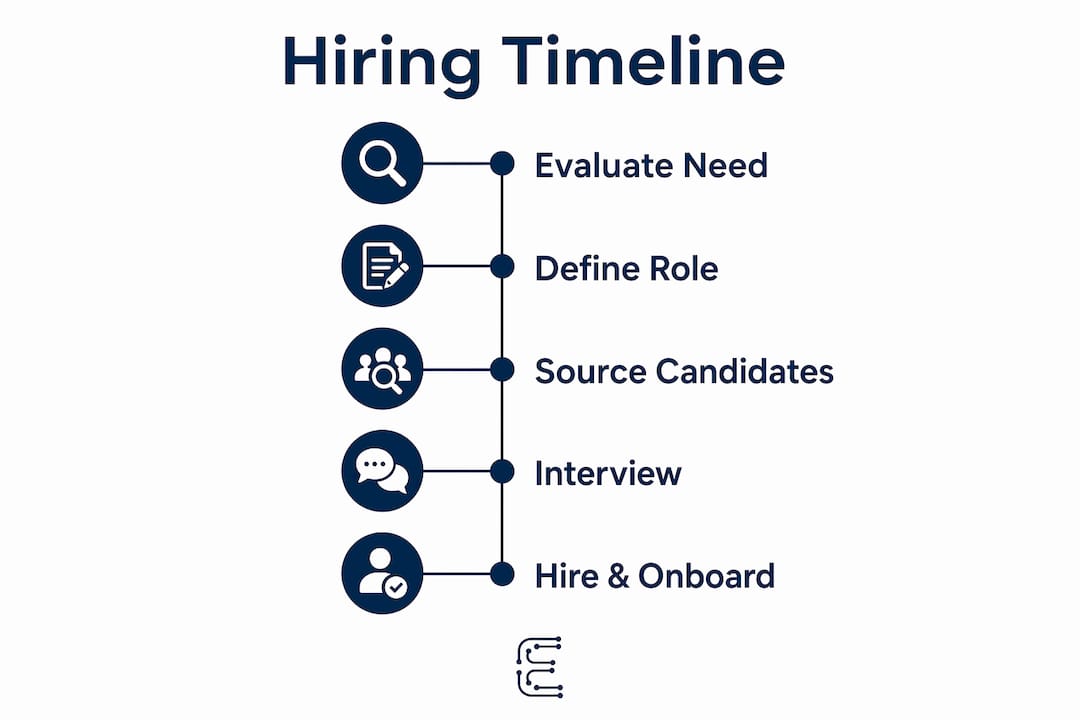
High-value accounts accelerate the decision further. Accounts with an annual contract value (ACV) above $200,000 justify an early customer success hire almost by definition. The revenue at risk in a single churned enterprise account typically exceeds the fully loaded cost of a CSM for an entire year. Framing the hire as insurance against that loss makes the business case straightforward.
How do customer success team structures evolve as companies scale?
Early-stage SaaS companies typically start with a single generalist CSM who handles onboarding, adoption, renewals, and expansion conversations for every account. That model works at low volume. As the account base grows, the generalist model breaks down and role-based specialization becomes necessary.
Customer success teams evolve from generalist roles to specialist functions as account volume increases. Onboarding specialists focus exclusively on getting new customers to their first value milestone. Adoption specialists monitor usage data and intervene when engagement drops. Renewal specialists own the commercial conversation at contract end. Each specialist role reduces cognitive load and improves the quality of execution in that specific phase of the customer lifecycle.
Segmentation drives the structure of a maturing team. TSIA data shows that 64% of companies segment their customer success teams by company size and 63% by contract revenue. That segmentation matters because a CSM managing a $500,000 enterprise account needs a fundamentally different playbook than one managing a $5,000 SMB account. Mixing those responsibilities on a single CSM creates confusion and dilutes the quality of both relationships.
The capacity benchmark for enterprise accounts is concrete. One CSM typically manages 8–15 high-touch accounts, and the signal to hire the next CSM is when any individual exceeds 12 accounts. Beyond that threshold, response times slow, proactive outreach drops, and the firefighting loop begins. Founders who wait until a CSM is managing 20 or 25 accounts before hiring are already paying the cost in silent churn.
Pro Tip: Before hiring your second or third CSM, define the segmentation model first. Decide whether you will divide accounts by size, contract value, or lifecycle stage. Hiring into a clear structure produces better outcomes than hiring and then trying to organize the team afterward.
The table below summarizes how team structure typically shifts across growth stages.
| Growth stage | Team model | Segmentation approach |
|---|---|---|
| 1–50 customers | Single generalist CSM | No formal segmentation |
| 50–200 customers | Two to three generalists with informal specialization | Segmented by account size or ACV |
| 200+ customers | Specialist roles: onboarding, adoption, renewal | Segmented by company size and contract revenue |
What strategic value does a customer success hire bring beyond retention?
The most common framing of customer success is defensive: hire a CSM to stop customers from leaving. That framing undersells the role by a wide margin. A well-placed CSM is a growth lever, not just a retention mechanism.
Proactive CSMs identify account expansion opportunities and prevent churn before it registers in the data. The distinction matters because expansion revenue from existing customers carries a dramatically lower cost of acquisition than new logo revenue. A CSM who surfaces an upsell opportunity at the right moment in the customer lifecycle is generating revenue that the sales team would otherwise have to work much harder to find.
The shift from cost center to revenue driver is the defining reframe for growth-stage companies. Gainsight and other industry voices have documented this transition extensively. When CS is treated as a core growth initiative rather than a post-sale support function, customer success roles shift from reactive problem-solving to proactive growth partnerships. That shift shows up in NRR, in expansion ARR, and in the quality of customer references available to the sales team.
The brand reputation impact is equally real, if harder to quantify. Customers who achieve their desired outcomes become advocates. They provide case studies, participate in reference calls, and generate referral pipeline. A CSM who builds genuine relationships with customers is, in effect, building a distributed sales force of satisfied clients. That outcome does not appear on a support ticket dashboard, but it compounds over time in ways that matter deeply to a growth-stage company.
Empathy and commercial skills in CSMs significantly reduce churn and increase upsell success. The combination of those two qualities is what separates a CSM who retains accounts from one who grows them. Founders who understand this distinction hire differently and get materially better results from their customer success investment.
Key Takeaways
A customer success hire is a growth investment, not a support cost. The timing, skills, and team structure around this role determine whether a SaaS company retains customers or loses them to silent churn.
| Point | Details |
|---|---|
| Define the role correctly | A CSM owns the post-sale relationship proactively, not reactively, from onboarding through renewal. |
| Hire based on product complexity | High-touch products warrant a CSM after 1–3 customers; low-touch products can wait until 30–50. |
| Prioritize hybrid skills | Empathy and commercial acumen together outperform pure product expertise in reducing churn. |
| Segment teams as you scale | Divide accounts by company size or contract value to improve focus and reduce CSM burnout. |
| Treat CS as a revenue function | Proactive CSMs drive upsells and expansion ARR, not just renewal rates. |
The hiring mistake I see SaaS founders make most often
The most common error is not hiring too early. It is hiring too late and then expecting one person to fix everything at once. By the time most founders make their first customer success hire, they are already in a firefighting loop. The new CSM inherits a backlog of at-risk accounts, an undocumented onboarding process, and no customer health data to work from. That is not a customer success function. That is a rescue operation.
The second mistake is writing a job description that asks for a unicorn. I have seen postings that require deep technical expertise, enterprise sales experience, data analysis skills, and executive relationship management, all for a single mid-level role. That profile does not exist at a price a growth-stage company can afford. The better approach is to identify the one or two capabilities most critical to your specific customer base and hire for those first. You can build the rest of the skill set through training, tooling, and eventually specialization.
The third mistake is skipping the structure conversation entirely. Founders often hire a CSM and then leave the role scope undefined, expecting the hire to figure it out. A CSM without a clear mandate for which accounts they own, what success looks like, and how they interact with sales and product will spend their first six months creating their own job rather than serving customers. Define the scope before you post the role. The E-regency blog covers how to structure these conversations in practical terms for early-stage teams.
The founders who get this right treat the first customer success hire as a systems builder, not just a relationship manager. They give the CSM time to document the onboarding process, build a customer health framework, and establish the feedback loops that will make the second and third hires far more effective.
— Raymond
How E-regency helps SaaS founders build effective customer success teams
SaaS founders who understand the customer success hire role still face a difficult execution challenge: building the right team structure, defining the right skills profile, and timing the hire correctly for their specific product and customer base.
E-regency combines AI-driven customer health modeling with hands-on advisory to help growth-stage companies make these decisions with confidence. Clients working with E-regency have achieved over a 20% reduction in gross churn and more than a 115% increase in net revenue retention. Those outcomes come from getting the customer success fundamentals right at the foundation level, before churn becomes a crisis. If you are ready to build a customer success function that drives real revenue growth, schedule a consultation with the E-regency team today.
FAQ
What is a customer success hire in SaaS?
A customer success hire, formally called a Customer Success Manager (CSM), is a professional who owns the post-sale customer relationship to drive product adoption, retention, and account expansion. The role is proactive by design, focused on customer outcomes rather than reactive support.
When should a SaaS startup make its first customer success hire?
High-touch products with complex onboarding warrant a CSM after 1–3 customers, while low-touch SMB products can delay until 30–50 customers. The clearest signal is when post-sale work consumes the majority of the founder’s time.
What skills matter most in a customer success manager?
TSIA identifies empathy, active listening, and commercial acumen as the most critical skills, combined with data fluency and CRM proficiency. Candidates who balance relationship management with the ability to navigate renewal conversations produce the best retention and expansion outcomes.
How many accounts can one CSM manage?
One CSM typically manages 8–15 high-touch enterprise accounts effectively. Hiring an additional CSM is warranted when any individual exceeds 12 accounts, as response quality and proactive outreach decline beyond that threshold.
How does customer success team structure change as a company grows?
Teams start with a single generalist CSM and evolve into specialist roles covering onboarding, adoption, and renewals as account volume increases. Most mature teams segment accounts by company size or contract revenue to improve resource allocation and reduce burnout.