

How SaaS Companies Build CS Teams That Retain More
TL;DR:
- Customer success proactively ensures customers achieve their goals, driving retention and revenue growth. Building structured playbooks and focusing on net revenue retention helps SaaS teams scale without losing focus on customer outcomes.
Customer Success (CS) is defined as the proactive function that ensures customers achieve their intended outcomes with your product, directly driving retention and expansion revenue. Understanding how SaaS companies build CS teams is the difference between a leaky bucket and a growth engine. 65% of SaaS revenue comes from existing customers, making a well-structured CS team one of the highest-return investments a SaaS leader can make. Strong onboarding alone can boost retention by up to 50%. The companies that win long-term treat CS not as a support cost, but as a revenue function with measurable outcomes.
How SaaS companies build CS teams: roles and structure
The Customer Success Manager (CSM) is the foundational role in any SaaS CS team. A CSM owns the full customer lifecycle: onboarding, adoption, health monitoring, renewal, and expansion. Every other CS role you add should support or extend what the CSM does, not replace it.

Staffing ratios matter more than most leaders realize. A high-touch CS model assigns one CSM per 30–50 accounts. That ratio reflects the depth of engagement required when account complexity is high and contract values justify white-glove attention. For lower-value or self-serve accounts, a scaled or tech-touch model allows one CSM to manage hundreds of accounts through automated check-ins, in-app messaging, and group webinars.
The structure of your CS team should match your customer segmentation, not your headcount. Early-stage companies with fewer than 50 accounts need one or two generalist CSMs who can handle onboarding, support escalations, and renewal conversations. As you cross 100 accounts, you add a CS Operations role to manage data, tooling, and process documentation. Analysts come next, helping the team identify churn signals and expansion patterns at scale.
Specialized roles like Implementation Managers and Solutions Engineers belong in the team only when account complexity demands them. Adding these roles too early creates overhead without proportional value. The right sequence is: CSM first, CS Ops second, then specialized functions as account complexity grows.
- CSM: Owns onboarding, adoption, health, renewal, and expansion for assigned accounts.
- CS Operations: Manages tooling, data hygiene, playbook documentation, and reporting.
- Implementation Manager: Leads technical onboarding for complex, high-value accounts.
- CS Analyst: Identifies churn risk signals and expansion opportunities from product and CRM data.
- VP or Head of CS: Sets team strategy, owns NRR targets, and aligns CS with sales and product.
Pro Tip: Hire your first CSM before you hire a Head of CS. A leader without a team to lead creates process documents no one uses. A CSM without a leader still closes renewals.
How to develop onboarding playbooks that drive retention
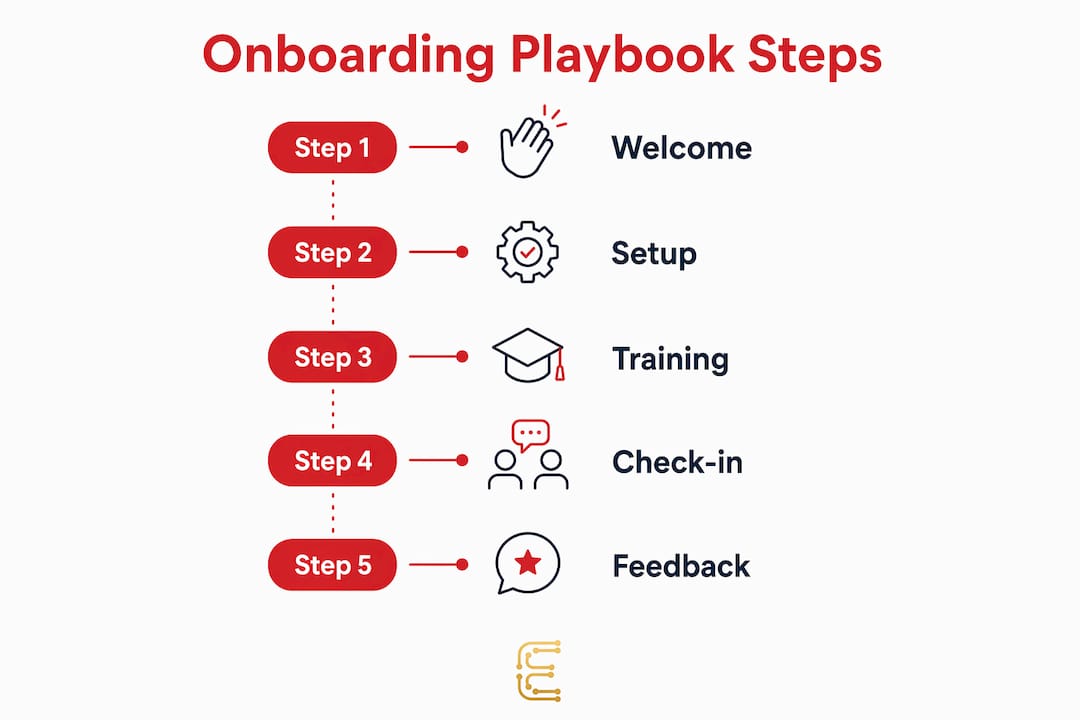
A customer success playbook is a documented, repeatable sequence of activities that guides customers from contract signature to measurable value. Without defined playbooks, CS teams operate reactively, responding to problems instead of preventing them. That reactive posture is the firefighting loop that kills retention at scale.
Building an effective playbook starts with mapping the customer journey. The map should cover every stage from initial signup through first value, full adoption, renewal, and expansion. Each stage needs a clear milestone, a defined CSM activity, and a success criterion. Vague milestones like “customer is happy” are not measurable. Specific milestones like “customer has completed three core workflows within 14 days of go-live” are.
- Define first value clearly. Identify the single action or outcome that signals a customer has gotten real value from your product. For a project management tool, that might be the first completed project. For a data platform, it might be the first exported report.
- Build a timed onboarding checklist. Assign specific tasks to specific days. Day 1: kickoff call. Day 3: admin setup complete. Day 7: first workflow live. Day 14: first value check-in. Timed checklists remove ambiguity and create accountability.
- Schedule health checks at key intervals. At 30, 60, and 90 days, the CSM reviews product usage data, collects qualitative feedback, and identifies any risk signals. Early risk identification prevents silent churn, the pattern where customers disengage quietly before canceling.
- Align CS activities to customer business goals. Every check-in should reference the customer’s stated objectives from the sales process. If the customer bought to reduce manual reporting time, every playbook touchpoint should reference that goal explicitly.
- Create an expansion trigger in the playbook. When a customer hits a defined adoption threshold, the CSM initiates an expansion conversation. This turns the playbook into a revenue motion, not just a retention tool.
Structured onboarding reduces time to value and increases product adoption, setting the tone for the entire customer relationship. The playbook is the mechanism that makes structured onboarding repeatable across every CSM on your team.
Pro Tip: Keep your first playbook simple enough to fit on one page. A playbook no one follows is worse than no playbook at all. Build complexity only after the simple version proves it works.
Which metrics should SaaS CS teams track?
Net Revenue Retention (NRR) is the gold standard metric for SaaS CS teams. NRR above 100% means expansion revenue from existing customers exceeds revenue lost to churn and downgrades. That number tells you whether your CS team is growing the business, not just maintaining it.
Gross churn, also called logo churn, measures the percentage of customers who cancel in a given period. It is a lagging indicator. By the time a customer cancels, the CS failure already happened weeks or months earlier. Tracking gross churn alongside leading indicators like product usage, support ticket frequency, and NPS scores gives you a complete picture.
| Metric | What it measures | Target |
|---|---|---|
| Net Revenue Retention (NRR) | Expansion minus churn and downgrades | Above 100% |
| Gross churn rate | Percentage of customers who cancel | Below 5% annually |
| Time to first value | Days from signup to first meaningful outcome | Defined per product |
| Customer health score | Composite of usage, engagement, and sentiment | Tracked per segment |
| Expansion rate | Revenue growth from existing accounts | Positive quarter over quarter |
Time to first value is the most underused metric in early-stage SaaS. It measures how quickly a new customer reaches the milestone defined in your onboarding playbook. A long time to first value predicts churn before the customer ever files a complaint. Shortening it is the fastest way to improve retention without changing your product.
Avoid metric overload. CS teams that track 15 KPIs end up acting on none of them. Choose three to five metrics that directly reflect customer outcomes and team performance, then build your reporting around those.
How can SaaS companies scale their CS teams without losing focus?
Scaling a CS team requires a different mindset than building one. The most common mistake SaaS leaders make is hiring a scaled CS leader too early. An experienced VP of CS from a 500-person company will arrive expecting systems, data, and processes that do not yet exist. Without those foundations, they spend their time building infrastructure instead of serving customers, and the team stalls.
The right early hire is a builder: someone comfortable with ambiguity, willing to work accounts directly, and capable of documenting what works as they go. That person creates the playbooks, tests the metrics, and defines the processes that a future leader can then scale. Hiring the builder first and the leader second is the sequence that works.
Technology decisions follow the same logic. Using existing CRM tools for health tracking and renewal management before investing in a dedicated CS platform is the right call for most early-stage teams. Salesforce, HubSpot, and similar CRMs can track customer health scores, renewal dates, and engagement data with modest configuration. Over-investing in a specialized CS platform before you have the data to populate it creates expensive shelfware.
Segmentation is the mechanism that makes scaling work. When your account base grows beyond 100 customers, you cannot treat every account the same way. High-value, high-complexity accounts get high-touch CSM coverage. Mid-market accounts get a scaled model with regular automated check-ins and quarterly business reviews. Small or self-serve accounts get a tech-touch model driven by in-app messaging and community resources. Segmentation lets you allocate CSM time where it generates the most revenue impact.
The final shift required for scale is positioning CS as a company-wide growth function. CS must be a company-wide mindset, not a department that handles complaints after sales closes a deal. When product, marketing, and sales teams treat customer outcomes as a shared responsibility, churn drops and expansion revenue grows. CS leaders who build cross-functional alignment consistently outperform those who operate in silos. You can read more about building that alignment on the E-regency blog.
Key Takeaways
Building effective SaaS CS teams requires hiring hands-on builders first, creating repeatable playbooks tied to customer outcomes, and measuring NRR as the primary indicator of team impact.
| Point | Details |
|---|---|
| Hire builders before leaders | Early CS hires should work accounts directly and document processes before a VP is brought in. |
| CSM ratios define coverage | High-touch models assign one CSM per 30–50 accounts; scale the model as account complexity decreases. |
| Playbooks prevent reactive CS | Documented, timed onboarding sequences reduce silent churn and create repeatable expansion triggers. |
| NRR is the north star metric | Net Revenue Retention above 100% confirms CS is generating growth, not just preventing cancellations. |
| Segmentation enables scale | Allocate high-touch, scaled, and tech-touch coverage based on account value and complexity. |
What I’ve learned about building CS teams that actually work
The most persistent mistake I see SaaS leaders make is treating customer success as a department you build after product-market fit is confirmed. By that point, you have already lost customers who could have stayed, and the data to understand why is gone. CS needs to be present from the first renewal conversation, not the tenth.
The second lesson is harder to accept: big, polished playbooks built in isolation do not work. The teams that retain customers build small, testable processes and refine them based on what actually happens in customer calls. A two-page onboarding checklist that every CSM follows beats a 40-slide playbook that lives in a shared drive no one opens.
I also believe most SaaS leaders underestimate the revenue impact of reducing involuntary churn alongside proactive CS work. Silent churn and failed payments together represent a significant portion of lost revenue that CS teams can address directly with the right telemetry and intervention triggers.
The leaders who build the best CS teams share one trait: they treat customer outcomes as a product in themselves. They measure, iterate, and invest in that product with the same rigor they apply to their software. That mindset is what separates a CS team that manages accounts from one that grows them.
— Raymond
How E-regency helps SaaS leaders build CS teams that grow revenue
SaaS leaders who want to move from reactive support to proactive revenue generation need more than a framework. They need a partner who understands the specific pressures of early-stage and growth-stage SaaS, where every churned account has an outsized impact on the business.
E-regency combines predictive AI health modeling with hands-on advisory to help SaaS founders build CS teams that deliver measurable outcomes. Clients have seen over a 20% reduction in gross churn and more than 115% increase in net revenue retention after working with E-regency. The approach is tailored to your customer base, your product, and your growth stage. If you are ready to build a CS team that drives expansion revenue rather than just managing renewals, schedule a strategy session with the E-regency team today.
FAQ
What is the first role to hire on a SaaS CS team?
The Customer Success Manager (CSM) is the first hire. A CSM handles onboarding, adoption, health monitoring, and renewals before any other specialized role is needed.
How many accounts should one CSM manage?
In a high-touch model, one CSM manages 30–50 accounts. Scaled and tech-touch models allow higher ratios when account complexity and contract value are lower.
What is the most important metric for a SaaS CS team?
Net Revenue Retention (NRR) is the gold standard. NRR above 100% confirms that expansion revenue from existing customers exceeds losses from churn and downgrades.
When should a SaaS company invest in a dedicated CS platform?
Use your existing CRM for health tracking and renewals first. Invest in a dedicated CS platform only after your account base and data volume exceed what CRM configurations can handle.
How does a customer success playbook reduce churn?
A playbook creates timed, repeatable onboarding and check-in sequences that surface risk signals early. Early risk identification allows CSMs to intervene before silent churn becomes a cancellation.