

What Is Expansion Revenue in SaaS: 2026 Guide
TL;DR:
- Expansion revenue in SaaS is the extra recurring income from existing customers through upsells, cross-sells, and usage growth. It is crucial for increasing net revenue retention and achieving higher company valuations. Building a dedicated expansion program with signal-driven tactics, aligned pricing, and segment-specific strategies drives sustained and capital-efficient growth.
Expansion revenue in SaaS is defined as the incremental recurring revenue generated from existing customers through upsells, cross-sells, seat additions, and usage growth after the initial contract is signed. This revenue category, formally tracked as Expansion MRR or Expansion ARR, sits at the center of every serious SaaS growth model. Top-quartile SaaS companies generate 38–40% of new ARR from expansion alone. That figure signals a structural shift: the best-performing SaaS businesses treat their existing customer base as a primary growth engine, not a secondary one. Understanding what expansion revenue in SaaS means, and how to build it deliberately, is the difference between a leaky bucket and a compounding growth machine.
What is expansion revenue in SaaS and why does it matter?
Expansion revenue is incremental ARR from existing customers through seat growth, feature upgrades, add-on purchases, and new departments adopting the product inside the same organization. A flat renewal does not count. The revenue must exceed the original contract value to qualify as expansion. This distinction matters because many SaaS founders conflate retention with growth, when the two are fundamentally different outcomes.

The strategic importance of expansion revenue centers on net revenue retention (NRR). NRR measures the percentage of recurring revenue retained from existing customers after accounting for churn, downgrades, and expansion. Expansion revenue is the primary driver pushing NRR above 100%, which means a SaaS company can grow its revenue base without signing a single new customer. Sustained expansion creates what practitioners call negative churn, where revenue from existing accounts grows faster than losses from cancellations.
For SaaS founders, this metric carries direct implications for valuation. Investors price SaaS businesses on revenue multiples that reward high NRR. A company with NRR above 120% commands a meaningfully higher multiple than one hovering at 95%, even if both report identical new logo growth. Expansion revenue is not a nice-to-have metric. It is a valuation lever.
What are the main types of expansion revenue in SaaS?
Expansion revenue takes four primary forms, and each one operates through a different mechanism in the customer lifecycle.
Seat expansion occurs when a customer adds users or licenses beyond their original contract. A team that starts with 10 seats and grows to 25 generates seat expansion revenue. This model works best in collaboration tools, CRMs, and project management platforms where adoption spreads organically across departments.
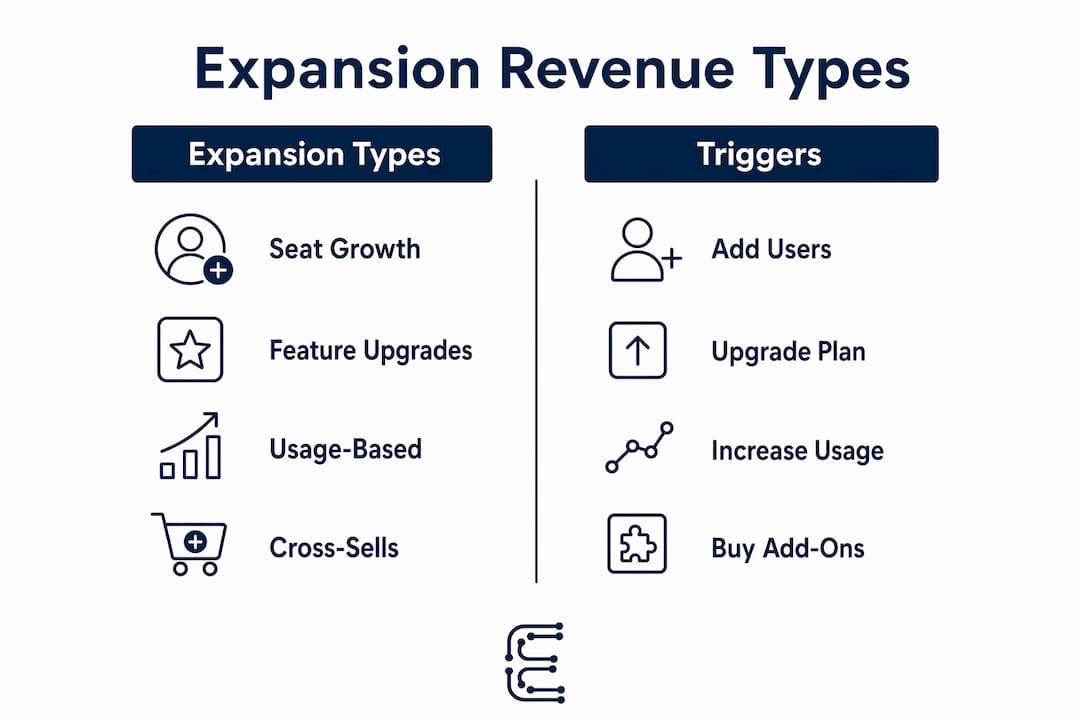
Tier or feature upgrades happen when a customer moves from a lower plan to a higher one to access advanced capabilities. Feature gating, where premium functionality is visible but locked at lower tiers, is the most common product mechanism driving this type of expansion. The upgrade feels like a natural next step rather than a sales push.
Usage-based expansion is the fastest-growing model in modern SaaS. Companies like Twilio and Snowflake charge per message, API call, or compute second. Consumption-based pricing drives expansion revenue as customers consume more of the product over time, without requiring any sales conversation to trigger the revenue increase.
Cross-sells and add-ons represent a fourth category where customers purchase adjacent products or modules outside their original scope. A customer buying a core analytics platform might later add a data enrichment module or an integrations package. Each purchase expands the account’s total contract value.
| Expansion type | Common example | Primary revenue trigger |
|---|---|---|
| Seat expansion | Adding users to a CRM | Organic team growth |
| Tier upgrade | Moving from Pro to Enterprise plan | Feature gate hit |
| Usage-based growth | More API calls or compute time | Product consumption increase |
| Cross-sell or add-on | Buying a new module or integration | Adjacent business need |
Pro Tip: Map your product’s natural growth moments, such as team size milestones or usage thresholds, and align your pricing tiers directly to those moments. Expansion should feel inevitable, not forced.
Why is expansion revenue the most capital-efficient growth lever?
Expanding an existing customer costs 5–7x less than acquiring a new one. That cost differential alone justifies building a dedicated expansion motion. The sales cycle is shorter, the trust is already established, and the customer already understands the product’s value.
Conversion rates tell the same story. Expansion deals close at 60–80%, while new logo sales convert at 20–30%. That gap represents a fundamental difference in sales efficiency. A founder who allocates equal resources to new acquisition and expansion is leaving a significant return on the table.
The compounding effect on NRR is where expansion revenue becomes a structural advantage. SaaS companies with NRR above 120% grow their revenue base year over year without needing to replace churned customers with new ones. This creates a financial flywheel: existing customers fund growth, which funds better product development, which drives more expansion.
Treating expansion as a dedicated sales motion with quotas and playbooks produces NRR above 120–130%. Passive or calendar-driven approaches typically deliver NRR in the 100–110% range. The gap between those two outcomes is not incremental. It is the difference between a business that scales and one that stagnates.
The valuation implications are direct. Investors and acquirers use NRR as a proxy for product-market fit and customer health. A SaaS company that demonstrates consistent expansion revenue signals that customers find increasing value over time. That signal commands a premium in any financing or exit scenario.
How do SaaS companies measure and optimize expansion revenue?
The core metrics for tracking expansion revenue are Expansion MRR, Expansion ARR, NRR, Gross Revenue Retention (GRR), and net churn. Each metric tells a different part of the story.
GRR measures retention before expansion. It captures how much revenue you keep, ignoring any growth from existing accounts. NRR adds expansion on top of GRR. If your GRR is 85% and your NRR is 115%, your expansion revenue is covering churn and generating net growth. Both numbers matter because GRR reveals the health of your core retention, while NRR reveals the strength of your expansion motion.
| Metric | What it measures | Healthy benchmark |
|---|---|---|
| Expansion MRR | Monthly revenue added from existing customers | Growing month over month |
| NRR | Total revenue retained plus expansion, minus churn | Above 100%; top performers above 120% |
| GRR | Revenue retained before expansion | 85–95% for most SaaS segments |
| Net churn | Revenue lost minus expansion gained | Negative churn is the target |
The most common mistake SaaS founders make is relying on contract calendar dates to trigger expansion conversations. Signal-driven expansion models initiate conversations 3–6 months before contract expiry, using leading indicators like feature gate hits, API usage spikes, and department login patterns. These signals predict readiness to expand far more accurately than a renewal date on a spreadsheet.
Pro Tip: Build a usage alert system that flags accounts hitting 80% of their current plan limits. That threshold is your expansion signal, not the renewal date.
Teams with dedicated expansion quotas and structured playbooks consistently outperform passive approaches by 15–20% in NRR. Assigning 8–12% commission to reps specifically for expansion ARR creates the right incentive structure. Without dedicated incentives, expansion gets treated as a secondary task, and the revenue opportunity quietly disappears.
What are the best practices for building an expansion revenue program?
The most durable expansion programs embed growth loops directly into the product. Feature gating, usage alerts, and self-serve tier upgrades create scalable expansion mechanisms that do not require a sales rep to initiate every conversation. Automatic overage billing, for example, captures usage-based expansion without any friction for the customer or the sales team.
Pricing architecture is the most overlooked variable in expansion revenue design. Misaligned pricing tiers create dead zones where customer usage grows but no upgrade is triggered. A product priced at 10 seats and then 50 seats leaves a customer growing from 15 to 40 seats with no natural upgrade path. That gap represents lost expansion revenue that never appears in any report because it was never captured in the first place.
Sales-led and product-led expansion motions serve different customer segments. Product-led expansion works best for self-serve accounts where usage data is rich and the upgrade path is clear. Sales-led expansion is necessary for enterprise accounts where contract complexity, procurement processes, and multi-stakeholder decisions require human coordination. Most SaaS companies need both motions running in parallel, with clear handoff criteria between them.
Segment-specific expansion playbooks matter because a 10-person startup and a 500-person enterprise expand through entirely different mechanisms. The startup expands through seat growth and self-serve upgrades. The enterprise expands through new department adoption and contract renegotiation. Building one generic playbook for both segments produces mediocre results in both. Founders who invest in customer experience in SaaS at the segment level see materially better expansion rates because the motion matches the customer’s actual buying behavior.
Pro Tip: Assign expansion revenue as a distinct sales territory with its own quota, commission structure, and pipeline reporting. Expansion treated as a side task for customer success managers will always underperform expansion treated as a primary revenue motion.
Key Takeaways
Expansion revenue is the single most capital-efficient growth lever available to SaaS founders, requiring lower cost, shorter cycles, and higher close rates than any new customer acquisition motion.
| Point | Details |
|---|---|
| Definition of expansion revenue | Incremental ARR from existing customers through seats, upgrades, usage, and cross-sells. |
| NRR is the core metric | Expansion revenue pushes NRR above 100%, enabling growth without new logo acquisition. |
| Capital efficiency advantage | Expanding existing customers costs 5–7x less than acquiring new ones, with 60–80% close rates. |
| Signal-driven timing | Track usage spikes and feature gate hits 3–6 months before renewal to identify expansion opportunities early. |
| Dedicated sales motion | Assign explicit quotas and commission for expansion ARR to prevent it from being treated as a secondary task. |
Expansion revenue deserves its own seat at the table
Most SaaS founders I work with understand expansion revenue conceptually. Where they consistently fall short is in treating it as a distinct business function rather than a byproduct of good customer success work. That distinction is where real money gets left on the table.
The calendar-driven model is the most common structural failure I see. Teams wait for renewal conversations to surface expansion opportunities, which means they are always reacting instead of leading. By the time the renewal arrives, the customer has already formed an opinion about whether they want more of the product. The expansion conversation should happen months earlier, triggered by usage data, not a contract date.
The other pattern I find consistently undervalued is pricing architecture. Founders spend enormous energy on acquisition pricing and almost none on whether their tier structure actually captures growth. Dead zones in pricing are silent revenue killers. A customer growing steadily inside a tier they will never outgrow is not a retention success. It is an expansion failure hiding behind a green health score.
Product-led expansion, when designed well, is the highest-ROI motion available. Automatic overage billing, self-serve upgrades, and in-product usage alerts create expansion revenue that scales without proportional headcount growth. The companies I see building durable NRR above 120% are almost always the ones that have embedded expansion into the product itself, not just the sales process.
— Raymond
How E-regency helps SaaS founders build expansion revenue programs
SaaS founders who want to move from reactive retention to proactive revenue growth need more than a framework. They need a partner who can translate expansion revenue strategy into execution at the account level.

E-regency works with growth-stage SaaS companies to build expansion revenue programs grounded in predictive AI health modeling and signal-driven sales motions. E-regency clients have seen over a 20% reduction in gross churn and more than a 115% increase in net revenue retention. If you are ready to treat expansion as a primary growth engine, the E-regency advisory team can help you build the playbook, structure the sales motion, and align your pricing to capture the revenue your product is already generating. Schedule an advisory session to get started.
FAQ
What is expansion revenue in SaaS?
Expansion revenue in SaaS is the incremental recurring revenue generated from existing customers through upsells, seat additions, tier upgrades, cross-sells, and usage growth beyond the original contract value. A flat renewal does not qualify as expansion.
How is expansion revenue different from NRR?
Expansion revenue is a component of net revenue retention (NRR). NRR measures total revenue retained from existing customers after accounting for churn, downgrades, and expansion. Expansion revenue is what pushes NRR above 100%.
What percentage of ARR should come from expansion?
Top-quartile SaaS companies generate 38–40% of new ARR from expansion revenue. Companies below that threshold are typically over-reliant on new logo acquisition to sustain growth.
How do you track expansion revenue effectively?
Track Expansion MRR, NRR, GRR, and leading indicators like feature gate hits and usage spikes. Signal-driven models that monitor usage 3–6 months before renewal outperform calendar-driven approaches in NRR outcomes.
What is the best pricing model for expansion revenue?
Usage-based pricing naturally drives expansion by charging customers as they consume more of the product. Tiered pricing works when tiers align to natural customer growth milestones and avoid dead zones where usage grows but no upgrade is triggered.