

What Is a Customer Success Motion for SaaS Teams
TL;DR:
- A customer success motion is a repeatable workflow designed to help customers achieve specific outcomes with a product. Teams that clearly define these motions see lower churn and higher revenue retention.
- Digital customer success motions automate routine touchpoints but must balance automation with human intervention to prevent silent churn.
A customer success motion is a defined, repeatable sequence of proactive activities designed to help customers reach specific outcomes with your product. The term is the operational layer beneath your broader customer success strategy. Where strategy sets direction, a motion specifies who does what, when, and why. SaaS teams that define these motions clearly shift from reactive firefighting to proactive revenue generation. E-regency clients who made that shift have seen over 20% reduction in gross churn and more than 115% increase in net revenue retention (NRR).
What is a customer success motion, exactly?
A customer success motion is the structured workflow that connects your product’s value to your customer’s desired business outcome. Think of it as the execution engine behind your customer success strategy. Without it, even the best-intentioned CS team operates reactively, running a leaky bucket instead of a growth system.

The concept sits at the intersection of customer success processes and revenue operations. Each motion has a trigger, a defined owner, a set of activities, and a completion criterion. That last element is where most teams stumble. Without a clear end state, motions become endless cycles that irritate customers and burn out your team.
Industry best practices from 2026 recommend keeping each customer success manager (CSM) under 40 accounts to preserve service quality. That number is not arbitrary. It reflects the cognitive and relational load required to run motions well across a portfolio. Exceed it, and motions collapse into reactive support.
What are the primary types of customer success motions?
High-performing CS teams typically run three core motions: proactive engagement, renewal and retention, and cross-functional alignment. Each serves a distinct purpose in the customer lifecycle.
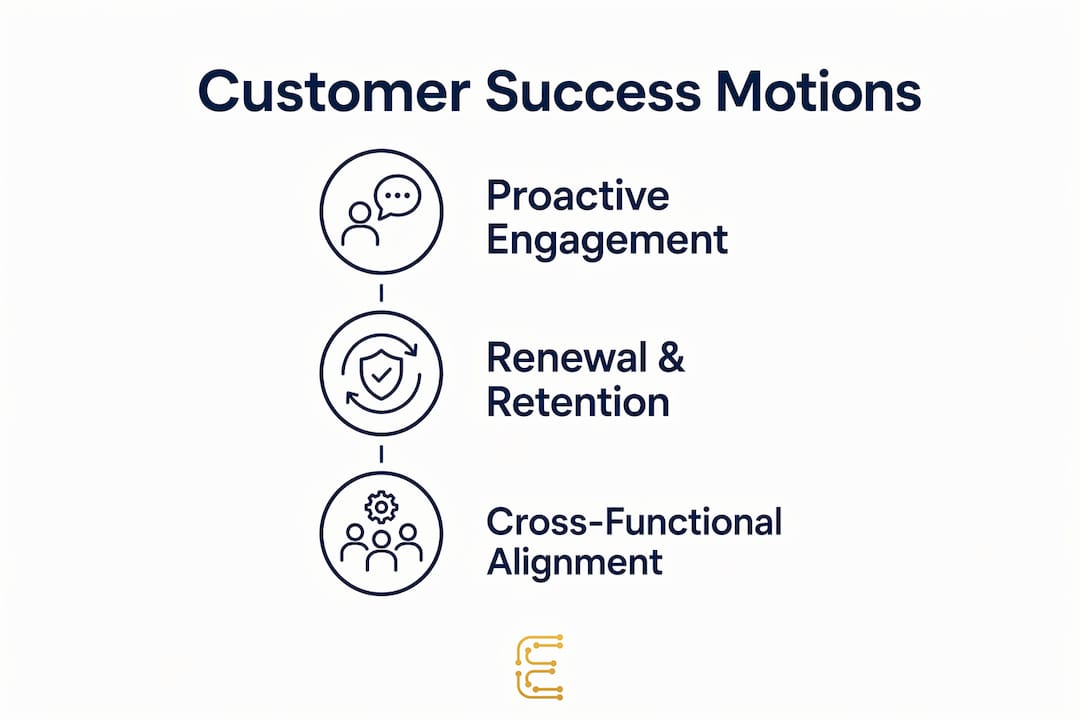
Proactive engagement motion
The proactive engagement motion activates when a customer reaches a defined adoption milestone or, critically, when they fail to reach one. The trigger is behavioral: product telemetry signals that a customer is underusing a feature tied to their stated goal. The CSM then executes a structured outreach sequence, not a check-in call, but a value-centric conversation tied to a specific outcome. The objective is to close the gap between what the customer bought and what they are actually doing with it.
Renewal and retention motion
The renewal motion begins 90 to 120 days before a contract end date. It is not a last-minute negotiation. It is a structured sequence of health checks, stakeholder alignment calls, and value documentation that builds the case for renewal before the customer ever questions it. Teams that treat renewal as a motion rather than an event consistently achieve higher renewal rates because the outcome is engineered, not hoped for.
Cross-functional alignment motion
The cross-functional alignment motion is the least visible and the most underbuilt. It coordinates CS, sales, and product around shared customer data. When a customer signals expansion intent, this motion routes that signal to sales. When a customer reports a product gap, this motion routes it to product with context. Fragmented workflows across tools weaken playbook effectiveness and diminish the customer experience. Shared visibility is what makes orchestration real.
| Motion | Primary trigger | Core objective |
|---|---|---|
| Proactive engagement | Adoption gap or milestone hit | Close value gap, drive product depth |
| Renewal and retention | 90–120 days before contract end | Secure renewal, document ROI |
| Cross-functional alignment | Expansion signal or product gap | Route intelligence to the right team |
How do customer success playbooks operationalize motions?
A customer success playbook is the blueprint that turns a motion concept into a repeatable workflow. It specifies the trigger that starts the motion, the owner responsible for each step, the activities in sequence, and the completion criterion that closes the loop. Without that structure, motions exist only in theory.
Playbooks connect onboarding, renewal, churn mitigation, quarterly business reviews (QBRs), and expansion workflows into a coherent system. Each playbook covers a distinct lifecycle moment, but they share a common architecture: trigger, sequence, owner, outcome. That consistency is what makes them scalable.
The five lifecycle playbooks every SaaS CS team needs are:
- Onboarding playbook. Activates at contract signature. Defines the first 30, 60, and 90-day milestones tied to the customer’s stated success criteria.
- Renewal playbook. Activates 90 to 120 days before renewal. Sequences health scoring, executive alignment, and ROI documentation.
- Churn mitigation playbook. Activates when a health score drops below a defined threshold. Sequences escalation, root cause analysis, and recovery actions.
- QBR playbook. Activates on a quarterly cadence. Structures the agenda around outcome progress, not product updates.
- Expansion playbook. Activates when usage signals or stakeholder conversations indicate unmet needs that a higher tier or add-on could address.
CS leaders recommend treating playbooks as execution sequences, not menus. A CSM should not pick and choose steps. The sequence exists because each step builds on the last. Skipping steps breaks the logic and produces inconsistent outcomes.
Pro Tip: Define completion criteria before you build the activity sequence. If you cannot describe what “done” looks like, the playbook will never close cleanly, and your team will cycle through the same customers indefinitely.
What distinguishes digital customer success motions from traditional models?
A digital customer success motion uses automated triggers, product behavioral data, and self-serve content to execute parts of the motion without direct CSM involvement. The standard industry term for this approach is “digital CS,” and it is frequently misunderstood as simply “low-touch.” That framing is wrong and costly.
Digital CS is not a reduced-service model. It is a scaled infrastructure that integrates automation with human CSM intervention at high-stakes moments. The automation handles routine touchpoints: onboarding email sequences, in-app guidance, health score alerts, and self-serve knowledge delivery. The human CSM handles moments where judgment, relationship, and nuance matter: escalations, renewals, and expansion conversations.
The components of a well-built digital motion include:
- Automated triggers tied to product events (first login, feature activation, inactivity threshold).
- Customer telemetry feeding a health model that scores accounts continuously, not just at renewal.
- Self-serve content delivered in context, so customers get answers without waiting for a CSM.
- Human intervention rules that define exactly when automation hands off to a person.
The risk of digital motions is over-automation. When every touchpoint is automated, customers feel processed rather than served. Digital CS properly integrates automation and human touch to enhance engagement quality, even across large customer bases. The signal that your digital motion is failing is silent churn: customers who stop engaging without ever complaining.
Pro Tip: Build your human intervention rules before you build your automation. Know exactly which health score threshold, which inactivity window, or which support ticket pattern triggers a CSM call. Automation without those rules creates a CX wall your customers cannot get past.
What are best practices for implementing customer success motions?
The most common implementation failure is treating motions as a CS team project rather than a company-wide operating model. Motions that live only inside the CS team produce fragmented customer experiences because sales, product, and support are running parallel, disconnected workflows.
The rule of 40 for CSM account limits is a useful starting constraint, but it is not a ceiling. As you build digital motions, automation absorbs routine touchpoints and frees CSMs to carry more accounts without sacrificing quality. The right number depends on your product complexity, customer segment, and motion maturity.
Metrics that measure motion impact include churn rate, renewal rate, and product adoption. These outcomes confirm whether motions are driving real customer value or just generating activity. Track activity metrics during implementation to diagnose problems, but report outcome metrics to leadership to demonstrate business impact.
Cross-team buy-in is the hardest part of implementation. Sales teams resist sharing account intelligence. Product teams resist attending customer calls. The way through is shared data, not shared meetings. When every team sees the same customer health score and the same motion status, coordination becomes self-evident. Shared visibility is the prerequisite for true cross-functional orchestration.
Iterate motions on a quarterly cadence. Run a motion for 90 days, measure completion rates and outcome metrics, identify the step with the highest drop-off, and redesign that step. Rigid adherence to a motion that is not working is as damaging as having no motion at all. The goal is a system that improves with use, not one that calcifies into bureaucracy. You can find deeper frameworks for this approach on the E-regency blog.
Key takeaways
A customer success motion is the repeatable, trigger-based workflow that converts customer goals into measurable outcomes, and teams that define motions clearly consistently outperform those that rely on reactive support.
| Point | Details |
|---|---|
| Define motions with completion criteria | Every motion needs a clear end state to prevent endless, low-value cycles. |
| Keep CSM accounts under 40 | The rule of 40 preserves service quality; digital motions extend that capacity. |
| Run three core motions | Proactive engagement, renewal, and cross-functional alignment cover the full lifecycle. |
| Treat playbooks as sequences | CSMs must execute every step in order; skipping steps breaks the motion logic. |
| Measure outcomes, not activity | Churn rate, renewal rate, and product adoption confirm real business impact. |
What I’ve learned about motions that most guides won’t tell you
Most articles on customer success motions describe what they are. Few describe why they fail. After working with SaaS founders across growth stages, the pattern is consistent: teams build the motion, skip the completion criteria, and then wonder why the same customers keep appearing in every weekly review.
The firefighting loop is not a workload problem. It is a design problem. When a motion has no defined end state, it never closes. The CSM circles back, the customer grows fatigued, and the team burns out. The fix is not more headcount. It is a single sentence added to every playbook: “This motion is complete when X.”
The second mistake I see constantly is treating the digital motion as a cost-cutting measure. Founders reduce CSM headcount, deploy automation, and call it a digital CS program. What they have actually built is a CX wall. Customers hit automated sequences and cannot reach a human when they need one. Silent churn follows within two quarters.
The balance is not complicated, but it requires discipline. Automate the routine. Protect the human moments. Define both in writing before you build either. The teams that get this right do not just retain customers. They build the kind of NRR that makes their next funding round easier to close.
— Raymond
How E-regency helps SaaS founders build effective success motions
SaaS founders who understand customer success motions conceptually often struggle to operationalize them at speed. E-regency’s advisory services are built for exactly that gap.
E-regency combines predictive AI health modeling with hands-on execution support to help growth-stage SaaS companies design, deploy, and refine their customer success motions. The result is a system that reduces involuntary churn and builds NRR that compounds over time. If you are ready to move from reactive support to a proactive revenue model, the E-regency advisory team is the right starting point. Schedule a consultation and get a motion framework built for your specific growth stage.
FAQ
What is a customer success motion in SaaS?
A customer success motion is a repeatable, trigger-based workflow that guides customers toward specific outcomes with your product. It defines who acts, when, and what the completion criteria are.
What is a digital customer success motion?
A digital customer success motion uses automated triggers, product behavioral data, and self-serve content to execute routine touchpoints at scale, while reserving human CSM involvement for high-stakes moments like renewals and escalations.
How many accounts should a CSM manage?
Industry best practices recommend keeping CSMs under 40 accounts to preserve service quality. Digital motions can extend that capacity by automating routine touchpoints.
What are the core customer success playbooks?
The five core playbooks are onboarding, renewal, churn mitigation, quarterly business reviews, and expansion. Each covers a distinct lifecycle moment with defined triggers and completion criteria.
How do you measure whether a customer success motion is working?
Track churn rate, renewal rate, and product adoption as your primary outcome metrics. If motions are running but these numbers are not improving, the completion criteria or trigger logic needs redesign.