

SaaS Renewal Rate: What Founders Must Know in 2026
SaaS renewal rate is defined as the percentage of customers or revenue that renews subscriptions when contracts expire, making it the clearest signal of whether your product earns its place in a customer’s budget year after year. Unlike vanity metrics that inflate confidence, renewal rate cuts through noise and reveals the true health of your subscription model. Successful SaaS firms maintain renewal rates above 90% to drive sustainable growth. Understanding what is renewal rate SaaS means understanding the engine behind predictable revenue.
What is renewal rate in SaaS and why does it matter?
SaaS renewal rate measures the percentage of eligible customers or contract value that renews at the end of a subscription period. The industry distinguishes two versions: the customer renewal rate, also called the logo renewal rate, and the revenue renewal rate. Both matter, but they tell different stories about your business.
Renewal rates are a primary signal of long-term product-market fit. When renewal rates fall, they quickly expose underlying product gaps, support failures, or misaligned customer expectations. A SaaS company that tracks only new bookings while ignoring renewal rate is filling a leaky bucket without checking the drain.

The importance of renewal rate extends beyond a single number. It connects directly to net revenue retention (NRR), gross revenue retention (GRR), and long-term revenue predictability. Founders who treat renewal rate as a quarterly checkbox rather than an operational discipline consistently underestimate how much silent churn is eroding their base.
How is SaaS renewal rate calculated?
Two formulas define the standard approach to measuring SaaS subscription renewal.
1. Customer (Logo) Renewal Rate
Customer Renewal Rate = (Renewed Customers ÷ Customers Up for Renewal) × 100
This formula counts the number of accounts that chose to renew, divided by the total number of accounts eligible to renew in the period. It tells you how many customers stayed, regardless of contract size.
2. Revenue Renewal Rate
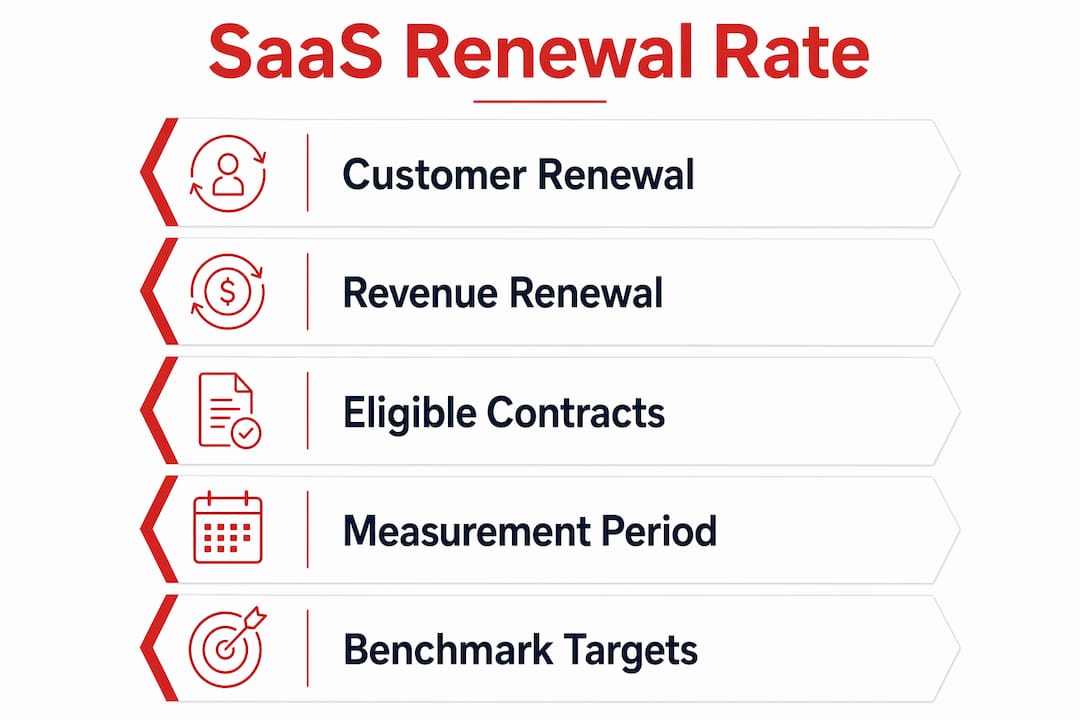
Revenue Renewal Rate = (Renewed Contract Value ÷ Contract Value Up for Renewal) × 100
This formula measures dollars retained at renewal. Revenue renewal rate can exceed 100% when expansions from existing customers surpass the value lost to churn. That means a company can technically report a revenue renewal rate above 100% while still losing customers at the logo level.
3. Defining the eligible renewal population
The denominator is where most founders make mistakes. Only contracts expiring in the exact reporting period should count as eligible renewals. Including mid-cycle churners, early renewals, or accounts outside the window distorts the rate in both directions. A blended or loosely defined denominator produces a number that looks clean in a board deck but means nothing operationally.
4. Measurement period consistency
Monthly, quarterly, and annual measurement periods each serve different purposes. Annual measurement suits enterprise contracts with defined renewal dates. Monthly measurement works better for SMB SaaS with rolling subscriptions. The critical rule is consistency: switching measurement periods mid-year makes trend analysis impossible.
Pro Tip: Audit your denominator before presenting renewal rate to investors or your board. A single definitional error, such as including customers who churned mid-cycle, can shift your reported rate by several percentage points and undermine credibility.
What renewal rate benchmarks should SaaS companies target?
Benchmarks vary significantly by company stage, customer segment, and contract type. Using the wrong benchmark to evaluate your performance leads to false confidence or unnecessary alarm.
Healthy annual logo renewal rates range from 80% to 98% depending on SaaS company stage. The breakdown by stage is specific and useful for founders assessing where they stand.
| Company Stage | Logo Renewal Rate Target | Notes |
|---|---|---|
| Seed | 80–85% | Early product-market fit phase; higher churn expected |
| Series A | 88–92% | Customer success function forming; retention improving |
| Growth | 93–97% | Defined ICP; proactive renewal management in place |
| Scale | 95–98% | Mature CS motion; auto-renewal programs active |
Beyond logo renewal, NRR targets of 120–130% represent top-quartile performance. NRR includes expansion revenue from upsells and cross-sells, so it can exceed 100%. GRR, which excludes expansion, targets 90% or above for enterprise, 85% for mid-market, and 80% for SMB accounts. GRR is the purer measure of retention because it strips out growth effects.
B2B SaaS companies with annual contracts typically report higher renewal rates than B2C SaaS with monthly subscriptions. Annual contracts create natural renewal conversations and give customer success teams time to intervene before a customer decides to leave. Monthly SaaS subscriptions face higher passive churn risk because cancellation requires minimal effort from the customer.
How do renewal rate, churn rate, and retention rate differ?
These three metrics are frequently used interchangeably, but they measure different things. Confusing them produces flawed analysis and misdirected responses.
Renewal rate focuses on customers eligible to renew in a specific period. It is a contract decision event metric. It answers: of the customers whose contracts came up for renewal, how many chose to stay?
Churn rate measures the percentage of customers lost over a period, regardless of whether their contract formally expired. A customer who cancels mid-contract counts in churn but does not appear in the renewal rate denominator. Renewal rate and churn rate sum to 100% for the same eligible cohort, which means improving one directly reduces the other.
Retention rate measures the percentage of customers still active at the end of a period compared to the start. It often includes customers on free plans, trial extensions, or month-to-month arrangements who never face a formal renewal event. This makes retention rate a broader but less precise signal than renewal rate for contract-based SaaS businesses.
Pro Tip: Track all three metrics simultaneously. Logo renewal rate tells you about contract decisions. Churn rate captures mid-cycle losses. Retention rate gives you the broadest view of customer presence. Each one reveals a blind spot the others miss.
What advanced nuances affect renewal rate interpretation?
Renewal rate management gets complicated when you look past the headline number. Several operational distinctions change how you should read and respond to your data.
Auto-renewal vs. negotiated renewal is one of the most underappreciated distinctions in SaaS renewal metrics. A high auto-renewal ratio creates predictable revenue with low cost to serve. Negotiated renewals, even when they close at similar rates, consume significant customer success and sales resources and carry higher risk of contraction or loss. A renewal book where 70% of contracts auto-renew is structurally more stable than one where most renewals require active negotiation.
Revenue renewal masking logo churn is a trap that catches many growth-stage founders. Stable revenue with declining logos signals dangerous concentration risk. If your three largest accounts renew and expand while ten smaller accounts churn, your revenue renewal rate looks healthy. Your logo renewal rate tells the real story. Monitoring both simultaneously is not optional for any SaaS company with a diverse customer base.
The table below compares the key renewal-related metrics and their primary uses.
| Metric | What It Measures | Primary Use Case |
|---|---|---|
| Logo Renewal Rate | % of accounts renewing | Customer base health |
| Revenue Renewal Rate | % of contract value renewing | Revenue predictability |
| Net Revenue Retention (NRR) | Revenue retained + expansion | Growth efficiency signal |
| Gross Revenue Retention (GRR) | Revenue retained, no expansion | Pure churn measurement |
| On-Time Renewal Rate | Renewals closed before expiry | Operational efficiency |
| Contraction at Renewal | Downgrades at renewal event | Expansion health check |
Leading indicators matter as much as the renewal rate itself. Product adoption depth, customer health scores, and executive engagement levels all predict renewal outcomes weeks or months before the contract date arrives. A customer who has not logged in for 60 days and has an unresolved support ticket is a renewal risk, even if their contract does not expire for another quarter. Predictive health modeling, the kind that E-regency applies for its clients, turns these signals into early warnings rather than post-mortems.
How can SaaS founders improve their renewal rate?
Improving renewal rate requires a systematic approach, not a last-minute push before contract expiration. The most effective interventions happen 90 to 120 days before renewal, not 30 days before.
The first discipline is defining and tracking a renewal calendar. Every account with a contract expiring in the next 180 days should have an assigned owner, a health score, and a documented renewal plan. Without this structure, renewal conversations happen reactively and under pressure, which reduces both the rate and the average contract value at renewal.
The second discipline is delivering measurable product value before the renewal conversation starts. Customers renew when they can articulate the return they get from your product. Customer success teams that conduct quarterly business reviews, share usage reports, and connect product outcomes to business goals give customers the language to justify renewal internally. This is especially critical in enterprise SaaS, where the person signing the renewal check is rarely the daily product user.
The third discipline is reducing negotiated renewal exposure. Every negotiated renewal is a risk event. Auto-renewal programs reduce that risk by removing the active cancellation decision from the customer’s path. For SMB SaaS, auto-renewal with clear opt-out terms is standard practice. For enterprise, multi-year contracts with annual payment terms achieve a similar effect.
Pro Tip: The most common pitfall in renewal rate optimization is focusing on the renewal date instead of the customer’s value realization timeline. If a customer has not hit their first meaningful outcome within 90 days of signing, the renewal conversation will be an uphill battle regardless of how good your CS team is.
Feedback loops close the cycle. Customers who do not renew carry the most useful data about product gaps, pricing friction, and support failures. A structured win-loss analysis on churned renewals, reviewed monthly, consistently surfaces patterns that product and CS teams can act on before the next renewal cohort arrives.
Key takeaways
SaaS renewal rate is the most direct measure of whether your product earns continued investment from customers, and tracking it accurately requires clean definitions, consistent measurement periods, and simultaneous monitoring of both logo and revenue renewal rates.
| Point | Details |
|---|---|
| Renewal rate definition | The percentage of eligible customers or contract value that renews at contract expiration. |
| Two formulas matter | Track both logo renewal rate and revenue renewal rate to avoid blind spots. |
| Benchmarks vary by stage | Seed-stage targets 80–85%; scale-stage targets 95–98% logo renewal annually. |
| NRR and GRR are complements | NRR above 120% signals growth; GRR below 80% signals a retention crisis. |
| Early intervention wins | Renewal strategies that start 90–120 days before expiry consistently outperform last-minute efforts. |
The metric that tells you the truth
Renewal rate is the metric that cannot be spun. New ARR can mask a collapsing base. NRR can hide logo churn behind expansion revenue. But logo renewal rate, calculated cleanly against a precisely defined eligible population, tells you exactly what percentage of customers decided your product was worth keeping. That is a hard number to argue with.
What I have seen consistently across SaaS businesses at different stages is that the companies with the highest renewal rates share one trait: they treat renewal as an outcome of the customer relationship, not a sales event. They invest in health scoring, product adoption tracking, and executive engagement long before the renewal date appears on a calendar. The renewal conversation, when it comes, is a formality rather than a negotiation.
The founders who struggle with renewal rate are usually the ones who built a great acquisition motion and assumed retention would follow. It does not. Retention is its own discipline, with its own metrics, its own team structure, and its own operational cadence. Renewal rate is the scorecard for that discipline. If you are not tracking it with the same rigor you apply to pipeline, you are flying blind on the half of your business that determines whether growth is real or just a treadmill.
— Raymond
How E-regency helps SaaS founders master renewal metrics
Renewal rate optimization is not a one-time project. It requires continuous monitoring, clean data infrastructure, and a customer success motion that runs ahead of the renewal calendar rather than behind it.

E-regency works directly with SaaS founders and growth-stage companies to build the systems that drive renewal performance. Clients have achieved over a 20% reduction in gross churn and more than 115% increase in net revenue retention by applying E-regency’s AI advisory approach to customer health modeling and renewal management. If your renewal rate is not where it needs to be, or if you are not certain how to measure it correctly, the right next step is a direct conversation with an advisor who has solved this problem before. Schedule a session to start building a renewal motion that compounds over time.
FAQ
What is a good renewal rate for a SaaS company?
A healthy SaaS renewal rate ranges from 80% to 98% depending on company stage. Scale-stage companies should target 95–98%, while seed-stage companies typically see 80–85%.
How do you calculate SaaS renewal rate?
Divide the number of customers who renewed by the total number of customers eligible to renew in the period, then multiply by 100. Apply the same formula to contract value for the revenue renewal rate.
What is the difference between renewal rate and retention rate?
Renewal rate measures contract decision events for customers whose subscriptions expired. Retention rate measures the broader percentage of customers still active over a period, including those not facing a formal renewal.
Why does revenue renewal rate sometimes exceed 100%?
Revenue renewal rate exceeds 100% when expansion revenue from existing customers, through upsells or seat additions, surpasses the contract value lost to churn in the same period.
How does renewal rate relate to net revenue retention?
NRR builds on revenue renewal rate by adding expansion revenue and subtracting contraction and churn. Top-quartile SaaS companies target NRR of 120–130%, which requires both strong renewal rates and active expansion programs.