

Proactive Customer Success Model for SaaS Growth
TL;DR:
- A proactive customer success model uses data-driven signals, health scores, and playbooks to prevent customer churn. It emphasizes continuous signal collection, clear owner actions, and layered cadences like weekly check-ins and quarterly reviews. Implementing validated health scores and focused playbooks helps SaaS teams improve retention and revenue growth.
A proactive customer success model is defined as a structured, data-driven approach that anticipates customer risk and triggers targeted interventions before churn becomes visible. Growth-stage SaaS companies that adopt this model shift from a firefighting loop, where customer success managers (CSMs) react to cancellations and complaints, to a system that detects warning signals weeks in advance. The core instruments are customer health scores, Quarterly Business Reviews (QBRs), and standardized playbooks. Together, these tools convert raw product telemetry into retention outcomes. E-regency clients who have implemented this approach have seen over a 20% reduction in gross churn and more than 115% increase in net revenue retention (NRR).
What are the essential components of a proactive customer success model?
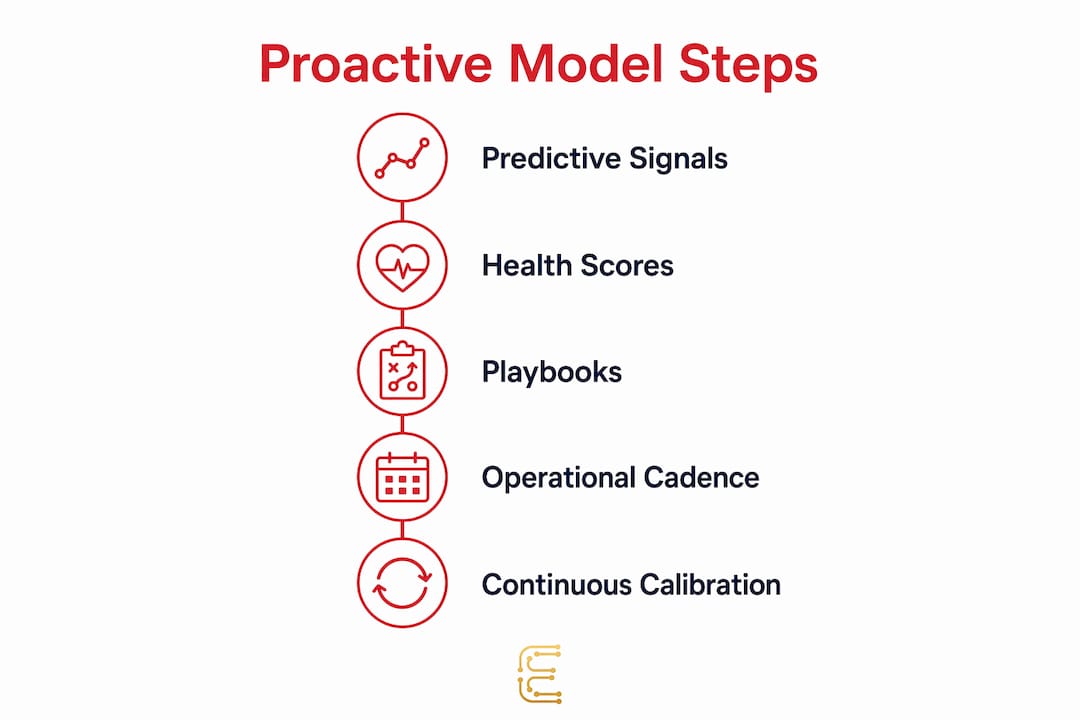
A proactive customer success model requires three interdependent components: predictive data signals, actionable health scores, and standardized playbooks. Remove any one of them and the system degrades. A dashboard without playbooks only raises awareness. A playbook without reliable signals produces random outreach. The combination is what drives consistent retention outcomes.

Predictive data signals
Predictive signals are the raw inputs that tell your team where risk is forming before a customer says a word. The most reliable signals in SaaS are product usage frequency, onboarding completion rate, support ticket volume, and Net Promoter Score (NPS) responses. Proactive CS prevents issues like onboarding stumbles or scheduled outages before customers encounter them. That prevention only works if your signal collection is continuous, not periodic.
Actionable health scores
A health score is only as useful as the actions it forces. Each health or risk input must map to a specific CSM action, or the score becomes noise that generates anxiety without resolution. The classic failure mode is the “watermelon account”: green on the outside, red on the inside, because no one owns the intervention triggered by a declining score. Assign ownership and due dates to every threshold breach.
Standardized playbooks
Playbooks convert health score triggers into repeatable CSM workflows. A playbook for a low onboarding score, for example, specifies the outreach message, the escalation path if there is no response, and the success metric that closes the intervention. Without playbooks, dashboards only raise awareness without driving action. The goal is to remove guesswork from the CSM’s daily decision-making.
Pro Tip: Start by building playbooks for your two or three highest-volume triggers. A fully built playbook for one scenario outperforms a half-built playbook for ten.
How to build and calibrate a customer health score that drives proactive outreach?
Building a valid health score is an engineering problem, not a spreadsheet exercise. The process has four distinct phases: signal selection, weight assignment, backtesting, and quarterly recalibration. Skipping any phase produces a score that looks credible but fails to predict churn accurately.
Phase 1: Select your signals. Pull your last 12 months of churned accounts and identify which behavioral signals preceded cancellation by 60–90 days. Common leading indicators are a drop in daily active users, a spike in support tickets, and a stalled onboarding milestone. These are your candidate signals.
Phase 2: Assign weights. A well-validated weighting model distributes score inputs as follows: product usage at 30%, onboarding at 25%, engagement at 20%, NPS at 15%, and support tickets at 10%. These weights are a starting point, not a universal law. Your own churn data will shift them.
Phase 3: Set thresholds. Accounts scoring below 40 points require immediate intervention. Accounts in the 40–70 range need scheduled outreach within the current week. Accounts above 70 are monitored on a standard cadence. The threshold numbers matter less than the consistency with which your team acts on them.
Phase 4: Backtest and recalibrate. Backtesting uses historical churn data from 60–90 days before churn events to validate whether your signals and weights would have flagged those accounts in time. Run this exercise quarterly. Customer behavior shifts as your product evolves, and a score that was accurate in Q1 can degrade significantly by Q3.
| Phase | Action | Frequency |
|---|---|---|
| Signal selection | Identify leading indicators from churned accounts | At model launch |
| Weight assignment | Distribute score inputs based on churn correlation | At model launch |
| Threshold setting | Define intervention tiers by score range | At model launch |
| Backtesting | Validate signals against historical churn data | Quarterly |
| Recalibration | Adjust weights based on new churn patterns | Quarterly |
Pro Tip: Treat your health score like a product. Version it, document changes, and track whether each recalibration improves your 90-day churn prediction rate.
What operational cadence ensures effective proactive customer success interventions?
Cadence is the delivery mechanism for everything your health score and playbooks produce. Without a structured cadence, even the best signals go unaddressed because no one has a scheduled moment to act on them. Proactive CS operating systems require layered cadence: weekly user check-ins, monthly manager reviews, quarterly executive QBRs, and annual renewal conversations.
Weekly check-ins are brief, product-focused touchpoints between CSMs and end users. Their purpose is to surface friction before it becomes a ticket. Monthly manager reviews shift the conversation to business outcomes: are users adopting the features that drive the value your customer bought? These reviews also serve as an early warning system for executive-level dissatisfaction.
QBRs are the most misunderstood element of this cadence. Most teams run them as status meetings. The most effective QBRs are retention levers. QBRs shift from status meetings to retention levers by featuring measurable business outcomes, forward roadmaps, named commitments, and follow-up on first action items. A QBR that runs 45–90 minutes, with 30 minutes dedicated to outcomes and ROI, gives your customer the evidence they need to justify renewal internally.
The table below compares reactive and proactive cadence structures to illustrate the operational difference:
| Cadence element | Reactive model | Proactive model |
|---|---|---|
| Weekly touchpoint | Triggered by support ticket | Scheduled regardless of ticket volume |
| Monthly review | Skipped if no escalations | Structured around health score trends |
| QBR | Status update on past activity | Outcome review with forward commitments |
| Escalation trigger | Customer complaint | Health score threshold breach |
The critical discipline is integration. Each cadence layer must feed information upward. A friction point surfaced in a weekly check-in should appear in the monthly review and, if unresolved, in the QBR agenda. Effective proactive CS programs dynamically adapt engagement timing and channels based on real-time customer intent, not static schedules. That adaptability only works when your cadence layers are connected.
How to design actionable proactive playbooks and avoid common pitfalls?
A playbook without a resolution path is worse than no playbook at all. It alerts the customer to a problem and then leaves them without a clear next step, which damages trust faster than silence would. Proactive alerts must provide clear next steps and a route for customer or agent follow-up to prevent negative experiences.
The most common pitfall in playbook design is scope creep at launch. Teams try to build playbooks for every possible trigger simultaneously and end up with 15 half-finished workflows. Focusing first on a few high-volume triggers, building end-to-end playbooks, and measuring impact before expanding coverage prevents operational overload. Onboarding stumbles and recurring ticket themes are the right starting points because they are high-frequency and high-impact.
Each playbook should specify four elements: the trigger condition (health score threshold or behavioral signal), the outreach message and channel, the escalation path if the customer does not respond within a defined window, and the success metric that closes the intervention. Without all four, your CSMs will improvise, and improvisation at scale produces inconsistent outcomes.
Pro Tip: Include a “reply path” in every outreach message. Give the customer one specific action to take, whether that is booking a call, completing a tutorial, or replying to confirm receipt. Ambiguous outreach gets ignored.
Quality orchestration in proactive CS means tailoring timing, messaging, and channel selection based on real-time customer behavior. A customer who has not logged in for 14 days needs a different message than one who logs in daily but never uses the core feature. Static batch campaigns underperform compared to adaptive, intent-based outreach. Your playbooks should reflect that distinction from day one.
Key takeaways
A proactive customer success model requires predictive health scoring, standardized playbooks, and a layered operational cadence to consistently reduce churn and grow net revenue retention.
| Point | Details |
|---|---|
| Health score design | Weight product usage, onboarding, NPS, and support tickets; set clear intervention thresholds. |
| Playbook discipline | Map every health score trigger to a specific CSM action with an escalation path and success metric. |
| Layered cadence | Run weekly check-ins, monthly reviews, and QBRs as connected retention instruments, not isolated events. |
| Backtesting is required | Validate and recalibrate your health score quarterly against 60–90 day pre-churn data. |
| Start narrow | Build complete playbooks for two or three high-volume triggers before expanding coverage. |
The health score is an engineering problem, not a dashboard feature
The most common mistake I see growth-stage SaaS teams make is treating the health score as a reporting artifact. They build it once, present it in a board deck, and then let it sit. Six months later, the score no longer reflects actual churn risk because the product has changed, the customer base has matured, and the original signal weights were never validated against real churn data.
The teams that get this right treat health score development as an engineering cycle. They build, test, measure, and recalibrate on a fixed quarterly schedule. They also resist the temptation to add signals before they have validated the ones they already have. A score with five well-tested inputs outperforms a score with fifteen unvalidated ones every time.
QBRs deserve the same discipline. The QBRs that actually reduce churn are the ones where the customer leaves with a written summary of what was decided and a named owner for each commitment. QBRs that focus on measurable ROI and forward commitments transform from mere status updates into powerful retention levers. That transformation does not happen by accident. It requires an agenda built around outcomes, not activity reports.
The last thing I will say is this: internal alignment matters as much as the model itself. If your product, sales, and CS teams are not sharing the same health data and acting on the same playbooks, you will always be fighting the leaky bucket. The model is the easy part. Getting your team to trust it and act on it consistently is where the real work happens. You can read more about the customer experience in SaaS to understand how alignment across teams compounds retention outcomes.
— Raymond
How E-regency helps SaaS teams build proactive retention systems
Growth-stage SaaS companies face a specific challenge: they have enough customers to feel the pain of churn but not enough operational infrastructure to address it systematically. E-regency Advisory was built for exactly that stage.
E-regency combines predictive AI health modeling with hands-on playbook design and cadence implementation. The advisory team works directly with your CS organization to build health scores validated against your own churn data, design intervention playbooks tied to real behavioral triggers, and structure QBR programs that convert renewals from hope into process. If you are ready to move from reactive support to a retention system that compounds over time, schedule a consultation with the E-regency team or learn more about the full range of advisory services available to SaaS founders.
FAQ
What is a proactive customer success model?
A proactive customer success model is a structured approach that uses predictive data signals, health scores, and standardized playbooks to identify and address customer risk before churn occurs. It combines anticipatory outreach with reactive support to cover both predictable failure modes and unique edge cases.
What signals should a SaaS health score include?
A validated SaaS health score weights product usage at 30%, onboarding completion at 25%, engagement at 20%, NPS at 15%, and support ticket volume at 10%. These weights should be backtested against your own historical churn data and recalibrated quarterly.
How often should customer health scores be updated?
Health scores for SaaS models should be updated weekly to reflect current product usage and engagement data. The underlying signal weights and thresholds should be recalibrated quarterly using churn data from the prior 60–90 days.
What makes a QBR a retention tool rather than a status meeting?
A QBR becomes a retention tool when it focuses on measurable business outcomes and ROI, includes a forward roadmap with named commitments, and closes with a written recap sent within 24 hours. Reaching approximately 80% action item closure within 30 days is the benchmark for an effective QBR program.
How do you avoid operational overload when scaling proactive playbooks?
Start with two or three high-volume triggers such as onboarding stumbles or recurring support ticket themes, build complete end-to-end playbooks for those scenarios, and measure save rates before expanding coverage. Scaling before measuring impact is the primary cause of playbook abandonment in growth-stage CS teams.