

Outcome-Based Customer Success: A SaaS Executive Guide
Outcome-based customer success is defined as a customer retention strategy that holds Customer Success teams accountable for delivering the specific, measurable business results customers were promised at the point of sale. Unlike activity-based models that track logins, QBR attendance, or NPS scores, this approach ties every CS motion to a customer’s Desired Business Outcomes (DBOs). Platforms like Gainsight and ChurnZero have built entire product philosophies around this model, and for good reason. When customers achieve their promised outcomes, they renew. When they don’t, no amount of relationship management saves the contract.
What is outcome-based customer success, and why does it matter for SaaS?
Outcome-based customer success is the practice of structuring every CS interaction around whether the customer is progressing toward a defined, measurable business goal. The industry term for this approach is “outcomes-driven customer success,” and it represents a fundamental departure from the relationship-first or activity-first models that dominated SaaS CS teams through the early 2010s.
The core logic is straightforward. A customer buys your product to solve a business problem, not to use a feature. If your CS team measures success by feature adoption or health score without connecting those signals to actual business impact, you are measuring the wrong thing. Customer success focused solely on relationship management quietly bleeds revenue because outcome gaps, not poor communication, are the primary cause of churn. That distinction matters enormously for how you build your CS function.

The strategic value for SaaS companies is compounding. When customers achieve outcomes, they expand. When they expand, Net Revenue Retention (NRR) climbs above 100%, meaning your existing customer base grows revenue without new acquisition spend. That is the financial engine behind the most durable SaaS businesses, and outcome-based success is the mechanism that drives it.
What metrics effectively measure customer success outcomes in SaaS?
The right customer success metrics tell you whether customers are achieving business results, not whether they are busy inside your product. Four metrics define the outcome-focused measurement stack.
Outcome Achievement Rate (OAR) is the single most predictive leading indicator of long-term renewal behavior. It measures the percentage of customers who achieve their promised business outcome within 90 days of going live. OAR outperforms login frequency and NPS because it tracks actual business impact rather than engagement proxies. A customer who logs in daily but never achieves their target outcome is a churn risk regardless of their health score.
Net Revenue Retention (NRR) above 100% means your existing customer revenue base is growing without new customer acquisition. NRR is the most commercially important KPI for customer success because it connects retention, churn, and expansion revenue into a single number that executives and investors understand immediately.
Time to First Value (TTFV) measures how long it takes a customer to reach a meaningful outcome after signing. TTFV is more predictive of long-term retention than activity metrics or health scores because customers who experience value quickly develop a habit of returning to your product for more. Slow time to value is one of the clearest early signals of eventual churn.
Gross Revenue Retention (GRR) captures the floor of your retention performance by measuring revenue retained from existing customers before expansion. GRR tells you how well you protect the base, while NRR tells you how well you grow it.
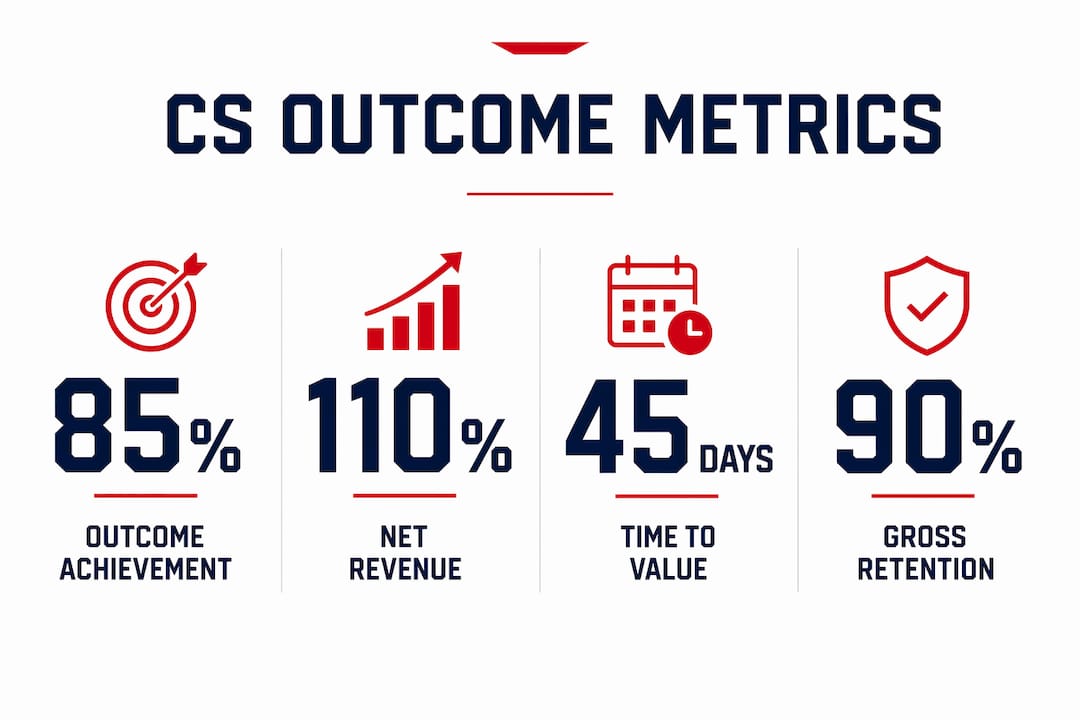
The table below contrasts traditional activity metrics with outcome metrics to show where each falls short or excels.
| Metric type | Example | What it measures | Limitation |
|---|---|---|---|
| Activity metric | Login frequency | Engagement volume | Does not confirm business value delivery |
| Activity metric | NPS score | Customer sentiment | Lags actual churn behavior by weeks |
| Outcome metric | OAR | Business result achievement | Requires clear DBO definition upfront |
| Outcome metric | NRR | Revenue growth from existing base | Lags OAR by one renewal cycle |
| Outcome metric | TTFV | Speed to first meaningful result | Needs product instrumentation to track |
Pro Tip: Set your OAR target before you set your NRR target. OAR is a leading indicator; NRR is a lagging one. If your OAR is declining in Q1, your NRR will reflect that damage in Q3.
70–80% of churning customers show measurable warning signs of outcome failure at least 30 days before cancellation. That 30-day window is not a grace period. It is the intervention window, and proactive CS teams use automated playbooks triggered by outcome-gap signals to close it before the customer decides to leave.
How does outcome-based customer success differ from traditional models?
Traditional CS models fall into two categories: relationship-based and activity-based. Both are well-intentioned and both carry a structural flaw that outcome-based success corrects.
Relationship-based success depends on a champion inside the customer organization. When that champion leaves, the contract becomes vulnerable. Outcome-based success delivers proven business ROI that protects contracts regardless of personnel changes. A customer who can point to $2 million saved or a process accelerated by 20% does not need a personal relationship to justify renewal. The business case speaks for itself. That is what practitioners mean when they say outcome-based contracts are “sticky.”
Activity-based success is the more common failure mode in SaaS. Teams track QBR completion rates, feature adoption percentages, and support ticket resolution times. These metrics feel productive because they generate data. The problem is that none of them confirm whether the customer is getting the business result they paid for. A customer with a 90% feature adoption rate and a completed QBR can still churn if the product is not moving their core KPIs. The activity was real; the outcome was absent.
“The true driver of loyalty is customers achieving their desired outcomes. Poor communication accelerates churn but does not cause it alone.” — B2B Customer Success: Activity vs. Outcomes
The paradigm shift is not just philosophical. It changes how CS teams spend their time, how they structure conversations with customers, and how they report to leadership. Outcome-focused teams spend less time on check-in calls and more time analyzing whether the customer’s business KPIs are moving in the right direction. That shift in attention is where the retention gains come from.
How to implement outcome-based customer success in your SaaS company
Moving from an activity-based model to an outcome-driven one requires deliberate sequencing. The following framework reflects what works in practice.
Step 1: Define Desired Business Outcomes before or at the point of sale. DBOs must be specific, measurable, and tied to the customer’s own business goals, not your product’s feature set. “Reduce manual reporting time by 40%” is a DBO. “Adopt the dashboard module” is a task. Sales and CS must align on DBOs before the contract is signed so the handoff carries clear success criteria.
Step 2: Build outcome-focused Success Plans co-authored with the customer. CS roles transform from usage-focused coaching to strategic partnership when CSMs co-create success plans aligned to executive-level outcomes. These plans replace generic onboarding checklists with milestone-based roadmaps tied directly to the customer’s DBOs. The customer’s leadership team should be able to read the plan and see their own language reflected back at them.
Step 3: Shift CSM roles from usage coaches to outcome strategists. This is the hardest part of the transition. CSMs who have spent years tracking logins and running QBRs need to reframe their entire job description. Their new question is not “Are you using the product?” It is “Is the product moving your business forward?” That reframe requires new skills, new conversation frameworks, and often new hiring criteria.
Step 4: Align OKRs to measurable outcomes, not activity counts. Using OKRs focused on specific outcome improvements drives growth and retention better than activity-based KPIs. A CS team OKR of “complete 100 QBRs this quarter” measures activity. An OKR of “increase OAR from 62% to 75% by end of Q3” measures outcomes. The difference in organizational focus is significant.
Step 5: Build early-warning systems and automated intervention playbooks. Outcome gaps rarely appear overnight. They build over weeks as customers miss milestones or stop progressing toward their DBOs. Automated playbooks triggered by outcome-gap signals, such as a customer who has not reached TTFV within 45 days, allow CS teams to intervene before the customer mentally checks out.
Pro Tip: Use AI call coaching tools to analyze customer conversations for outcome-gap language. Phrases like “we haven’t seen the results yet” or “it’s not quite working as expected” are early-warning signals that automated health scores often miss.
What challenges do teams face when shifting to outcome-based success?
The transition to outcome-focused customer success exposes problems that activity-based models allow teams to ignore. Understanding these obstacles in advance reduces the cost of the shift.
The first challenge is defining authentic outcomes versus proxies. Many teams initially substitute product milestones for business outcomes. “Customer completed onboarding” is not an outcome. “Customer reduced invoice processing time by 30%” is. The discipline required to hold this distinction consistently is harder than it sounds, especially when sales teams have been selling features rather than results.
The second challenge is cultural resistance. CSMs who have built their careers on relationship management often feel threatened by outcome-based accountability. The concern is legitimate. Outcome-based success makes performance more visible and harder to obscure behind activity volume. Leadership must communicate clearly that the shift is about equipping CSMs to do better work, not about penalizing them for a model they inherited.
The third challenge is data infrastructure. Most organizations struggle with outcome-based success because they attempt to measure outcomes using flawed legacy data rather than building new, outcome-specific tracking. Implementing OAR tracking, for example, requires a clear definition of what “achieved outcome” means for each customer segment, instrumentation to detect that moment, and a data pipeline that surfaces it to the CS team in real time.
The fourth challenge is OKR misalignment. CS teams frequently mix tasks with results in their OKRs, listing activities like QBR completion alongside outcome metrics like NRR improvement. That mixing dilutes focus and makes it difficult to evaluate whether the team is actually moving the needle on customer outcomes.
Pro Tip: Audit your current CS OKRs and flag every item that describes an activity rather than a result. If more than half your key results are activity-based, your team is optimizing for the wrong things.
Key takeaways
Outcome-based customer success is the most reliable path to durable SaaS retention because it ties every CS motion to the business results customers were promised at the point of sale.
| Point | Details |
|---|---|
| Define DBOs before the sale closes | Desired Business Outcomes must be specific and measurable before the CS handoff occurs. |
| OAR predicts renewal better than NPS | Outcome Achievement Rate within 90 days is the leading indicator of long-term renewal behavior. |
| Outcome stickiness outlasts champions | Contracts tied to proven ROI survive personnel changes that relationship-based models cannot. |
| Legacy data blocks outcome tracking | Building new outcome-specific data infrastructure is required, not optional, for this model to work. |
| OKRs must reflect results, not activity | Mixing tasks and outcomes in CS OKRs dilutes focus and undermines the entire framework. |
Why outcome-based success is the only model worth building on
I have worked with enough SaaS CS teams to recognize a pattern. The teams that struggle most with retention are not the ones with poor relationships or low engagement scores. They are the ones that have never clearly defined what success looks like for their customers. They are running a firefighting loop, responding to churn signals after the customer has already decided to leave, because they built their entire CS function around activity rather than impact.
The shift to outcome-based success is not a tactical adjustment. It is a structural one. It forces alignment between sales, product, and CS around a shared definition of value. It exposes gaps in sales messaging and product-market fit that activity-based models allow leadership to ignore. That exposure is uncomfortable, but it is also the most valuable diagnostic a SaaS company can run on itself.
The CSMs who thrive in this model are the ones who stop thinking of themselves as account managers and start thinking of themselves as business partners. Their customers’ KPIs become their KPIs. That shift in identity is what separates CS teams that drive expansion revenue from those that merely prevent cancellations. The CRM and retention data consistently shows that customers who achieve measurable outcomes expand at significantly higher rates than those who simply remain engaged.
The executives I respect most in this space have stopped asking “Are our customers happy?” and started asking “Are our customers succeeding?” Those are different questions, and the second one is the only one that predicts the future.
— Raymond
How E-regency accelerates your outcome-based customer success strategy
Building an outcome-based CS function from scratch is one of the most complex operational shifts a SaaS company can undertake. E-regency specializes in exactly this transition, blending predictive AI health-modeling with hands-on execution to help growth-stage SaaS companies move from reactive support to proactive revenue generation. Clients have reported gross churn reductions of over 20% and NRR increases above 115% after implementing E-regency’s outcome-focused frameworks.
If your CS team is still measuring success by activity volume rather than business outcomes, the gap between where you are and where you need to be is costing you revenue today. E-regency’s retention strategy optimization service builds the metrics, playbooks, and CSM frameworks your team needs to make the shift. You can also schedule a strategy session to assess your current CS model and identify the highest-impact changes available to your organization right now.
FAQ
What is outcome-based customer success in SaaS?
Outcome-based customer success is a CS model that holds teams accountable for delivering the specific, measurable business results customers were promised at the point of sale, rather than tracking activity metrics like logins or QBR completion rates.
How is Outcome Achievement Rate calculated?
Outcome Achievement Rate (OAR) measures the percentage of customers who achieve their promised business outcome within 90 days of going live. It is widely recognized as the single most predictive leading indicator of long-term renewal behavior.
Why does outcome-based success reduce churn more effectively than relationship-based models?
Outcome-based success ties contract value to proven business ROI rather than personal relationships. When a customer champion leaves, a contract backed by measurable results survives; one backed only by relationships often does not.
What is the first step to implementing outcome-based customer success?
The first step is defining Desired Business Outcomes (DBOs) before or at the point of sale. DBOs must be specific, measurable, and tied to the customer’s own business goals so the CS team has clear success criteria from day one.
How do OKRs support outcome-based customer success?
OKRs aligned to measurable business outcomes, such as increasing OAR or NRR, drive better retention results than activity-based KPIs. The key is keeping key results focused on business impact and separating them from task-based activity metrics.