

Expansion Revenue's Role in NRR: A SaaS Finance Guide
Expansion revenue is defined as incremental recurring revenue generated from existing customers through upsells, seat additions, usage growth, and cross-sells. Its role in net revenue retention (NRR) is singular: expansion revenue is the only component in the NRR formula that can push the metric above 100%, making it the primary engine of compounding SaaS growth. While Stripe, Gainsight, and Snowflake have each demonstrated this dynamic at scale, the mechanics and operational discipline behind expansion revenue remain widely misunderstood by finance teams and SaaS leaders alike.
How does expansion revenue mathematically impact NRR?
The NRR formula is straightforward: Starting MRR plus Expansion MRR, minus Contraction MRR, minus Churn MRR, divided by Starting MRR, multiplied by 100. Expansion MRR sits in the numerator as an additive force. Every other variable either holds revenue flat or reduces it.
This structure has a critical implication. When expansion MRR exceeds the combined total of churn and contraction MRR, NRR rises above 100%. That means a SaaS business can lose customers and still grow revenue from its existing base. No other metric captures this dynamic as clearly.

Gross Revenue Retention (GRR) tells a different story. GRR excludes expansion entirely and caps at 100%, measuring only how much revenue survives after churn and contraction. The gap between NRR and GRR directly quantifies expansion revenue’s contribution. A business with 95% GRR and 115% NRR is generating enough expansion to not only cover losses but grow net revenue by 15% from its existing cohort.
Pro Tip: Never evaluate NRR in isolation. Read it alongside GRR to separate expansion performance from pure retention health. A high NRR built on a weak GRR signals a fragile foundation.
What are the main sources of expansion revenue in SaaS?
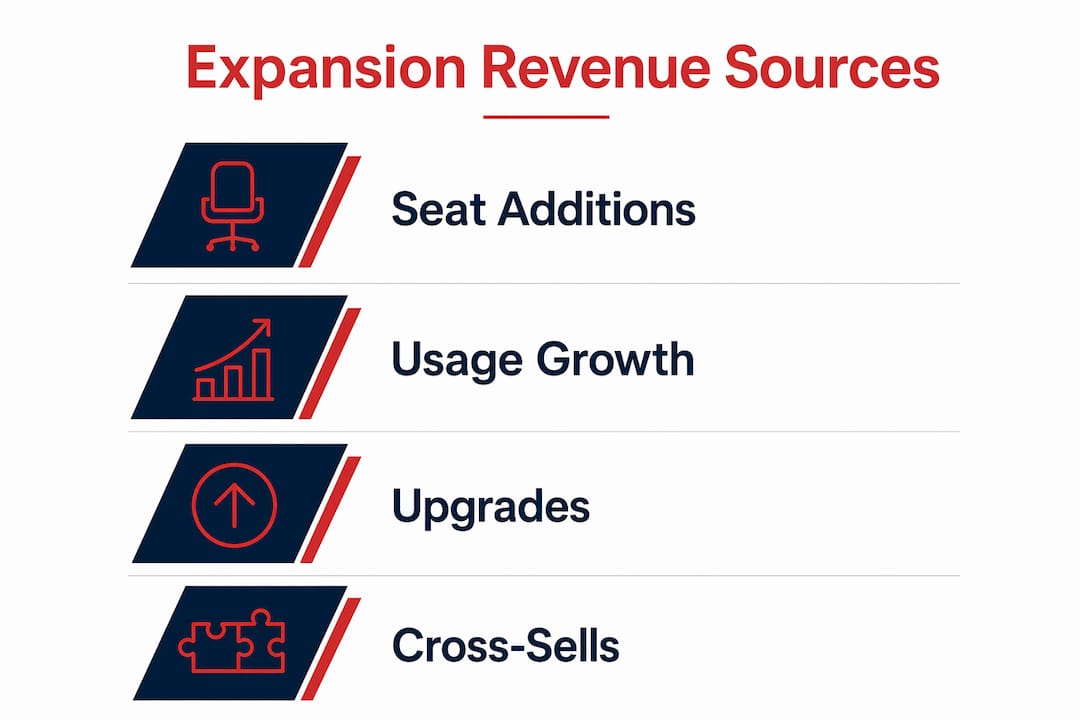
Expansion revenue in SaaS comes from four primary sources, each tied to distinct customer behaviors and pricing structures. Understanding which source drives your expansion MRR determines how you build the systems to grow it.
The first source is seat additions. As teams grow inside a customer account, additional licenses generate predictable, recurring expansion. The second is tier upgrades, where customers move from a lower plan to a higher one as their usage or feature needs increase. The third is usage-based growth, where consumption models automatically expand revenue as customers use more compute, API calls, or data storage. The fourth is cross-sells, where adjacent product modules or services are added to an existing contract.
Timing is the variable most SaaS teams underestimate. Expansion conversations triggered by behavioral signals, such as a customer approaching a usage cap or activating a new feature set, convert at significantly higher rates than calendar-driven outreach. A customer who just hit 90% of their storage limit is primed for an upgrade conversation. A customer who received an arbitrary renewal email is not.
Pricing and packaging architecture also determines how much expansion revenue is structurally possible. Tiered plans with clear value thresholds and usage-based pricing models create natural expansion paths. Flat-rate pricing with no usage ceiling eliminates them entirely.
Pro Tip: Map your product’s natural usage milestones to your pricing tiers. If customers routinely hit limits before they reach the next tier, you have an expansion gap. Fix the packaging before you train the team.
How does expansion revenue affect SaaS profitability and valuation?
Expansion revenue grows revenue from existing customers at a fraction of the cost of acquiring new ones. Generating a dollar from an existing customer through expansion consistently requires less spend than acquiring a new customer from scratch. That cost differential compounds over time, improving unit economics across the entire customer base.
The downstream effect on valuation is material. NRR above 100% correlates with higher Enterprise Value to Revenue multiples compared to businesses operating below that threshold. Investors treat high NRR as evidence of product stickiness, pricing power, and a self-reinforcing growth engine. Snowflake’s consumption-based model, which generates expansion revenue automatically as customers process more data, has been cited repeatedly as a benchmark for this dynamic.
Expansion revenue also produces what finance teams call net negative churn. When expansion MRR from existing customers exceeds revenue lost to churn and contraction, the cohort grows in revenue terms even as it shrinks in customer count. That condition creates revenue predictability that new customer acquisition alone cannot replicate.
“Investors and boards focus on NRR because it blends defensive retention with offensive expansion revenue, making expansion revenue integral to SaaS compounding growth.” — Stripe
What pitfalls should finance leaders watch for in expansion-driven NRR?
A high NRR number can conceal serious problems. A 115% NRR paired with a 75% GRR means expansion revenue is masking significant underlying churn. The business is losing a large share of its customer base and compensating by extracting more revenue from the customers who remain. That is not a sustainable growth model. It is a warning sign.
Finance leaders should track expansion MRR by source and by cohort, not as a single aggregate figure. Reconciling expansion MRR at the source level, separating upsells from seat adds from usage growth, reveals which expansion motions are actually working and which are inflating the headline number through one-time true-ups or contract adjustments.
Measurement discipline matters as much as the metric itself. Mixing company-wide revenue data with cohort-based NRR calculations produces inaccurate conclusions. NRR must be calculated on a fixed cohort over a defined period, excluding new customers added during that window. Without that discipline, expansion revenue appears to drive NRR improvement when the actual driver is new customer revenue being misclassified.
Durable expansion also differs from manufactured expansion. Discounting to trigger an upgrade before a renewal deadline inflates expansion MRR in the short term. Expansion driven by genuine product adoption, such as usage approaching natural limits or new feature activation, produces revenue that holds through subsequent periods.
How to operationalize expansion revenue strategies for stronger NRR
The most effective expansion programs start with data. Customer health scores built from product usage telemetry, support ticket frequency, login patterns, and feature adoption rates identify which accounts are ready for an expansion conversation and which need stabilization first. Approaching an at-risk account with an upsell pitch accelerates churn rather than preventing it.
Customer success manager (CSM) incentive structures shape behavior in ways that either support or undermine expansion. Tying CSM compensation partly to expansion MRR aligns their work with revenue outcomes. The risk is that aggressive expansion targets push CSMs toward premature upsell conversations that damage trust. The balance is achieved by gating expansion conversations on health score thresholds, not on calendar dates.
Cross-functional alignment between Revenue Operations, Finance, Customer Success, and Product is what separates teams that generate consistent expansion from those that generate occasional wins. RevOps owns the data infrastructure and attribution. Finance sets the cohort definitions and measurement standards. Customer Success executes the conversations. Product builds the usage triggers and packaging that make expansion feel natural rather than forced.
Pricing experiments are underused in most SaaS organizations. Testing usage-based pricing tiers, add-on module pricing, and seat-based scaling within existing accounts generates direct evidence of what customers will pay for. That evidence informs both product roadmap decisions and the expansion playbook that CSMs use in the field.
Key takeaways
Expansion revenue is the only NRR component that drives the metric above 100%, making it the defining factor in sustainable SaaS revenue growth.
| Point | Details |
|---|---|
| Expansion drives NRR above 100% | Only expansion MRR can push the NRR numerator beyond the starting baseline. |
| NRR and GRR must be read together | The gap between NRR and GRR reveals exactly how much expansion is contributing to retention. |
| Behavioral signals outperform calendars | Expansion triggered by usage limits and feature adoption is more durable than date-driven upsells. |
| Cohort discipline prevents misreading | NRR must exclude new customers and track fixed cohorts to accurately reflect expansion impact. |
| Unit economics favor expansion | Growing revenue from existing customers costs less than acquiring new ones, improving overall profitability. |
What I’ve learned about expansion revenue that most articles skip
The conversation around expansion revenue tends to focus on tactics: upsell playbooks, pricing tiers, CSM scripts. Those matter. But the more consequential question is whether your organization has built the measurement infrastructure to know if expansion is actually working or just appearing to work.
I’ve seen SaaS finance teams celebrate a 120% NRR without noticing that their GRR had dropped to 72% over the same period. The expansion revenue was real. The underlying customer base was eroding. The two facts coexisted because no one was tracking them side by side with consistent cohort definitions.
The other pattern I see consistently is expansion revenue that is structurally impossible to generate because of how the product was priced at launch. Flat-rate pricing with unlimited usage feels customer-friendly. It also eliminates every natural expansion trigger. By the time a growth-stage company realizes the problem, repricing existing customers is politically and contractually difficult.
The leaders who get this right build expansion into the product and pricing architecture from the beginning. They treat customer usage signals as revenue intelligence, not just product analytics. And they measure NRR with the same rigor they apply to their financial statements, not as a marketing number for investor decks.
— Raymond
How E-regency helps SaaS leaders build expansion-driven NRR
SaaS leaders who want to move from reactive retention to proactive expansion revenue growth need more than a playbook. They need real-time customer data analysis, cohort-level NRR tracking, and a clear view of which accounts are ready to expand and which are at risk.

E-regency Advisory combines predictive AI health modeling with hands-on execution to help SaaS founders and finance teams identify expansion opportunities before they expire. Clients working with E-regency have seen more than a 115% increase in net revenue retention by aligning customer success motions with product usage signals. If your NRR is not reflecting the expansion potential inside your existing accounts, the E-regency advisory platform is built to close that gap. You can schedule a consultation to see where your expansion revenue strategy stands today.
FAQ
What is the role of expansion revenue in NRR?
Expansion revenue is the additive component in the NRR formula that allows the metric to exceed 100%. It represents incremental recurring revenue from existing customers through upsells, seat additions, usage growth, and cross-sells.
How does expansion revenue differ from new revenue in NRR calculations?
New customer revenue is excluded from NRR calculations entirely. NRR measures only what happens within a fixed cohort of existing customers, so expansion revenue from that cohort is the sole growth driver inside the metric.
What is a healthy NRR benchmark for SaaS companies?
NRR above 100% is the standard threshold for healthy SaaS growth. Businesses with NRR consistently above 110–120% are typically generating enough expansion to compound revenue from their existing base without relying solely on new customer acquisition.
Why can high NRR be misleading without GRR context?
A high NRR can mask significant underlying churn if expansion revenue is disproportionately large. Gainsight notes that a 115% NRR paired with a 75% GRR signals that expansion is covering serious retention losses, which is not a sustainable position.
How should SaaS teams track expansion MRR accurately?
Expansion MRR should be tracked by source, including upsells, seat additions, and usage growth, within consistent cohort definitions. Mixing company-wide revenue data with cohort-based NRR metrics produces inaccurate conclusions about expansion revenue’s true impact.