

Customer Data Actionable Strategy to Reduce Churn
TL;DR:
- A customer data actionable strategy converts customer information into targeted decisions that reduce churn and grow revenue. Most strategies fail due to organizational issues like unclear ownership and fragmented identity resolution rather than technology limitations. Regular 90-day reviews and integrating insights into workflows are essential for a successful customer analytics program.
A customer data actionable strategy is the systematic plan that turns customer information into targeted business decisions that reduce churn and grow revenue retention. The industry term for this discipline is customer analytics strategy, and the two phrases describe the same practice: connecting data signals to specific, owned actions with measurable outcomes. Setting measurable goals such as a 15% churn reduction before choosing any technology is the defining first step. Without that anchor, data programs drift into reporting exercises that inform no one and change nothing. E-regency works with growth-stage SaaS companies to close exactly that gap, turning customer telemetry into revenue decisions rather than dashboard noise.
What are the essential components of a customer data actionable strategy?
The foundation of any effective customer analytics strategy is a clear business outcome, not a technology stack. A phased 12-month roadmap that moves from diagnosing data fragmentation to unified activation gives teams a concrete sequence to follow. Skipping this sequence is how organizations end up with expensive platforms and no measurable change in net revenue retention (NRR).
Five components determine whether a data strategy produces action or just reports.
Business outcome alignment. Define the specific metric you want to move before touching data architecture. Churn rate, NRR, and repeat purchase rate are the most common anchors for customer success teams. Every downstream data decision should trace back to one of these outcomes.
Customer journey data mapping. Map which data signals correspond to each stage of the customer lifecycle. Onboarding engagement scores, feature adoption rates, and support ticket frequency each tell a different part of the retention story. Gaps in this map become blind spots in your predictive health modeling.

Federated governance. Governance does not mean a central data team that owns everything. A federated model assigns data stewards within each business unit while maintaining shared standards for quality, privacy, and compliance. This keeps data programs moving without creating bottlenecks.
Identity resolution. Linking customer records across CRM, product, billing, and support systems is the mandatory foundation before any advanced modeling. Fragmented identity produces inaccurate churn predictions and wasted intervention budgets.
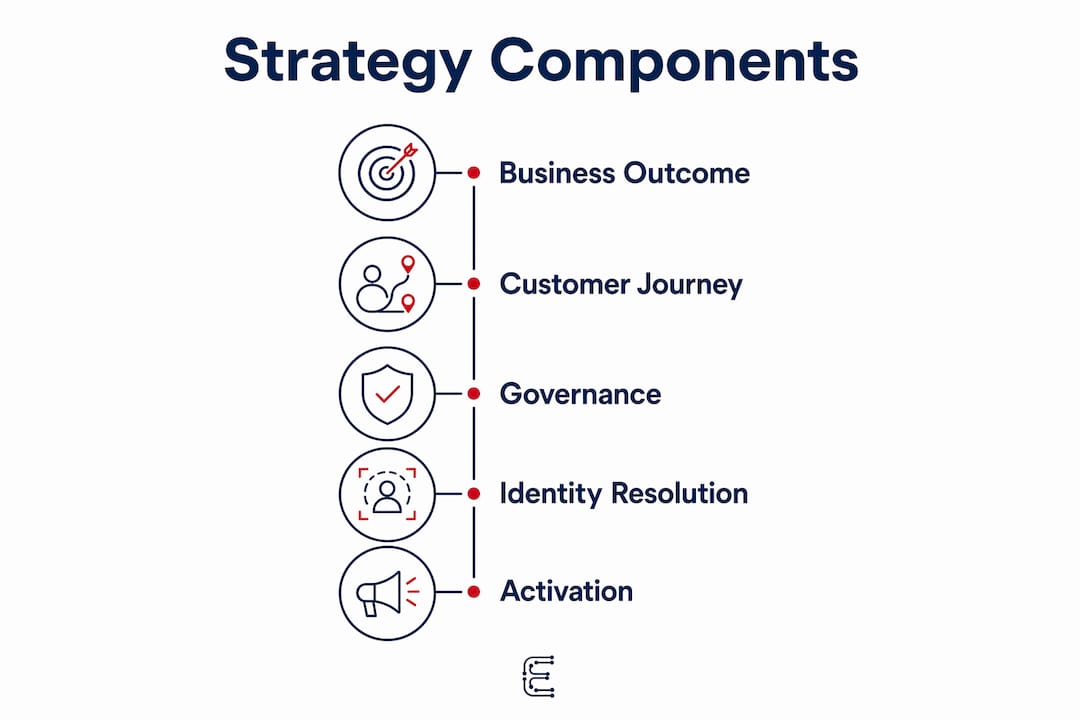
Intelligence and activation. Predictive analytics tied directly to business goals converts unified data into churn likelihood scores, next-best-action recommendations, and expansion signals. Activation means those scores reach the right team member at the right moment through automated orchestration across channels.
Pro Tip: Build your identity resolution layer in the first 90 days. Every predictive model you build afterward will be only as reliable as the customer records feeding it.
How to create actionable insights from customer data that drive decisions
The most common mistake in data-driven marketing strategy is starting with datasets instead of decisions. Before pulling a single report, ask: what decision will this data inform, and who will make that decision? That question filters out the majority of analysis that consumes analyst time without changing any business outcome.
A four-step process converts raw customer data into decisions.
-
Organize data into themes. Group signals by customer behavior category: onboarding, adoption, support, and renewal. Themes prevent the “leaky bucket” problem where teams react to individual data points rather than patterns. Grouping by theme is the first step toward insights that prescribe action rather than describe history.
-
Identify patterns within themes. Look for recurring sequences, not one-off anomalies. Customers who log in fewer than three times in their first 30 days and never contact support represent a pattern of silent churn in progress. A single low-login event is noise; the recurring sequence is a signal.
-
Extract root causes. Pattern identification tells you what is happening. Root cause analysis tells you why. A drop in feature adoption after a product update points to a UX friction issue, not a customer success failure. The distinction changes which team owns the fix.
-
Connect to measurable goals. Every insight must link to a KPI. If the insight does not move churn rate, NRR, or expansion revenue, it belongs in a research backlog, not an action queue.
Actionable insights must be specific, timely, and owned. If any one of those three qualities is missing, the insight is informational at best and noise at worst. Specificity means the insight names a customer segment and a behavior. Timeliness means the insight reaches the owner while intervention is still possible. Ownership means one person is accountable for the next step.
Apply the “so what? / now what?” filter to every insight before it leaves the analytics team. “So what?” confirms the business relevance. “Now what?” confirms there is a clear, time-bound action with an accountable owner. Insights that fail either test go back for refinement, not into a report.
Pro Tip: Co-create insights with customer success, sales, and product teams. Analysts who build in isolation produce insights that operators ignore. Shared creation produces shared accountability.
Closing the feedback loop is the step most teams skip. After an action is taken based on an insight, track whether the predicted outcome materialized. This loop is what separates a data program that learns from one that repeats the same analysis every quarter.
What are best practices to activate and operationalize your data strategy?
Activation is where most data strategies stall. The insights exist, but they never reach the customer success manager, the marketing automation platform, or the renewal conversation. Operationalizing a customer analytics strategy requires connecting intelligence to workflow, not just to dashboards.
A unified customer database can improve marketing efficiency by excluding 40% of customers from irrelevant targeting. That exclusion matters because irrelevant outreach accelerates silent churn. Customers who receive generic communications disengage faster than those who receive none at all.
The following practices move a data strategy from analysis to execution.
Activate unified customer profiles across channels. Static demographic segments produce static results. Moving to dynamic segments powered by behavioral data improves both conversion and retention. A customer who just hit a usage milestone needs an expansion conversation, not a renewal reminder.
Design automated journeys for anchor lifecycle stages. Onboarding, adoption, and renewal are the three stages where churn risk concentrates. Automated journeys triggered by behavioral signals, not calendar dates, reach customers at the moment of highest relevance.
Use predictive scores in human workflows. Churn likelihood scores and next-best-action recommendations are only useful if a customer success manager sees them before the renewal call, not after. Embed scores directly into CRM views and customer health dashboards.
Maintain human oversight in AI-powered personalization. Predictive health modeling surfaces risk, but a human escalation path handles the accounts where relationship context matters more than any score. The firefighting loop breaks when AI flags the risk and a human owns the response.
Iterate in 90-day learning cycles. Measure KPI movement at 90-day intervals, adjust the model inputs, and re-prioritize the action queue. This cadence prevents the common failure of building a strategy once and treating it as permanent.
| Activation Layer | Key Action | Primary KPI |
|---|---|---|
| Identity resolution | Link records across CRM, product, billing | Data accuracy rate |
| Segmentation | Shift to behavioral dynamic segments | Engagement rate by segment |
| Automated journeys | Trigger by behavior, not calendar date | Onboarding completion rate |
| Predictive scoring | Embed churn scores in CSM workflows | Churn rate reduction |
| Feedback loop | Track action outcomes at 90-day intervals | NRR improvement |
What common pitfalls prevent customer data strategies from becoming actionable?
The most expensive failure in customer analytics is treating the entire program as a technology project. The bottleneck in turning data into revenue is almost always organizational, not technical. A new customer data platform does not fix a team that has no clear owner for the insights it produces.
“Many organizations fail by treating customer data strategy as a tech project instead of a human-led business initiative with clear ownership and governance. This failure undermines adoption and impact.”
Six organizational pitfalls consistently derail data programs before they produce results.
No defined ownership for recurring insights. When an insight belongs to everyone, it belongs to no one. Every recurring insight needs a named owner, a response protocol, and a deadline. Without these, insights accumulate in reports and expire unused.
Fragmented identity resolution. Skipping the identity layer means predictive models run on incomplete customer records. Inaccurate predictions lead to misallocated intervention budgets and missed churn signals. This is the most technically avoidable failure and the most commonly skipped step.
Governance treated as a compliance checkbox. Data governance that exists only to satisfy legal requirements does not produce data quality. Federated governance with active stewardship produces the clean, consistent data that makes predictive health modeling reliable.
Ignoring the feedback loop. Teams that act on insights but never measure outcomes cannot improve their models. The absence of a feedback loop turns a data strategy into a static reporting function rather than a learning system.
Collecting data without a decision map. Excessive data collection without a clear map of which decisions each dataset informs creates noise, not intelligence. Every data source should trace to at least one business decision. If it does not, the collection cost is waste.
Neglecting adoption. The most sophisticated customer telemetry system fails if customer success managers do not trust or use its outputs. Adoption requires training, visible wins, and leadership reinforcement, not just a software rollout.
Key Takeaways
A customer data actionable strategy succeeds only when clear business outcomes, named ownership, and behavioral activation work together as a system, not as separate initiatives.
| Point | Details |
|---|---|
| Outcomes before technology | Define the specific KPI you want to move before selecting any data platform or tool. |
| Identity resolution first | Link customer records across all systems before building predictive models or churn scores. |
| Insights need three qualities | Every insight must be specific, timely, and assigned to a named owner to drive action. |
| Activation requires workflow integration | Embed churn scores and next-best-action signals directly into CSM and marketing workflows. |
| Iterate every 90 days | Measure KPI movement, adjust model inputs, and re-prioritize the action queue on a 90-day cycle. |
The gap I keep seeing between data and decisions
The organizations I work with rarely have a data shortage. They have a decision shortage. Dashboards are full. Action queues are empty. That gap is a leadership problem, not an analytics problem.
What I have found consistently is that the teams making the most progress on churn reduction are not the ones with the most sophisticated platforms. They are the ones where a specific person is accountable for each insight, where that person has a protocol to follow, and where outcomes are reviewed on a fixed cadence. The technology is secondary to that structure.
The other pattern I see is an over-reliance on demographic segmentation long after behavioral data is available. Moving from “enterprise customers in the healthcare vertical” to “customers who completed onboarding but have not used the core feature in 14 days” changes the entire conversation. The second segment tells you exactly who to call and what to say. The first tells you almost nothing about what to do next.
Identity resolution is the step I advocate for most aggressively in early engagements. Teams want to skip it because it is unglamorous work. But every predictive model built on fragmented records produces fragmented predictions. Getting this right in the first 90 days pays compounding returns for every model built afterward.
The last thing I will say: measurement discipline separates programs that improve from programs that plateau. If you act on an insight and never check whether the action worked, you are not running a data strategy. You are running a hypothesis with no feedback. Close the loop, even when the results are uncomfortable.
— Raymond
How E-regency helps you close the data-to-action gap
E-regency Advisory works with SaaS founders and customer success leaders who know their data holds retention answers but cannot get those answers into the hands of the people who need them. The advisory practice connects AI-driven customer insights to the workflows, ownership structures, and measurement cadences that make those insights produce results.

Clients who work with E-regency on retention strategy optimization have seen over a 20% reduction in gross churn and more than 115% increase in net revenue retention. Those outcomes come from building the identity layer correctly, activating behavioral segments across channels, and holding teams accountable to 90-day iteration cycles. If your data program is producing reports but not decisions, a focused advisory engagement is the fastest path to changing that. Schedule a conversation to see where the gap is in your current strategy.
FAQ
What is a customer data actionable strategy?
A customer data actionable strategy is a plan that converts customer information into specific, owned business decisions with measurable outcomes. It connects data signals to actions that reduce churn and improve revenue retention.
Why do most customer data strategies fail to produce results?
Most failures are organizational, not technical. Teams treat data programs as technology projects without assigning clear ownership, governance, or action protocols to the insights they generate.
What does identity resolution mean in a data strategy?
Identity resolution is the process of linking a single customer’s records across CRM, product, billing, and support systems into one unified profile. Without it, predictive models run on incomplete data and produce unreliable churn scores.
How do I know if an insight is truly actionable?
Apply the “so what? / now what?” test. An insight is actionable when it names a specific segment, arrives while intervention is still possible, and has a named owner with a time-bound next step.
How often should a customer data strategy be reviewed?
A 90-day iteration cycle is the standard cadence for measuring KPI movement, adjusting model inputs, and re-prioritizing the action queue. Annual reviews are too infrequent to catch drift in customer behavior patterns.