

Customer Activation in SaaS: What Founders Must Know
TL;DR:
- Customer activation in SaaS is the point when a user first recognizes your product’s value through specific behaviors. This milestone predicts long-term retention and is distinct from onboarding completion or engagement. Improving activation rates by 25% can lead to a 34% increase in annual revenue.
Customer activation in SaaS is defined as the moment a new user experiences the core value of your product for the first time, crossing a behavioral threshold that separates retained customers from those who quietly disappear. This is not the same as onboarding completion. Activation is a milestone, not a process, typically reached through a sequence of 3–5 incremental steps that move a user from signup to genuine product engagement. SaaS founders who conflate activation with account setup are operating with a leaky bucket. They fill the top of the funnel while value drains out the bottom before customers ever reach the point of no return.
What is customer activation in SaaS and why does it define retention?
Customer activation is the industry term for the transition point where a user stops being a prospect and starts being a customer in the truest sense. The activation moment is a specific, observable behavior that signals a user has recognized your product’s value on their own terms. It is not completing a profile, confirming an email, or watching an onboarding video. Those are setup actions. Activation is the first time a user completes their first campaign in a marketing tool, invites a teammate in a collaboration platform, or generates a report in an analytics product.

The distinction matters because value-mapped onboarding steps produce meaningfully better completion rates than generic instructions. When every step in your onboarding sequence connects to a business outcome the customer can name, they move faster and drop off less. A user who understands why they are completing a step is far more likely to complete it than one following a checklist with no context.
Activation also differs from engagement. Engagement is broad and ongoing. Activation is a precise moment in time. Once a customer crosses that threshold, their probability of churning drops significantly. That is why customer success teams at growth-stage SaaS companies treat the activation moment as the single most important event in the early customer lifecycle.
Pro Tip: Map your activation moment by analyzing the behavioral patterns of your best retained customers. Find the one action they all completed within their first two weeks that churned users never did. That action is your activation event.
What is the activation moment and why does it matter in SaaS?
The activation moment is a specific behavioral milestone that marks successful value realization, not just product familiarity. Activation requires mapping every onboarding step explicitly to a customer-recognized value, not just to a product feature. This is the critical gap most SaaS teams miss. They build onboarding flows around their product architecture rather than around the customer’s desired outcome.
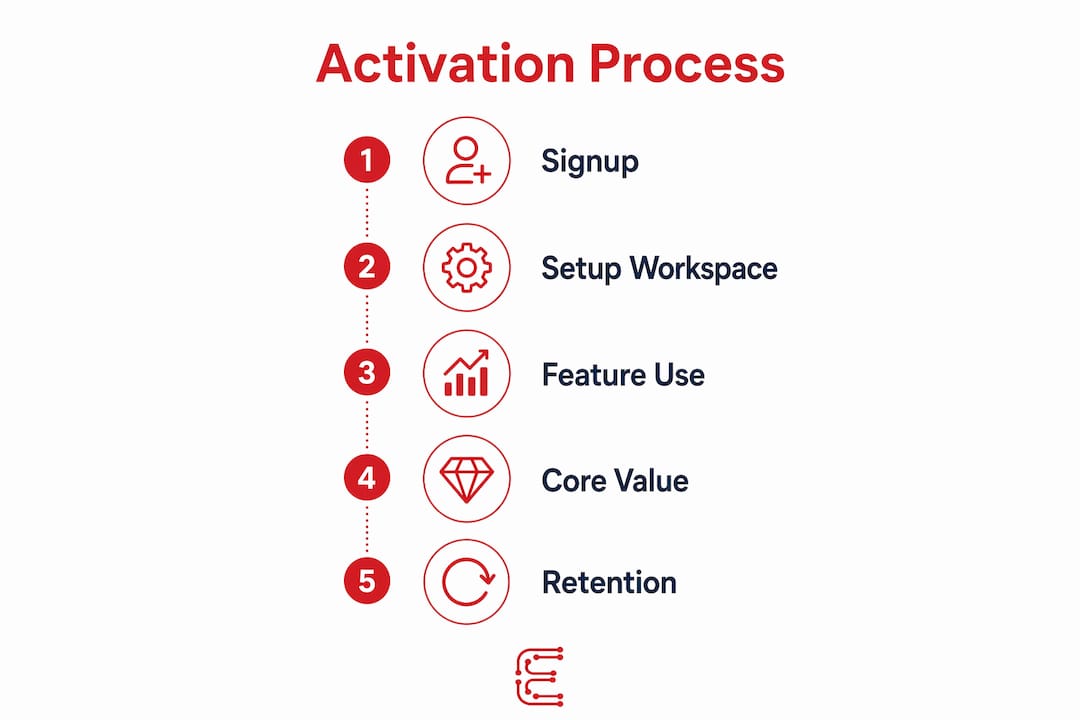
Consider a project management SaaS. Setup completion means a user has created an account and named a workspace. Activation means they have assigned a task to a teammate and received a notification confirming the workflow is live. The second event is the one that makes the product feel real. It is the moment the customer thinks, “This actually works for us.” That cognitive shift is what activation is designed to produce.
Activation is also a dynamic lifecycle state, not a one-off event. Users progressively realize product value in ways they can explicitly relate to their own business outcomes. A customer who activates at week one may deepen that activation at week six when they discover an advanced feature that solves a problem they did not know the product could address. This progressive realization is what separates products with strong net revenue retention (NRR) from those stuck in a firefighting loop of constant churn replacement.
The practical implication for SaaS founders is clear. Activation is not a customer success task. It is a product design task, a messaging task, and a customer success task simultaneously. Organizations that assign activation ownership to a single team consistently underperform those that treat it as a cross-functional responsibility.
How do activation rates compare across SaaS models?
The average activation rate for SaaS companies in 2026 is approximately 37.5%. That number carries significant weight. It means that roughly six out of every ten users who sign up for a SaaS product never reach the activation moment. Sales-led growth models average 41.6%, while product-led growth models average 34.6%. The gap reflects the role of human guidance. Sales-led models benefit from direct rep involvement that steers users toward value faster.
The financial stakes are equally clear. A 25% increase in activation rate correlates with a 34% increase in annual Monthly Recurring Revenue (MRR). That is not a marginal gain. It is the kind of compounding effect that changes a company’s growth trajectory within a single fiscal year.
| SaaS Model | Average Activation Rate | Key Driver |
|---|---|---|
| Industry average | 37.5% | Mixed acquisition channels |
| Sales-led growth | 41.6% | Human-guided onboarding |
| Product-led growth | 34.6% | Self-serve product experience |
These benchmarks are directional, not absolute. A product-led company with a well-designed activation layer can outperform a sales-led competitor with poor value mapping. Context matters more than category.
Pro Tip: Never benchmark your activation rate against the industry average alone. Compare it against your own cohort data month over month. A rising rate within your own product is a stronger signal than a rate that beats the average but is declining.
What common mistakes hinder effective customer activation?
The most damaging mistake SaaS teams make is treating activation as synonymous with onboarding completion. High onboarding completion rates can coexist with low activation rates when the onboarding flow is not mapped to customer-recognized value. A user can complete every step in a product tour and still churn within 30 days because they never experienced the product’s core value in a way that connected to their own goals.
The second major pitfall is ignoring activation depth. Most teams measure whether a user activated. Far fewer measure how deeply they activated across the product’s core features. Activation depth is more predictive of long-term retention than activation rate alone. A customer who uses three core features is significantly less likely to churn than one who uses only one, even if both are counted as “activated” in your metrics.
Common pitfalls that SaaS founders and customer success teams encounter include:
- Measuring activation as a binary event rather than tracking depth across features
- Applying incentives too early, before users have reached the activation threshold
- Failing to connect each onboarding step to a specific, named business outcome
- Relying entirely on manual customer success coverage, which does not scale
- Treating activation as a one-time milestone rather than a progressive lifecycle state
The incentive timing problem deserves specific attention. Incentives offered too early or without conditioning on the activation event reduce overall effectiveness. A discount offered at signup does not drive activation. A conditional reward offered at the precise moment a user is one step away from their activation event is a different mechanism entirely.
What are proven strategies to improve customer activation and reduce churn?
The most effective activation strategies combine three distinct levers: onboarding UX improvements, targeted messaging sequences, and conditional incentives. Each lever targets a different user group. UX improvements help users who want to activate but face friction. Messaging sequences re-engage users who signed up but have not perceived value yet. Conditional incentives move users who are motivated but stalled at the edge of the activation event.
Mapping incremental milestones is the structural foundation of any activation strategy. Rather than designing a single “aha moment,” the most effective SaaS products build a sequence of small value deliveries that compound. Each milestone should produce a result the customer can name and measure. For an email marketing platform, that sequence might look like this:
- Import a contact list and confirm it is clean
- Build a first campaign using a template
- Send a test email and review the preview
- Launch the campaign to a live segment
- Review the open rate report and identify a top performer
Each step delivers a discrete piece of value. By step five, the customer has experienced the product’s core loop and can articulate what it does for their business. That is full activation.
The activation layer concept addresses the scalability problem directly. This layer sits between signup and active product use, providing proactive, real-time guidance that handles standard activation paths without requiring proportional growth in your customer success team. For growth-stage SaaS companies, this is the difference between a CS team that scales with revenue and one that becomes a cost center.
Tracking activation depth means monitoring which core features each customer has used within their first 30, 60, and 90 days. Customers who engage with multiple core features show significantly lower churn risk. Customer success teams at companies like those E-regency works with use this telemetry to trigger proactive outreach before silent churn sets in, not after a renewal conversation has already gone cold.
Pro Tip: Condition your activation incentive on the specific activation event, not on time elapsed since signup. A reward triggered by completing a first campaign converts far better than a reward triggered by “day 7 of your trial.”
Key Takeaways
Customer activation in SaaS is the behavioral threshold where users first experience core product value, and improving it by 25% correlates directly with a 34% increase in annual MRR.
| Point | Details |
|---|---|
| Activation vs. onboarding | Activation is a value-recognition milestone, not the completion of setup steps. |
| Activation depth matters | Tracking how many core features a customer uses predicts retention better than a binary activated/not activated metric. |
| Benchmark by model | Sales-led SaaS averages 41.6% activation; product-led averages 34.6%; industry average is 37.5%. |
| Three strategic levers | Combine onboarding UX, targeted messaging, and conditional incentives to address different user groups. |
| Scale with an activation layer | Proactive real-time guidance between signup and product use reduces CS team dependency and prevents silent churn. |
Activation is a growth orientation, not a dashboard metric
The most persistent organizational mistake I see SaaS founders make is assigning activation ownership to a single team and then measuring it as a number on a dashboard. Activation is not a metric to report. It is a growth orientation that should shape how product, marketing, and customer success teams make decisions every week.
Activated customers are also one of the most underused sources of product intelligence available to a SaaS company. When a customer crosses the activation threshold, they have just told you, through their behavior, exactly what your product does well. That signal is more reliable than any survey. Companies that build feedback loops from activated users into their product roadmap consistently build stickier products than those relying on NPS scores from the general user base.
Cross-team accountability for activation acceleration is not optional at scale. When product owns the UX, marketing owns the messaging, and customer success owns the human touchpoints, activation improves faster than when any one team carries the full weight. The organizations I have seen reduce gross churn by more than 20% all shared one trait: they treated activation as a company-wide priority, not a CS metric.
The referral loop that activated customers create is also frequently underestimated. A customer who has genuinely experienced your product’s core value is far more likely to recommend it within their professional network. That organic referral loop is the compounding return on activation investment that rarely shows up in a quarterly review but drives growth over a two to three year horizon.
— Raymond
How E-regency helps SaaS founders build activation frameworks that hold
SaaS founders who understand the theory of customer activation often still struggle to build the systems that make it repeatable. Mapping activation moments, designing value-mapped onboarding sequences, and building an activation layer that scales without growing your CS headcount proportionally requires both analytical rigor and hands-on execution.
E-regency works directly with growth-stage SaaS companies to build these frameworks from the ground up. Using predictive AI health modeling alongside customer telemetry, E-regency identifies the precise activation events that separate retained customers from those at churn risk. Clients have seen over a 20% reduction in gross churn and more than 115% increase in net revenue retention. If you are ready to move from reactive support to proactive revenue generation, schedule a session with the E-regency advisory team to map your activation strategy.
FAQ
What is customer activation in SaaS?
Customer activation in SaaS is the moment a user first experiences the core value of your product through a specific, observable behavior. It marks the transition from signup to genuine engagement and is the strongest early predictor of long-term retention.
How is activation different from onboarding?
Onboarding is the process of setting up a product. Activation is the outcome of that process, specifically the moment a user recognizes the product’s value in terms of their own business goals. High onboarding completion does not guarantee activation.
What is a good activation rate for a SaaS product?
The industry average activation rate is approximately 37.5%, with sales-led models averaging 41.6% and product-led models averaging 34.6%. A rising rate within your own cohort data is a stronger performance signal than comparison to industry averages alone.
What is activation depth and why does it matter?
Activation depth measures how many of a product’s core features a customer actively uses. Deeper activation across multiple features correlates with significantly lower churn risk and is more predictive of retention than a simple activated or not-activated classification.
When should SaaS companies offer incentives to drive activation?
Incentives should be conditional on the activation event itself, not on time elapsed since signup. Offering rewards at the precise moment a user is one step away from their activation threshold produces far better results than blanket or time-based incentive programs.