

AI Insights for Customer Retention: A 2026 SaaS Guide
TL;DR:
- Using AI insights helps SaaS companies identify high-risk customers early and personalize interventions to reduce churn. Combining predictive scoring, behavioral signals, and human review enhances retention and revenue growth. Structuring product data for AI compatibility and ensuring data integration are essential for effective retention strategies.
AI insights for customer retention is the practice of using machine learning and predictive modeling to identify churn risk, segment high-value customers, and personalize interventions before attrition occurs. In SaaS, this discipline goes by several industry terms: predictive health modeling, churn propensity scoring, and customer telemetry analysis. E-regency clients who apply these methods have seen over a 20% reduction in gross churn and more than 115% increase in net revenue retention (NRR). For customer success managers and data analysts, the gap between knowing a customer is at risk and acting on that knowledge in time is where revenue is won or lost.
What AI insights are most valuable for customer retention?
Predictive cohort scoring is the highest-leverage AI technique for SaaS retention. Brands using this method report 15–30% improvements in customer lifetime value to acquisition cost ratios by identifying and nurturing high-potential customers immediately after their first transaction. That means your retention model pays dividends before a customer ever reaches the 90-day mark.

Churn propensity modeling goes deeper than cohort scoring. It assigns each customer a real-time risk score based on behavioral signals, support ticket frequency, product usage drops, and billing anomalies. When that score crosses a defined threshold, the system triggers an intervention. The model does not wait for a cancellation request. It acts while the relationship is still recoverable.
Behavioral signal analysis is where most SaaS teams leave money on the table. Granular behavioral signals such as time spent on product pages, scroll depth, and email engagement timing in the first 48 hours outperform basic purchase history in retention modeling. A customer who logs in three times in week one and then disappears is sending a clear distress signal. Basic analytics misses it. AI catches it.
Engagement timing is a sharper signal than most teams expect. Customers who open marketing emails within 6 hours of their first purchase show 67% higher six-month retention rates than those who open after 24 hours. That single behavioral marker, captured at the moment of first contact, predicts long-term loyalty with remarkable accuracy.
AI-powered customer lifetime value (CLV) prediction rounds out the toolkit. It lets your team prioritize which at-risk customers deserve a high-touch intervention and which can be handled through automated sequences. Without CLV scoring, customer success teams treat every churn risk equally, which burns capacity on low-value accounts while high-value customers quietly cancel.
Pro Tip: Set your AI model to flag customers who show a 30% or greater drop in product usage within any 14-day window. That pattern consistently precedes cancellation by 3–6 weeks, giving your team enough runway to intervene.
What data sources and tools does AI-driven retention require?
The quality of your retention model depends entirely on the quality of your input data. First-party behavioral data is the foundation: interaction timestamps, feature adoption rates, session frequency, and in-app engagement sequences. This is the customer telemetry layer that separates a predictive model from a reactive dashboard.
CRM data, support ticket history, and billing transaction records must feed into the same pipeline. Siloed data is the single biggest reason AI retention models underperform. A customer who files three support tickets in a week while their product usage drops is showing a compound risk signal. Your model only sees it if all three data streams connect.
The table below maps the core data sources to their function in a retention AI system.
| Data source | Role in retention AI |
|---|---|
| In-app behavioral logs | Feeds churn propensity and engagement timing models |
| CRM contact and activity history | Provides relationship context and account health baseline |
| Support ticket data | Identifies friction signals and unresolved pain points |
| Billing and subscription records | Detects payment failures and downgrade patterns |
| Email engagement data | Captures early behavioral signals like open timing |
AI and machine learning platforms that support predictive analytics must also handle automation triggers. The platform needs to score customers continuously, not just in weekly batch runs. Batch scoring creates a lag between the moment a customer goes at-risk and the moment your team sees it. Real-time or near-real-time scoring closes that gap.
Pro Tip: Before building any AI model, audit your data for completeness. A model trained on 60% complete behavioral data will produce unreliable scores. Prioritize data quality over model complexity every time.
How to implement AI-driven retention strategies step by step
Execution separates teams that generate AI insights from teams that act on them. The following roadmap applies directly to SaaS customer success workflows.
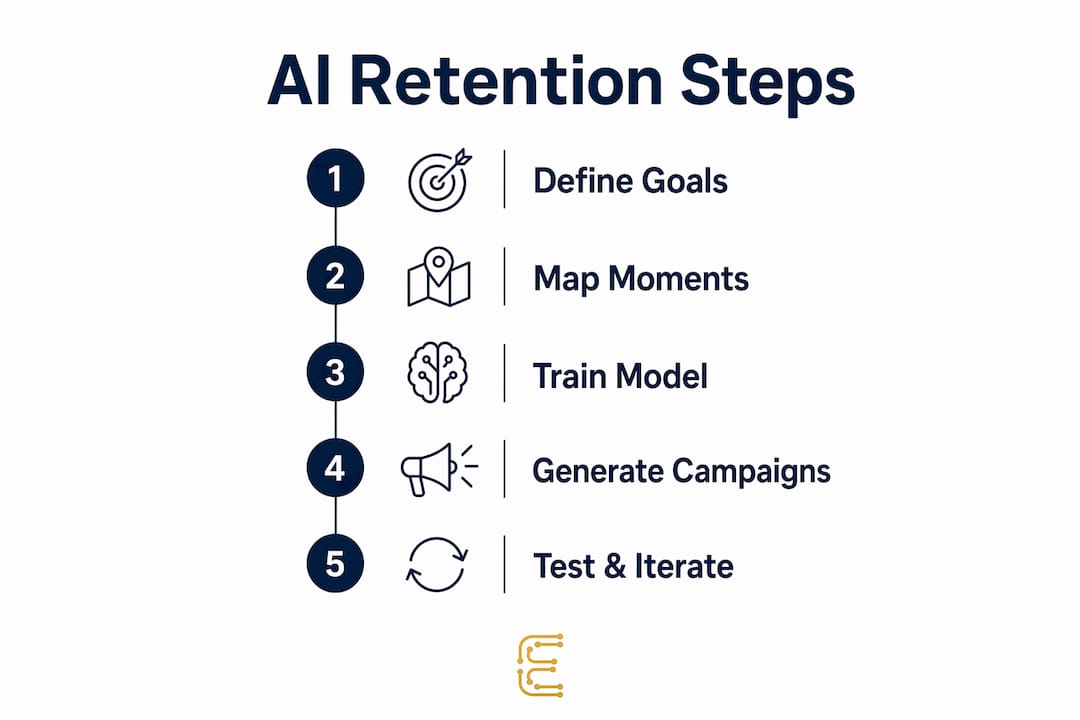
Step 1: Define retention outcome goals and KPIs. Set specific targets before touching any model. NRR above 100%, gross churn below 5% annually, and CLV-to-CAC ratio above 3:1 are standard SaaS benchmarks. Without defined targets, you cannot evaluate whether your AI model is working.
Step 2: Map your “moments of truth.” These are the inflection points where customer behavior predicts long-term outcomes. First login, first successful use of a core feature, first renewal, and first support ticket are the four most predictive moments in most SaaS products. AI intervention at these points produces the highest retention lift.
Step 3: Build and train your churn propensity model. Use your behavioral, CRM, and support data to train a model that scores each customer’s likelihood to churn within the next 30, 60, and 90 days. Segment customers into risk tiers: high, medium, and low. Each tier gets a different intervention playbook.
Step 4: Generate AI campaign drafts with human approval. AI retention marketing closes the gap between insights and action by generating context-aware campaign drafts that require human approval, improving both speed and quality of customer engagements. This human-in-the-loop step prevents campaign sprawl and protects brand voice. Your customer success manager reviews and approves before anything reaches the customer.
Step 5: Test, measure, and iterate. Run A/B tests on intervention timing, message format, and offer type. Feed results back into the model. Retention AI is not a set-and-forget system. It improves with every cycle of data it receives.
The most common mistake at this stage is treating the model as finished once it is deployed. Retention as a continuous value optimization challenge means AI must prioritize customers and personalize interventions rather than apply broad discounting. A customer who churns after receiving a discount offer was not retained. They were delayed.
What challenges arise when using AI insights for retention?
Data integration is the first wall most SaaS teams hit. Behavioral data lives in the product, CRM data lives in Salesforce or HubSpot, and support data lives in Zendesk or Intercom. Getting these systems to talk to each other requires engineering resources that most growth-stage companies have not yet allocated. Without integration, your AI model scores customers on incomplete information.
The gap between insight generation and action execution is the second major challenge. A churn risk score sitting in a dashboard does no work. The score must trigger a workflow: an alert to a customer success manager, an automated email sequence, or a product-in-app message. Teams that generate insights without connecting them to action pipelines are running a very expensive reporting system.
Campaign sprawl and message fatigue are real operational risks. When AI generates outreach at scale, customers can receive too many touchpoints in a short window. Preventing campaign sprawl requires automated, context-aware campaign drafts that humans approve to balance scale and brand voice. Volume without relevance accelerates churn rather than preventing it.
“Treating retention as a value optimization problem with AI-driven evaluation of churn risk and customer value reduces margin leakage and enhances retention outcomes.” This reframes the entire discipline: the goal is not to retain every customer at any cost. It is to retain the right customers at the right margin.
Balancing AI automation with human empathy is the most underappreciated challenge. AI identifies the risk. A human customer success manager builds the relationship that resolves it. Teams that over-automate the intervention step often find that customers feel processed rather than valued. The firefighting loop that follows is harder to break than the churn it was meant to prevent.
How is AI reshaping loyalty in the agentic commerce era?
A new category of customer now exists: the AI agent acting on behalf of a human buyer. Traffic to retail websites from generative AI assistants has surged by 4,700% year-on-year, fundamentally altering how customers discover and evaluate SaaS products. Your retention strategy must now account for an intermediary that does not respond to emotional appeals or brand storytelling.
74% of consumers would trust a personal AI agent more than their best friend to make a purchase on their behalf. That statistic signals a structural shift in how loyalty is earned and maintained. The AI agent evaluates your product on structured, machine-readable criteria: pricing clarity, feature specificity, availability, and documented use cases.
56% of consumers feel comfortable delegating communications to AI, but 37% would let their AI agent switch brands if a better fit is found. Loyalty in the agentic era is conditional and algorithmic. A customer who loves your product may still churn if their AI agent recommends a switch based on a competitor’s cleaner data structure.
Customer success managers must now manage dual relationships: the traditional human-to-brand relationship and the algorithmic-to-brand relationship where AI agents represent consumer interests. Earning loyalty twice requires two parallel strategies. The first is the high-touch, empathy-driven engagement your team already practices. The second is structuring your product data so that AI agents can read, evaluate, and recommend your solution accurately.
Brands that optimize product data for machine readability with explicit pricing, availability, and use cases are positioned to be favored by AI agents. This is not a future consideration. It is a current competitive requirement for any SaaS company operating in markets where AI-assisted purchasing is already common.
Key Takeaways
The most effective AI-driven retention strategy combines predictive churn scoring, behavioral signal analysis, and a human-in-the-loop approval process to reduce attrition and protect NRR.
| Point | Details |
|---|---|
| Predictive cohort scoring | Identify high-value customers immediately after first transaction to improve CLV-to-CAC ratios. |
| Behavioral timing signals | Email opens within 6 hours of first purchase predict 67% higher six-month retention rates. |
| Human-in-the-loop approval | AI generates campaign drafts, but human review protects brand voice and prevents message fatigue. |
| Agentic loyalty | Structure product data for machine readability to earn loyalty from both human users and AI agents. |
| Value optimization mindset | Retain the right customers at the right margin, not every customer through broad discounting. |
Why most SaaS teams are still flying blind on retention
I have worked with enough SaaS customer success teams to know the pattern. The data exists. The intent is there. But the model never gets built because the team is too busy responding to churn that already happened. That firefighting loop is the real enemy, not the churn itself.
The teams that break out of it share one habit: they treat first-day behavior as the most important data they will ever collect on a customer. The rapid engagement signals in the first 6 hours after onboarding predict long-term retention better than any survey or NPS score collected 90 days later. If your model is not watching that window, you are building on a blind spot.
The other thing I push back on consistently is the instinct to discount your way out of churn. Discounting retains the account number, not the customer. A customer who stays because you cut their price by 20% is a customer who has already decided your product is not worth full price. That is a silent churn signal wearing a retention badge. The better move is to identify what value they have not yet realized and put a customer success manager on it before the renewal conversation starts.
The evolving role of customer success professionals alongside AI is not a threat. It is a promotion. AI handles the pattern recognition. Your team handles the relationship. That division of labor, when executed well, produces the kind of NRR growth that compounds year over year.
— Raymond
How E-regency helps SaaS teams turn AI insights into retention results
SaaS teams that generate AI insights but struggle to act on them face a specific problem: the gap between analysis and execution. E-regency Advisory closes that gap with a hands-on approach that combines predictive AI health modeling with direct customer success execution.
E-regency works with startups and growth-stage SaaS companies to build retention frameworks that are specific to their customer base, not generic playbooks. The results are measurable: clients report over a 20% reduction in gross churn and more than 115% increase in NRR. If your team is ready to move from reactive support to proactive revenue generation, schedule a consultation with E-regency to build a retention strategy grounded in real AI-driven outcomes.
FAQ
What is AI-driven customer retention in SaaS?
AI-driven customer retention is the use of predictive modeling and behavioral analytics to identify churn risk and trigger personalized interventions before a customer cancels. It replaces reactive support with proactive, data-driven engagement.
How does predictive cohort scoring improve retention?
Predictive cohort scoring segments customers by behavior and value potential immediately after their first transaction, allowing teams to prioritize high-value accounts and personalize outreach early in the customer lifecycle.
What data does a SaaS retention AI model need?
A retention AI model requires first-party behavioral data, CRM history, support ticket records, billing data, and email engagement signals. Data quality and integration across these sources directly determine model accuracy.
How do AI agents affect customer loyalty in SaaS?
AI agents now act as purchasing intermediaries, and 37% of consumers would let their agent switch brands if a better option is found. SaaS companies must structure product data for machine readability to remain competitive in this environment.
What is the human-in-the-loop role in AI retention campaigns?
Human-in-the-loop means customer success managers review and approve AI-generated campaign drafts before they reach customers. This step prevents message fatigue, protects brand voice, and ensures interventions are contextually appropriate.