

What Is Net Revenue Retention? A 2026 SaaS Guide
Net revenue retention (NRR) is the percentage of recurring revenue retained and expanded from existing customers over a specific period, accounting for upgrades, downgrades, and churn. For SaaS companies, it is the single most telling indicator of whether the business grows from within or bleeds quietly through a leaky bucket. Platforms like Zuora and Salesforce embed NRR tracking directly into their revenue operations frameworks because investors and boards treat it as a proxy for product-market fit and long-term viability. Understanding what is net revenue retention means understanding whether your existing customer base is a growth engine or a slow drain.
How is net revenue retention calculated?
The NRR formula is straightforward: take your starting recurring revenue for a cohort, add expansion revenue from upsells and cross-sells, subtract churned revenue from cancellations, subtract contraction revenue from downgrades, then divide the result by starting revenue and multiply by 100.
Written out, it looks like this:
NRR = (Starting Revenue + Expansion Revenue − Churned Revenue − Contraction Revenue) / Starting Revenue × 100
Each component carries weight. Starting recurring revenue is the baseline monthly or annual recurring revenue (MRR or ARR) from a defined customer cohort at the beginning of the period. Expansion revenue captures every dollar added through seat increases, tier upgrades, or usage overages. Churned revenue is the full contract value lost from customers who canceled. Contraction revenue reflects customers who downgraded to a lower plan without canceling entirely.
A practical example clarifies the math. Suppose your cohort begins the quarter with $500,000 in ARR. During the quarter, upsells add $80,000, one customer churns costing $30,000, and two customers downgrade costing $20,000. Your NRR equals ($500,000 + $80,000 − $30,000 − $20,000) / $500,000 × 100, which equals 106%. That result means your existing customer base grew revenue by 6% without acquiring a single new logo.

Accurate NRR calculation requires consistent revenue measurement units throughout. Mixing MRR and ARR figures in the same formula produces a distorted result that will mislead your board and your customer success team equally.
Pro Tip: Never include new customer revenue in your NRR cohort. New logos belong in new ARR calculations. Blending them inflates NRR artificially and masks true expansion performance from your existing base.
Why does NRR matter for SaaS growth and valuation?
NRR above 100% means your existing customer base generates more revenue this period than it did last period, without counting a single new sale. That compounding dynamic is what separates high-growth SaaS businesses from those perpetually chasing acquisition to offset churn.
The valuation implications are concrete. A 10-point NRR increase can boost company valuation by 20–30%. Companies sustaining 120% or higher NRR command ARR multiples of 8–11x, compared to 6–8x for companies sitting at 100%. That gap represents tens of millions of dollars in enterprise value for a $10M ARR business.
Investors read NRR as a signal of product-market fit with staying power. A company that retains and expands revenue from its installed base proves its product solves a problem customers keep paying to solve, and pay more to solve over time. That is a fundamentally different risk profile than a business dependent on constant new logo acquisition to replace churned revenue.
NRR also serves as a diagnostic for customer success operations. When NRR drops, the cause is almost always traceable to one of three failure modes: involuntary churn from failed payments, voluntary churn from unresolved dissatisfaction, or stalled expansion from a lack of systematic upsell triggers. Each failure mode requires a different fix, and NRR tells you the fire exists before it becomes a crisis.
Pro Tip: Early-stage SaaS companies under $5M ARR should not panic if NRR sits below 110%. The benchmark applies most meaningfully at $5M and above, where the installed base is large enough for expansion revenue to compound materially.
Net revenue retention vs. gross revenue retention: what is the difference?
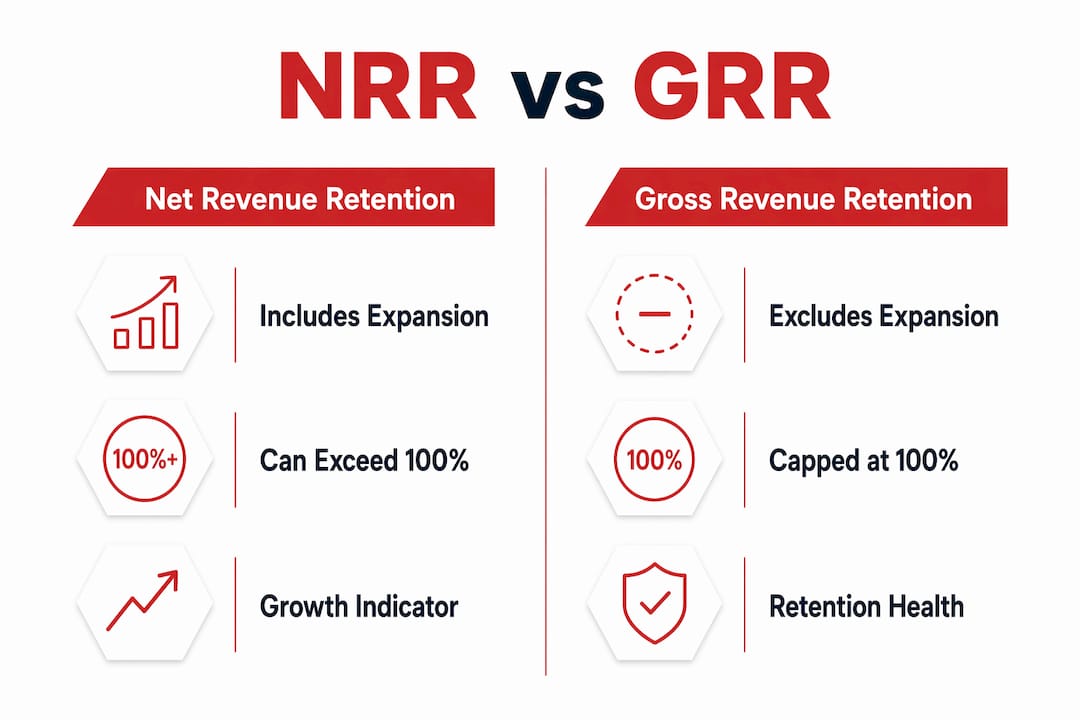
Gross revenue retention (GRR) and NRR measure different things, and confusing them leads to flawed strategic decisions. GRR measures revenue retained without including any expansion revenue, which means it is capped at 100% by definition. NRR includes upsells and cross-sells, which is why it can exceed 100%.
The table below summarizes the key distinctions:
| Metric | What It Measures | Can Exceed 100%? | Best Used For |
|---|---|---|---|
| Gross Revenue Retention (GRR) | Revenue kept after churn and contraction only | No | Measuring pure retention health |
| Net Revenue Retention (NRR) | Revenue kept plus expansion minus churn and contraction | Yes | Measuring total revenue momentum |
| Net Dollar Retention (NDR) | Same as NRR, alternate industry label | Yes | Investor reporting, benchmarking |
| Monthly Recurring Revenue (MRR) | Total recurring revenue in a given month | N/A | Tracking revenue trajectory over time |
GRR is the more conservative metric. A company with 85% GRR is losing 15% of its revenue base each year from churn and downgrades before expansion is considered. That is a leaky bucket that no amount of upselling fully repairs. NRR above 100% can mask a weak GRR, which is why sophisticated operators track both simultaneously.
The practical rule: use GRR to diagnose retention problems at the base level, and use NRR to measure the net revenue outcome of your entire customer success motion. A business with 90% GRR and 115% NRR is expanding aggressively but still has a churn problem worth fixing.
What strategies actually improve net revenue retention?
Improving NRR requires working on both sides of the equation: reducing revenue lost to churn and contraction, and systematically growing expansion revenue from the existing base.
The fastest wins come from fixing involuntary churn. Failed payments and expired credit cards cause a surprising share of cancellations that have nothing to do with product dissatisfaction. Dunning processes and tailored onboarding that guide customers to their first meaningful outcome, the “aha moment,” address both involuntary and early voluntary churn simultaneously. These fixes are operational and can show results within weeks.
Renewal management is the next lever. Starting renewal conversations at least 90 days before contract end gives your customer success team time to surface dissatisfaction, negotiate terms, and position upsells before the customer has mentally moved on. Companies that begin renewal outreach at 30 days or less are already in a defensive posture, reacting rather than leading.
Expansion revenue requires a different playbook entirely. Expansion revenue ideally contributes 44% of net new ARR for SaaS companies in the $5M–$20M range. Most operators under $5M achieve only 20–25%, not because their market lacks expansion potential, but because they lack systematic triggers. Usage-based pricing, cross-sell sequences tied to product milestones, and structured quarterly business reviews all create expansion opportunities that would otherwise go unnoticed.
The most advanced operators are applying predictive AI scoring to their installed base on a weekly cadence. Predictive AI scoring identifies at-risk and expansion-ready accounts 90 days before renewal, increasing a single customer success manager’s effective account capacity by nearly 40%. That means one CSM can manage 70–80 accounts effectively instead of the 40–60 typical in manual workflows.
A critical nuance: high feature adoption alone does not predict strong NRR. The metric that actually matters is whether each user role completes the daily workflows that fulfill their core job. A customer using 12 features superficially is more churn-prone than one using 3 features deeply and repeatedly. Customer success teams that chase adoption breadth instead of workflow depth are solving the wrong problem.
Pro Tip: Avoid global product configuration changes to address individual customer friction. Use additive customization, building per-customer workflow apps or role-specific views, so that fixing one account’s experience does not degrade another’s.
Key takeaways
Net revenue retention is the definitive measure of whether a SaaS company grows from its existing customer base, and companies sustaining NRR above 110% command significantly higher valuation multiples than those that do not.
| Point | Details |
|---|---|
| NRR definition | NRR measures recurring revenue retained plus expansion minus churn and contraction, expressed as a percentage. |
| Valuation impact | A 10-point NRR increase can raise company valuation by 20–30%, with 120%+ NRR commanding 8–11x ARR multiples. |
| GRR vs. NRR | Track both metrics: GRR diagnoses base retention health, while NRR captures total revenue momentum including expansion. |
| Fastest improvement lever | Fix involuntary churn through dunning and onboarding first; systematic expansion playbooks follow as the longer-term driver. |
| AI-driven scaling | Predictive AI scoring expands CSM account capacity by nearly 40%, enabling proactive retention at scale. |
Where most SaaS leaders get NRR wrong
Most SaaS founders I advise treat NRR as a reporting metric rather than an operating system. They calculate it quarterly for the board deck, note whether it moved up or down, and move on. That approach misses the entire point.
NRR is a lagging indicator. By the time it drops, the damage is already done. The operators who sustain 120%+ NRR are not reacting to the number. They are tracking leading indicators like Product Qualified Leads and specific feature usage thresholds that predict expansion 3–6 months in advance. They know which accounts are expansion-ready before the customer success manager picks up the phone.
The second mistake I see constantly is the headcount trap. Leaders assume that hiring more customer success managers will fix NRR. Assigning more CSMs alone does not increase NRR. Automation and predictive systems multiply CSM effectiveness. Without those systems, you are just adding labor cost to a broken process.
The third mistake is focusing on feature adoption as the proxy for retention health. Real retention drivers are workflows that align with user roles’ critical jobs to be done. A customer who logs in daily but never completes a meaningful workflow is a churn risk wearing the mask of an engaged user. That is silent churn in its earliest form, and it is invisible to teams that only track login frequency and feature clicks.
NRR optimization is not a customer success problem. It is a revenue architecture problem, and it requires the same rigor you apply to your acquisition funnel.
— Raymond
How E-regency helps SaaS companies build NRR that compounds
If your NRR is below 110% or you cannot explain exactly which accounts are expansion-ready 90 days from now, the gap is almost certainly operational, not market-driven.

E-regency’s AI-powered advisory for SaaS founders transforms customer telemetry into a proactive retention and expansion system. From predictive health modeling to structured retention strategy optimization, E-regency works with growth-stage companies to replace the firefighting loop with a revenue-focused customer success framework. Clients have reported gross churn reductions of over 20% and NRR increases exceeding 115%. If you are ready to move from reactive support to compounding revenue, schedule a meeting with the E-regency advisory team today.
FAQ
What is the net revenue retention definition?
Net revenue retention is the percentage of recurring revenue retained from an existing customer cohort over a set period, including expansion revenue from upsells and cross-sells, minus revenue lost to churn and downgrades. An NRR above 100% means the existing customer base is growing revenue without new customer acquisition.
How do you calculate net revenue retention?
The formula is: (Starting Revenue + Expansion Revenue − Churned Revenue − Contraction Revenue) / Starting Revenue × 100. All figures must use the same revenue unit, either MRR or ARR, applied consistently to a defined customer cohort.
What is a good NRR benchmark for SaaS?
NRR above 110% is the widely accepted target for top SaaS performance, and companies sustaining 120% or higher command valuation multiples of 8–11x ARR. Early-stage companies under $5M ARR may reasonably operate below this threshold while building their expansion motion.
How does NRR differ from gross revenue retention?
Gross revenue retention measures only revenue kept after churn and contraction, capped at 100%, while NRR adds expansion revenue and can exceed 100%. GRR diagnoses base retention health; NRR measures the full revenue outcome of your customer success motion.
What are the fastest ways to improve NRR?
Fixing involuntary churn through dunning processes and structured onboarding produces the fastest results. Systematic renewal management starting 90 or more days before contract end and AI-driven expansion playbooks tied to usage data drive longer-term NRR improvement.