

What Is a Customer Success Platform for SaaS Teams
TL;DR:
- Customer success platforms unify post-sale data to predict churn and promote expansion revenue.
- Successful implementation depends on clean data, clear strategy, and proper lifecycle mapping.
A customer success platform (CSP) is purpose-built software that centralizes customer data and automates proactive engagement to protect and grow revenue after the sale. Unlike a CRM, which tracks deals and contacts, a CSP manages what happens once a customer signs the contract. It unifies data from product analytics, support systems, and billing to give customer success managers a complete picture of every account. TSIA standards define CSPs as tools that predict churn, automate lifecycle engagement, and identify expansion opportunities. For SaaS companies where net revenue retention (NRR) determines long-term growth, a CSP is not optional infrastructure. It is the operational core of a customer success management strategy.
What is a customer success platform and what does it do?
A CSP is specialized post-sale software that helps B2B and SaaS companies manage the entire customer lifecycle from onboarding through renewal and expansion. The distinction from other software categories matters. A CRM captures the sale. A support ticketing system resolves problems after they surface. A CSP sits between those two functions and works to prevent problems before they become tickets or, worse, cancellations.

The platform pulls data from every system that touches the customer: the CRM, the product, the billing engine, and the support queue. It then surfaces that data in a single customer health view, which customer success managers use to prioritize their time and trigger the right interventions at the right moment. This is the core mechanic that separates a CSP from a spreadsheet or a CRM add-on.
CSPs also automate the repetitive work that consumes CS team capacity. Onboarding check-ins, renewal reminders, usage-drop alerts, and expansion signals can all be triggered automatically based on customer behavior. That automation frees CS managers to focus on the accounts that need a human conversation, not a templated email.
The most capable platforms include predictive health modeling, which assigns a health score to each account based on product usage, support activity, payment history, and engagement patterns. That score tells the team which accounts are at risk of silent churn before the customer says a word.
What features define a modern customer success platform?
The core capabilities of a CSP include health scoring, lifecycle management, renewal forecasting, automated engagement, and unified customer data management. Each feature addresses a specific failure mode in post-sale customer management.
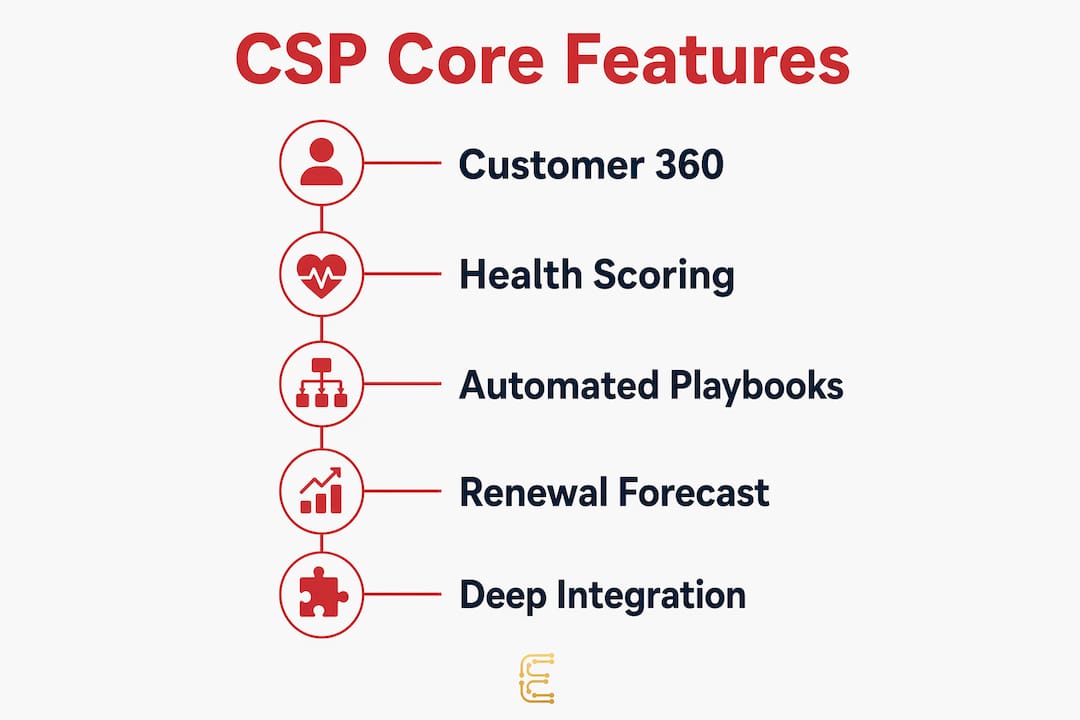
Customer 360 view. The platform aggregates data from the CRM, product analytics, support systems, and communication tools into a single account record. Without this unified view, CS managers make decisions based on incomplete information, which produces inaccurate health scores and missed churn signals.
Health scoring and risk detection. The platform assigns a quantitative score to each account based on configurable signals: login frequency, feature adoption, support ticket volume, and payment status. A declining score triggers an alert before the customer reaches out to cancel.
Automated lifecycle playbooks. Playbooks are pre-built workflows that fire based on customer behavior or lifecycle stage. A new customer who has not completed onboarding after 14 days triggers a check-in sequence. An account approaching renewal with a low health score triggers an escalation to a senior CS manager.
Renewal forecasting and expansion identification. SaaS growth depends on expansion revenue and high NRR, which means a CSP must surface upsell and cross-sell opportunities before renewal negotiations begin. The best platforms flag accounts showing high product engagement as candidates for expansion, not just accounts at risk of churn.
Integration depth. A CSP without clean integrations is a data island. The platform must connect to the CRM, the product telemetry layer, the billing system, and ideally the communication stack. Shallow integrations produce fragmented data, which corrupts health scores and undermines the entire system.
Pro Tip: Before evaluating any platform, audit your existing data sources. If your product telemetry is incomplete or your CRM records are inconsistent, the CSP will surface misleading health scores. Clean data is the prerequisite, not the outcome, of a successful deployment.
How does a CSP differ from CRM and customer support software?
The three software categories serve different phases of the customer relationship, and confusing them leads to coverage gaps. The table below clarifies the functional boundaries.
| Category | Primary focus | Orientation | Core output |
|---|---|---|---|
| CRM | Pre-sale pipeline and contact management | Reactive to sales activity | Closed deals and contact records |
| Support software | Resolving customer-reported issues | Reactive to customer problems | Resolved tickets and case history |
| Customer success platform | Post-sale adoption, retention, and growth | Proactive across the full lifecycle | Retained accounts and expansion revenue |
CSM platforms guard and expand revenue post-sale, while CRMs primarily support deal closing. That is not a subtle distinction. A CRM tells you who bought and when. A CSP tells you whether they are getting value, whether they are at risk, and what action to take next.
Support software is reactive by design. It waits for a customer to file a ticket. A CSP detects churn risks early and automates proactive outreach before support tickets are filed. The difference in timing is the difference between retaining an account and losing it.
CSPs do not replace CRMs or support systems. They consume data from both and add the post-sale intelligence layer that neither provides. A SaaS company running only a CRM and a support tool has a leaky bucket. The CSP is what patches it.
What are the business outcomes of customer success platforms?
The benefits of customer success platforms are measurable and tied directly to revenue. Proactive CS automation enhances team capacity by automating routine touchpoints and flagging accounts that need human attention. That shift from firefighting to relationship building is where the financial returns accumulate.
Churn prevention is the most immediate outcome. When a CSP surfaces a declining health score 60 days before renewal, the CS team has time to intervene. Without that signal, the first indication of a problem is often the cancellation email. E-regency clients have experienced over a 20% reduction in gross churn after implementing predictive health modeling alongside structured CS playbooks.
Expansion revenue is the second major outcome. CSM platforms surface expansion insights before renewal negotiations begin, which shifts the conversation from retention to growth. An account that has adopted three of five available features is a candidate for an upgrade conversation, not just a renewal check-in.
Operational efficiency compounds both outcomes. When CS tools automate tasks triggered by usage drops, upcoming renewals, and onboarding milestones, CS managers spend their time on the accounts where human judgment adds the most value. E-regency clients have reported more than 115% increases in net revenue retention when proactive automation is paired with a clear expansion strategy.
Data-driven decision support changes how CS leaders manage their teams. Instead of relying on anecdotal account knowledge, managers can see portfolio-level health trends, identify which playbooks are working, and allocate headcount based on account risk rather than relationship history.
How do SaaS companies select and implement the right CSP?
Platform selection starts before you look at any vendor. Mapping the customer lifecycle and defining what success means for your product and customer base is the prerequisite work that determines which platform will fit and which will fail.
The selection criteria shift significantly by company stage. Startups need platforms that deploy quickly and require minimal data engineering. Entry-level CS tools can be operational in days and provide basic health scoring and playbook automation without the complexity of enterprise configuration. Mid-market companies prioritize real-time churn detection and deeper integration with product telemetry. Enterprise firms require platforms that can handle complex data architectures, multi-product portfolios, and large CS team workflows.
Integration requirements deserve serious scrutiny during evaluation. The platform must connect cleanly to your CRM, your product analytics layer, and your billing system. A CSP that cannot ingest product telemetry cannot produce accurate health scores. A CSP that cannot read billing data cannot forecast renewals reliably.
Enterprise-grade implementations generally require 3–6 months due to the technical complexity of unifying billing records, product logs, and support tickets into a single customer view. That timeline should be planned realistically. Teams that expect a two-week deployment of a complex platform consistently underestimate the data engineering work required and end up with a system that is live but not trusted.
The most common implementation failure is fragmented data. Organizations that skip lifecycle mapping and metric definition end up with misleading health scores that erode CS team confidence in the platform. When the health score says an account is healthy and it churns anyway, the team stops trusting the tool.
Pro Tip: Run a data quality audit before signing any contract. Pull a sample of 20 accounts and check whether your CRM, product, and billing data are consistent and complete for each one. If they are not, fix the data pipeline first. The platform will only amplify whatever quality of data you feed it.
Key Takeaways
A customer success platform delivers measurable retention and revenue growth only when it is built on clean, unified customer data and paired with a defined CS strategy.
| Point | Details |
|---|---|
| CSP definition | A CSP is post-sale software that unifies customer data to predict churn and drive expansion revenue. |
| Core differentiator | CSPs are proactive; CRMs and support tools are reactive and do not manage post-sale lifecycle outcomes. |
| Implementation timeline | Enterprise deployments take 3–6 months; startups can launch entry-level tools in days. |
| Data quality first | Fragmented or incomplete data produces misleading health scores that undermine CS team trust. |
| Revenue impact | Proactive CS platforms reduce gross churn and increase NRR when paired with structured playbooks. |
The uncomfortable truth about CSP adoption I’ve seen firsthand
Most SaaS teams buy a customer success platform and then wonder why it is not working six months later. The platform is rarely the problem. The data is.
I have seen well-funded growth-stage companies deploy capable platforms and still end up with health scores that no one trusts. The root cause is almost always the same: the CRM was not kept current, the product telemetry was never properly instrumented, and the billing system used different account identifiers than the CRM. The platform tried to unify three inconsistent datasets and produced noise instead of signal.
The second pattern I see consistently is misalignment between the CS strategy and the platform configuration. A team that has not defined what a healthy customer looks like cannot configure a meaningful health score. The platform reflects the clarity, or the lack of it, in the underlying strategy. You cannot automate your way out of a strategy gap.
What actually works is treating the platform as the last step, not the first. Map the lifecycle. Define the health signals. Agree on what success looks like at 30, 90, and 180 days. Then configure the platform to reflect that thinking. When you do it in that order, the tool becomes a force multiplier. When you do it in reverse, it becomes an expensive dashboard that the team ignores.
The SaaS companies that get the most from their CS platforms are the ones that treat customer success as a revenue function, not a support function. The platform is the infrastructure for that function. But the strategy, the data discipline, and the organizational alignment have to come first.
— Raymond
How E-regency helps SaaS leaders get real results from customer success
SaaS founders who have invested in a customer success platform but are not seeing the retention or expansion results they expected often share a common problem: the technology is in place, but the strategy and data foundation are not.
E-regency combines AI-driven advisory with hands-on execution to help growth-stage SaaS companies build the customer success infrastructure that actually reduces churn and grows NRR. The work starts with customer lifecycle mapping and data quality assessment, then moves to platform configuration, playbook design, and CS team alignment. If you are ready to move from reactive support to proactive revenue generation, schedule a consultation with the E-regency team and get a clear picture of what your CS operation needs to perform.
FAQ
What is a customer success platform in simple terms?
A customer success platform is software that helps SaaS companies monitor customer health, automate engagement, and prevent churn after the sale. It unifies data from the CRM, product, and support systems into a single view for CS teams.
How does a customer success platform differ from a CRM?
A CRM manages pre-sale contacts and pipeline activity, while a CSP manages post-sale adoption, retention, and expansion. CSPs are proactive tools; CRMs are primarily records of sales activity.
What are the core benefits of customer success platforms?
The primary benefits include early churn detection, automated lifecycle engagement, expansion revenue identification, and improved CS team efficiency. Platforms that use predictive health modeling can surface at-risk accounts weeks before a customer signals intent to cancel.
How long does it take to implement a customer success platform?
Enterprise implementations typically take 3–6 months due to the complexity of unifying billing, product, and support data. Entry-level platforms for startups can be operational in days but offer less depth.
What should SaaS companies do before selecting a CSP?
Map the customer lifecycle, define health signals, and audit data quality across the CRM, product analytics, and billing systems. Skipping this pre-work leads to fragmented data and health scores that the CS team cannot trust.