

Pricing Strategy for Customer Retention in SaaS
TL;DR:
- Pricing influences customer loyalty by shaping perceived value and trust, with transparent, stable models boosting retention.
- Effective communication and structured options like downgrades and annual plans help reduce churn and strengthen customer relationships.
Pricing is the single most direct signal a SaaS customer uses to judge whether your product is worth keeping. The role of pricing in customer retention goes far beyond the number on an invoice. It shapes perceived value, communicates fairness, and determines whether a customer renews or quietly cancels. Pricing is also the highest-leverage revenue growth lever in subscription businesses, outperforming acquisition and retention improvements alone. SaaS leaders who treat pricing as a static decision miss the compounding retention gains that come from treating it as a continuous practice.
How does pricing influence customer loyalty and churn in SaaS?
The most common mistake in SaaS churn analysis is conflating price sensitivity with value perception failure. Price is cited as a cancellation reason in 17–22% of exit surveys, but only 5–9% of churn is genuinely driven by price. The rest traces back to customers who never understood what they were paying for. That distinction matters enormously for how you respond.
When a customer says “it’s too expensive,” they are almost always saying “I don’t see enough value.” A customer who logs in daily, hits their key outcomes, and receives regular ROI reporting rarely cancels over price. The customer who cancels is typically one who onboarded poorly, used a fraction of the product, and never connected the subscription cost to a measurable business result.
Addressing value perception failures through better onboarding and outcome reporting reduces price-cited churn by 30–50% without cutting prices. That is a significant retention gain that costs far less than discounting. The implication is clear: before adjusting your pricing, fix your value communication.
Pro Tip: Correlate feature usage data with cancellation reasons before concluding you have a pricing problem. If churned accounts show low feature adoption, the issue is onboarding, not price.
The impact of pricing on loyalty also runs through customer psychology. Customers who feel they are paying a fair price for a product that delivers results become advocates. Customers who feel overcharged, or who cannot connect cost to outcome, become detractors. Pricing strategy for retention, therefore, starts with ensuring every customer reaches their first meaningful outcome before the first renewal decision arrives.
What pricing models optimize customer retention?
Not all pricing structures carry the same retention profile. The choice of model shapes how customers experience cost overtime and how exposed your revenue is to churn events.

Flat-rate annual pricing shows 20–30% lower logo churn than monthly or usage-based pricing. Annual commitments reduce the frequency of renewal decisions, which means fewer opportunities for a customer to reconsider. The upfront discount also creates a psychological anchor: the customer has already committed, and switching costs feel higher.
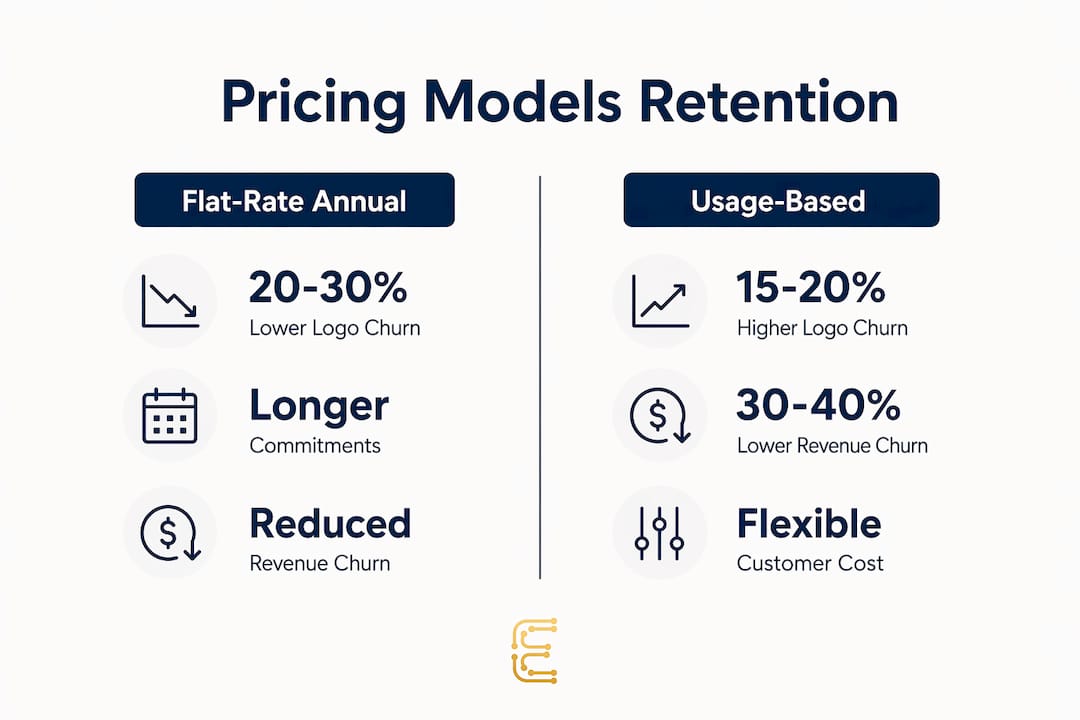
Usage-based pricing tells a different story. These models show 15–20% higher logo churn but 30–40% lower revenue churn due to expansion. Customers who stay tend to grow their usage and spend more over time. The tradeoff is a higher volume of smaller cancellations from low-usage accounts that never found their footing.
Stable pricing and its effect on long-term loyalty
Stable pricing is cited by 60% of customers as the primary factor for loyalty in a price-sensitive market. That number reflects a fundamental truth: customers plan budgets, and unexpected price changes disrupt that planning. When a SaaS product holds its price steady, customers build it into their operating costs without anxiety.
Stable pricing models strengthen consumer trust and brand loyalty, while dynamic pricing drives short-term purchase intentions. Dynamic pricing can accelerate revenue in the short run, but it introduces uncertainty that erodes the trust required for long-term retention. Balancing both approaches, stable base pricing with usage-based expansion, supports immediate revenue needs without sacrificing the loyalty that comes from predictability.
Pricing transparency and fairness as retention drivers
Customer loyalty depends on perceived price fairness, ethical pricing, and transparency. These factors mediate trust and retention more than the price level itself. A customer who understands exactly what they pay for, why the price is set as it is, and how it compares to the value delivered will tolerate a higher price point than a customer left guessing.
Openly communicating your pricing structure, including what triggers tier changes and how expansion pricing works, builds the kind of long-term trust that survives market pressure. SaaS companies that treat pricing as a black box invite suspicion. Those that publish clear pricing logic invite confidence.
Pro Tip: Publish a pricing FAQ on your website that explains your value metric, tier thresholds, and upgrade triggers. Customers who understand the model churn less when they hit a tier boundary.
How do pricing communication and incentives affect retention?
The way you announce a price change matters as much as the change itself. Effective communication during price increases reduces churn by 40% compared to simply announcing the change. That gap represents the difference between customers who feel respected and customers who feel ambushed.
The mechanics of good price-change communication follow a clear pattern. Give customers at least 60 days of notice before a price increase takes effect. Explain the specific investments the increase funds, whether that is new features, improved support, or infrastructure. Offer a path for customers who cannot absorb the increase, such as a downgrade option or a loyalty rate. Each of these steps signals that you value the relationship, not just the revenue.
Incentives during price transitions also carry measurable weight. 23% of customers facing price increases are open to staying if given loyalty benefits, and 17% respond positively to future discounts. These are not trivial numbers. A targeted loyalty offer to at-risk accounts during a repricing event can recover a meaningful share of customers who would otherwise cancel.
Annual plans with a 15–20% discount increase retention by locking customers into longer commitments. The discount functions as both an incentive and a commitment device. Customers who pay annually are statistically less likely to churn because the decision to cancel requires forfeiting prepaid value. Offering an annual plan option during a price increase gives customers a way to absorb the change while locking in a lower effective rate.
The broader principle here is that pricing communication is a retention tool in its own right. Over 70% of SaaS companies that announce increases with clear value messaging see improved retention outcomes. The message is not “we are charging you more.” The message is “here is what your investment is building.”
What practical steps can SaaS leaders take to use pricing for retention?
Pricing for retention is an organizational practice, not a one-time decision. Treating repricing as a one-off event causes disruptive churn and loss in sales productivity. The companies that retain customers through pricing changes are the ones that have built repricing into their operating rhythm.
1. Conduct quarterly pricing reviews. Review your pricing model against feature usage data, NRR trends, and customer health scores every quarter. Pricing that made sense at 500 customers may misalign at 5,000. Regular reviews catch drift before it becomes a churn event.
2. Diagnose churn before adjusting price. Correlate cancellation reasons with product telemetry. If churned accounts show low feature adoption and short session times, the issue is onboarding and value delivery, not price. Cutting price to fix an onboarding problem is expensive and ineffective.
3. Build structured downgrade paths. Structured downgrade paths yield a 40–60% chance of customer upgrade within 12 months after downgrade. A customer who downgrades is not lost. A customer who cancels is. Offering a lower tier preserves the relationship and keeps the door open for expansion.
4. Add pause options. Pause options convert 12–20% of cancellations into paused accounts that often reactivate. This is particularly effective for seasonal businesses or customers facing temporary budget constraints. A paused account costs almost nothing to maintain and frequently returns.
5. Grandfather existing customers through value metric changes. Changing value metrics mid-cycle is a major trust event and should never happen without grandfathering or a clear opt-in path. Customers who signed up under one pricing logic and find it changed without warning churn at elevated rates. Phased increases with grandfathering protect your most loyal accounts while you transition new customers to updated pricing.
6. Use E-regency’s predictive health modeling. E-regency clients have seen over a 20% reduction in gross churn by combining pricing diagnostics with AI-driven customer health signals. Knowing which accounts are at risk before a price increase lands gives you time to intervene with targeted communication or incentives. You can explore more on this approach through the E-regency blog.
Key Takeaways
Pricing strategy for retention works when it aligns price with perceived value, communicates changes transparently, and builds structural options that keep customers from canceling.
| Point | Details |
|---|---|
| Value perception drives churn | Most price-cited churn is a value communication failure, not a price problem. |
| Annual plans reduce churn | Flat-rate annual pricing shows 20–30% lower logo churn than monthly billing. |
| Communication cuts churn risk | Announcing price increases with value messaging reduces churn by 40%. |
| Downgrade paths preserve revenue | Structured downgrades give customers a 40–60% chance of upgrading within 12 months. |
| Stable pricing builds loyalty | 60% of customers cite stable pricing as the primary reason they stay loyal. |
Pricing is a trust contract, not just a number
Pricing is the one lever that touches every customer relationship simultaneously. I have worked with SaaS founders who spent months debating whether to raise prices by 10%, only to discover their real problem was that customers had no idea what they were getting for what they already paid. The price was fine. The value story was broken.
The mistake I see most often is underpricing early and then overcorrecting with a large increase later. Underpricing trains customers to expect a bargain. When the correction comes, it feels like a betrayal rather than a fair adjustment. The better path is to price confidently from the start, communicate your value metric clearly, and iterate in small, well-explained steps.
Data-driven pricing decisions are not about running experiments for their own sake. They involve knowing, with specificity, which customer segments are price-sensitive and which are value-sensitive. Those two groups require entirely different responses. Treating them the same way is how you lose the wrong customers and keep the wrong ones.
Transparent pricing is not just an ethical practice. It is a retention strategy. Customers who trust your pricing logic stay longer, expand more readily, and forgive the occasional misstep. The ones who feel manipulated leave at the first opportunity, and they tell others why.
— Raymond
How E-regency helps SaaS companies retain customers through pricing
SaaS founders who want to move from reactive pricing decisions to a proactive retention system need more than a pricing framework. They need visibility into which customers are at risk, why they are at risk, and what intervention will work before the cancellation request arrives.
E-regency combines predictive AI health modeling with hands-on advisory execution to give SaaS companies exactly that visibility. Clients have achieved over a 20% reduction in gross churn and more than 115% increase in net revenue retention by pairing pricing diagnostics with customer success frameworks built for their specific stage and segment. If your pricing strategy needs to do more work for your retention numbers, E-regency’s advisory services are built for that problem. You can also schedule a session to discuss your specific pricing and churn challenges directly.
FAQ
What is the real role of pricing in customer retention?
Pricing shapes perceived value and fairness, which directly determines whether customers renew or cancel. Most price-cited churn is actually a value perception failure, not a price problem.
How much churn does a price increase actually cause?
A 10–15% price increase typically causes less than 2% incremental churn when properly communicated and justified by value. The communication strategy matters as much as the size of the increase.
Which pricing model retains SaaS customers best?
Flat-rate annual pricing shows 20–30% lower logo churn than monthly or usage-based billing. Annual commitments reduce renewal decision frequency and create stronger switching costs.
How do downgrade options reduce churn?
Structured downgrade paths give customers an alternative to canceling, and 40–60% of customers who downgrade upgrade again within 12 months. Pause options convert 12–20% of cancellation attempts into temporary holds that often reactivate.
Why does pricing transparency improve loyalty?
Customers who understand what they pay for, why the price is set as it is, and how it connects to their outcomes trust the product more. That trust mediates long-term retention more reliably than any discount program.