

Customer Expansion Revenue Workflow for SaaS Growth
TL;DR:
- A customer expansion revenue workflow is a repeatable, signal-driven process that grows revenue from existing accounts through upsell, cross-sell, seat additions, and feature adoption. Top SaaS companies maintain an NRR above 120% by implementing structured workflows that proactively identify expansion signals and assign quota-bearing owners to execute targeted outreach.
A customer expansion revenue workflow is a repeatable, signal-driven process for growing revenue from existing accounts through targeted upsell, cross-sell, seat additions, and feature adoption. The industry term for this motion is expansion revenue management, and it sits at the core of net revenue retention (NRR). Top-quartile SaaS companies generate 38–40% of new ARR from expansion and maintain NRR above 120%. That benchmark is not an accident. It reflects a deliberate, structured customer expansion revenue workflow that replaces reactive support with proactive revenue generation. Growth-stage companies that treat expansion as an afterthought leave their most accessible revenue on the table.
What are the core signals and metrics to identify expansion-ready accounts?
Expansion readiness is visible in product behavior before a customer ever asks for more. The clearest signals are seat utilization nearing capacity, feature gate hits, new use case adoption, admin activity spikes, and API usage growth. Each of these behaviors indicates a customer whose current contract no longer fits their actual usage pattern.
Quantitative thresholds matter more than intuition. A seat utilization rate of 85% sustained for 14 days is a reliable trigger for a seat expansion conversation. Feature gate hits above a defined weekly frequency signal tier upgrade readiness. API call volume crossing a consumption threshold points toward usage-based expansion. Without defined thresholds, customer success managers (CSMs) spend time chasing noise instead of qualified opportunities.
A weighted health score refines signal accuracy further. Not every spike in admin activity means a customer is ready to buy more. Context matters: a spike during onboarding differs from one in month eight of a contract. Layering customer health scores with usage signals filters out false positives and surfaces accounts where expansion conversations will land well.
Pro Tip: Analyze your 20–30 most recent successful expansion deals to map the product actions customers took in the 30 days before upgrading. Those behaviors become your leading indicators.
The table below summarizes the most reliable expansion signals and their recommended thresholds.
| Signal | Threshold | Expansion Motion |
|---|---|---|
| Seat utilization | 85% for 14+ days | Seat addition |
| Feature gate hits | 5+ per week per user | Tier upgrade |
| API call volume | 90% of plan limit | Consumption expansion |
| Admin activity spikes | 3x baseline in 7 days | Cross-sell or new module |
| New use case adoption | 2+ new workflows in 30 days | Cross-sell |
How to build a repeatable customer expansion playbook workflow
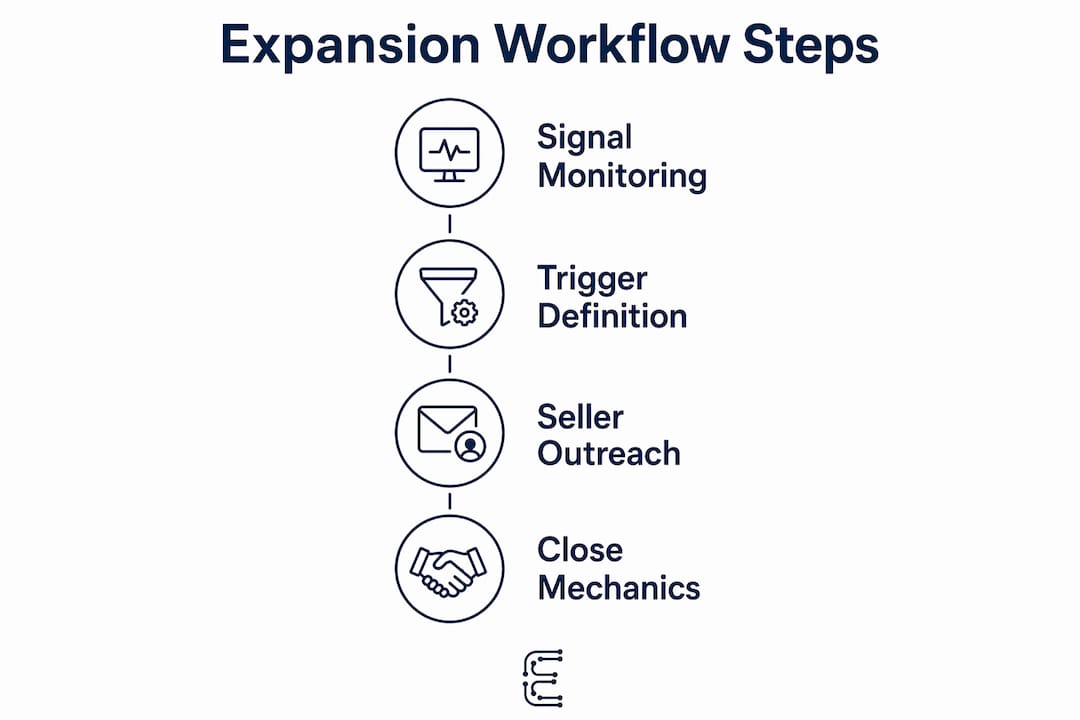
An effective expansion playbook has four stages: monitoring adoption signals, setting quantitative triggers, executing seller-owned outreach, and managing close mechanics. Each stage builds on the last. Skipping signal monitoring and jumping to outreach produces the calendar-driven nudges that customers ignore.
Stage one is signal monitoring. This means instrumenting your product telemetry so that usage data flows into a centralized scoring system. CSMs and account managers (AMs) should not be manually checking dashboards. Automated alerts tied to threshold breaches create a live expansion pipeline without adding headcount.

Stage two is trigger definition. A trigger is a specific, measurable event that moves an account from “monitored” to “active opportunity.” Examples include a seat utilization trigger at 85% for 14 days, a feature gate trigger at five hits per week, or a consumption trigger at 90% of plan capacity. Triggers must be documented, tested against historical data, and assigned to a specific owner before any outreach begins.
Stage three is seller-owned outreach. Data-driven expansion workflows outperform calendar-driven approaches because they reach customers at the moment of felt need. An outreach template tied to a seat expansion trigger reads differently than a generic quarterly check-in. The message references the specific usage behavior, frames the expansion as solving a current problem, and proposes a clear next step.
Stage four is close mechanics. Mid-cycle expansion wins on speed and improves deal velocity. Renewal-cycle expansion allows packaging upgrades into multi-year contracts, which reduces churn risk. Teams that treat every expansion the same way miss the timing advantage that mid-cycle deals provide.
Pro Tip: Build two separate close templates: one for mid-cycle expansions focused on speed and immediate value, and one for renewal-cycle expansions focused on multi-year packaging and risk reduction.
A 90-day build-out plan works well in two-week sprints. Sprint one covers signal instrumentation. Sprint two covers trigger definition and scoring. Sprints three and four cover outreach template development. Sprints five and six cover close mechanics and quota alignment. The final sprint covers measurement setup and first-cycle review.
Different expansion motions contribute differently to NRR: seat expansions account for roughly 40%, consumption growth for 30%, cross-sell for 20%, and tier upgrades for 10%. Layering all four motions creates a more resilient expansion engine than relying on any single play.
| Motion | NRR Contribution | Typical Cycle Length | Primary Owner |
|---|---|---|---|
| Seat expansion | ~40% | Mid-cycle | AM or CSM with quota |
| Consumption growth | ~30% | Ongoing | CSM with quota |
| Cross-sell | ~20% | Renewal-cycle | AE or AM |
| Tier upgrade | ~10% | Renewal-cycle | AM |
What are the common pitfalls in executing expansion workflows?
The most damaging pitfall is treating expansion as a reactive, sales-only effort. When CSMs wait for customers to ask for more, the “leaky bucket” dynamic takes hold: new ARR flows in while expansion revenue quietly drains away through missed opportunities and silent churn. A structured workflow prevents this by moving the team from a firefighting loop to a proactive revenue motion.
Three failure modes appear most often in growth-stage SaaS companies. First, ownership without quota: assigning expansion responsibility to CSMs who carry no commercial target produces effort without urgency. Teams with CSMs carrying quota outperform those without by 14 NRR points on average. That gap is too large to ignore. Second, no signal pipeline: teams that rely on manual account reviews miss the majority of expansion signals before they expire. Third, routing expansion to new-business account executives (AEs) who lack the customer relationship context needed to close without damaging trust.
Ownership clarity and aligned incentives are critical. The split between CS, AM, and AE roles must be documented, and compensation must be tied to expansion results. Without that alignment, revenue leaks at every handoff.
Signal noise is a real operational risk. Expansion workflows require strict ICP filters and weighted trigger scoring to avoid wasted sales effort. A customer who hits a feature gate once during a trial period is not the same as a customer who hits it five times per week in month six. Context filters prevent the team from burning goodwill on poorly timed outreach.
Calendar-driven nudges are the most common symptom of a workflow that has not been properly instrumented. Quarterly business reviews and renewal reminders have their place, but they are not expansion triggers. Self-serve upgrade paths reduce friction for customers who are ready to expand without a sales conversation, and they free up CSMs to focus on complex, high-value plays.
Pro Tip: Enable self-serve upgrades for seat additions below a defined threshold, such as five seats or less. Reserve seller-led outreach for expansions that require negotiation, packaging changes, or multi-year commitments.
How to measure and sustain an effective expansion revenue process
Measurement is what separates a one-time expansion push from a sustained revenue motion. The four metrics that matter most are expansion revenue as a percentage of total ARR, expansion pipeline coverage relative to quota, trigger-to-close conversion rate, and NRR trend over rolling 90-day periods. Each metric tells a different part of the story.
Expansion pipeline coverage should run at a minimum of 1.4x quota. A coverage ratio below that signals either weak signal instrumentation or poor trigger-to-opportunity conversion. NRR trend is the lagging indicator that confirms whether the workflow is producing durable growth or just short-term spikes.
AI and product usage data now allow teams to identify expansion opportunities with greater precision, recommending the right play, timing, and even drafting outreach communications. This capability shifts the CSM’s role from data analyst to relationship executor, which is where their time produces the highest return.
Pro Tip: A Customer Value Map (CVM) connects growth, margin, and cost in a single view. Use it to prioritize which expansion motions deserve investment and which to prune based on actual margin contribution.
Regular play reviews prevent the workflow from going stale. A quarterly cadence works well: review trigger accuracy, outreach conversion rates, and close rates by motion type. Double down on the plays that convert. Retire the ones that produce pipeline but not revenue. Cross-functional alignment between revenue operations, product, and customer success is what keeps the workflow calibrated as the product and customer base evolve.
| Metric | Target | Review Cadence |
|---|---|---|
| Expansion pipeline coverage | 1.4x quota minimum | Monthly |
| Trigger-to-close conversion | Track by motion type | Quarterly |
| NRR trend | 120%+ for top quartile | Rolling 90 days |
| Expansion revenue % of ARR | 38–40% for top quartile | Quarterly |
Key Takeaways
A structured, signal-driven customer expansion revenue workflow is the most direct path to 120%+ NRR in growth-stage SaaS companies.
| Point | Details |
|---|---|
| Signal-driven triggers outperform calendars | Set quantitative thresholds like 85% seat utilization for 14 days before initiating outreach. |
| Quota-bearing ownership closes the NRR gap | CSMs with expansion quota outperform those without by 14 NRR points on average. |
| Layer all four expansion motions | Seat, consumption, cross-sell, and tier upgrades together build a resilient expansion engine. |
| Mid-cycle and renewal mechanics differ | Use speed-focused closes mid-cycle and multi-year packaging at renewal to reduce churn risk. |
| Measure pipeline coverage at 1.4x quota | Coverage below that ratio signals weak instrumentation or poor trigger conversion. |
Why most SaaS expansion programs fail before they start
The uncomfortable truth I have observed across growth-stage SaaS companies is this: most expansion programs fail not because of bad strategy but because of bad ownership. Teams design playbooks, build signal dashboards, and write outreach templates. Then they assign execution to CSMs who carry no commercial quota and wonder why the pipeline never fills.
Expansion revenue is a commercial motion. It requires the same discipline as new-business sales: a defined owner, a measurable target, a pipeline, and a close process. When customer success management is treated as a support function rather than a revenue function, expansion becomes accidental rather than systematic.
The second pattern I see consistently is the over-reliance on a single expansion motion. A team finds that seat expansions convert well and stops building cross-sell or consumption plays. That works until the product matures and seat growth slows. The companies that sustain 120%+ NRR layer all four motions and treat each one as a separate, managed pipeline.
The third observation is about timing. Signal-driven expansion reaches customers at the moment of felt need. That is when the conversation is easiest and the close rate is highest. Waiting for the renewal cycle to surface every expansion opportunity is the equivalent of leaving money in a drawer for 11 months and then rushing to collect it in the 12th.
Build the workflow first. Instrument the signals. Assign quota-bearing owners. Then measure relentlessly and prune what does not convert. That sequence is not glamorous, but it is what produces predictable, compounding expansion revenue.
— Raymond
How E-regency helps SaaS leaders build expansion workflows that produce results
Growth-stage SaaS companies that want to move from reactive support to a managed expansion revenue engine have a clear path forward with E-regency.

E-regency’s AI-driven advisory services combine predictive health modeling with hands-on playbook design, signal instrumentation, and incentive alignment. Clients have achieved over a 20% reduction in gross churn and more than a 115% increase in net revenue retention. E-regency works directly with business leaders and customer success teams to build retention and expansion frameworks tailored to their product, customer base, and growth stage. If you are ready to turn expansion into a measurable revenue motion, schedule a consultation with the E-regency team.
FAQ
What is a customer expansion revenue workflow?
A customer expansion revenue workflow is a structured, signal-driven process for growing revenue from existing accounts through upsell, cross-sell, seat additions, and tier upgrades. It replaces reactive or calendar-based approaches with quantitative triggers tied to product usage behavior.
What NRR do top SaaS companies achieve from expansion?
Top-quartile SaaS companies maintain NRR above 120% and source 38–40% of new ARR from expansion revenue. That level of performance requires a structured workflow, not ad hoc outreach.
Why does CSM quota matter for expansion revenue?
CSMs carrying expansion quota outperform those without commercial targets by 14 NRR points on average, according to Gainsight’s 2024 expansion report. Ownership without accountability produces effort without results.
What are the four stages of an expansion playbook?
The four stages are signal monitoring, trigger definition, seller-owned outreach, and close mechanics. Each stage must be documented and assigned to a quota-bearing owner before the workflow can produce consistent pipeline.
How often should expansion plays be reviewed?
A quarterly review cadence works best for assessing trigger accuracy, outreach conversion rates, and close rates by motion type. Teams should prune underperforming plays and reinvest in the motions that consistently convert.